
The Latin America and Caribbean region has made considerable progress in poverty reduction and improving food security since COVID-19. However, the improvements have not been driven by inclusive growth.A characteristic feature of the LAC experience is that major disparities in economic performance,…
publications

Jalal Abdel-Latif Senior Fellow

Hisham Aidi Senior Fellow

Abdelaaziz Ait Ali Head - Research in Economics

Driss Alaoui Belghiti Senior International Relations Specialist

Nezha Alaoui M’hammdi Senior Fellow

Eduardo Amaral Haddad Senior Fellow

Mahmoud Arbouch Senior Economist

Fahd Azaroual Economist

Fatim Zohra Azouzou Junior Analyst

Mina Baliamoune Senior Fellow

Abdelhak Bassou Senior Fellow

Ferid Belhaj Senior Fellow

Mehdi Benomar Head – Research in International Relations

Rim Berahab Senior Economist

Dominique Bocquet Senior Fellow

Mounia Boucetta Senior Fellow

Oumayma Bourhriba Senior Economist

Oumnia Boutaleb International Relations Specialist

Otaviano Canuto Senior Fellow

Khalid Chegraoui Senior Fellow

Nouzha Chekrouni Senior Fellow

Alfredo Da Gama e Abreu Valladão Senior Fellow

Uri Dadush Non-Resident Senior Fellow

Christian de Boissieu Senior Fellow

Marcus Vinicius de Freitas Senior Fellow

Hinh T. Dinh Senior Fellow

Mohammed Rachid Doukkali Senior Fellow

M'hammed Dryef Senior Fellow

Loubna Eddallal Junior Analyst

Karim El Aynaoui Executive President

Rachid El Houdaigui Senior Fellow

Youssef El Jai Economist

Nihal El Mquirmi International Relations Specialist

Amal El Ouassif Senior International Relations Specialist

Saloi El Yamani Economist

Sabrine Emran Senior Economist

Helyette Geman Senior Fellow

Hafez Ghanem Senior Fellow

Tayeb Ghazi Principal Economist

Ihssane Guennoun International Relations Specialist (On Leave)

Aomar Ibourk Senior Fellow

Len Ishmael Senior Fellow

Chaima Jabbar Research Analyst

Larabi Jaïdi Senior Fellow

Abdessalam Saad Jaldi Senior International Relations Specialist

Yves Jégourel Senior Fellow

Kidane Kiros Senior Fellow

Adnane Lahzaoui Economist

Boutaina Lmasrar Junior Economist

Mohammed Loulichki Senior Fellow

Prakash Loungani Senior Fellow

Rida Lyammouri Senior Fellow

Jamal Machrouh Senior Fellow

Bilal Mahli International Relations Specialist

Khadija Mamouni Junior Analyst

Badr Mandri Economist

Iván Martín Senior Fellow

Aziz Mekouar Senior Fellow

Hamza Mjahed International Relations Specialist - Strategic Monitoring & Analysis Unit
Rabi Mohtar Senior Fellow

Redouan Najah Senior International Relations Specialist

Ian O. Lesser Senior Fellow

Fathallah Oualalou Senior Fellow

Ahmed Ouhnini Senior Program Officer, Policy Center for the New South

Francis Perrin Senior Fellow

Emmanuel Pinto Moreira Senior Fellow

El Mostafa Rezrazi Senior Fellow

Abdallah Saaf Senior Fellow

Hamza Saoudi Senior Economist

Matsumoto Shoji Senior Fellow

Landry Signé Senior Fellow

Maha Skah Political Affairs Officer, United Nations

Helmut Sorge Columnist

Oussama Tayebi Senior International Relations Specialist

Youssef Tobi International Relations Specialist

Hung Q. Tran Senior Fellow

Isabelle Tsakok Senior Fellow

Henri-Louis Védie Senior Fellow

Akram Zaoui Chargé de Mission to the Executive President

Afaf Zarkik Senior Economist
Selected filters :
 Policy PaperSeptember 25, 2026
 Policy BriefSeptember 14, 2026Le déclenchement de la Guerre en Iran et le blocage du détroit d’Ormuz ont eu des conséquences majeures sur un grand nombre de marchés mondiaux de matières premières. Si l’attention médiatique s’est logiquement portée sur le pétrole et le gaz naturel, ainsi que sur l’aluminium, en raison de la…Related topics:
 Research PaperAugust 5, 2026This paper addresses the persistent challenge of resource dependence in the world's poorest countries, focusing on the ten poorest African nations where natural- resource rents average 14% of income. It argues that four decades of conventional policy advice, which treated resource dependence…
 Policy BriefJuly 31, 2026Ethiopia continues to struggle to lay the economic foundations of food security for all, more than 30 years after first adopting the East Asian Developmental State Model (EADS) under Zenawi (1911-2012), continued under Hailemariam Desalegn (2012-April 2018), and later shifting toward a neo-liberal,…
 Policy PaperJune 24, 2026Africa today remains far from food secure. Chronic malnutrition, widespread anemia among women of childbearing age, stunting and wasting among young children, pervasive underemployment in both rural and urban areas, and a youth bulge frustrated by high unemployment are key features of a continent…Related topics:
 Policy BriefMay 5, 2026Gaspillage de l’eau et son mésusage : deux facteurs du stress hydriqueCe Policy Brief est consacré aux phénomènes de gaspillage et de mésusage de l’eau: deux impératifs de la lutte contre le stress hydrique, rappelés, avec insistance, par Sa Majesté le Roi Mohammed VI dans son discours…Related topics:
 Policy PaperApril 15, 2026This paper examines the complexities of the Moroccan agricultural model from a systemic and paradoxical viewpoint. It highlights the fundamental contradiction facing Moroccan agriculture: balancing export-driven growth and global competitiveness with rising ecological challenges and social…Related topics:
 Policy BriefAugust 29, 2025After 1994, everything was a priority, and our people were completely broken. But we made three fundamental choices that guide us to this day. One—we chose to stay together. Two—we chose to be accountable to ourselves. Three—we chose to think big. — His Excellency President Paul Kagame, 20th…Related topics:
 Policy BriefJuly 25, 2025A generation after the end of Apartheid in 1994, the Republic of South Africa is once again at a critical juncture in its long march to realize Mandela’s vision of a society that enjoys six freedoms: freedom from want, hunger, deprivation, ignorance, suppression and fear. While much has been…Related topics:
 Paper in Academic JournalsJune 25, 2025This Paper was originally published on springer.com This study investigates the impact of female agricultural cooperatives on women’s empowerment in Morocco, with a focus on the rural Marrakech-Safi region. The research evaluates the effectiveness of these cooperatives in enhancing women’s…
 Policy BriefMay 27, 2025Ethiopia presents a unique case among developing countries, having combined major social welfare programs with an East Asian-style development-state approach to investment. However, it differs from its East Asian counterparts in two key areas: it has not maintained decades of uninterrupted…Related topics:
 Policy BriefApril 29, 2025Tunisia’s stagnant growth since the Jasmine Revolution (2011) illustrates that political democracy, when not anchored in economic democracy, is fragile at best. Economic democracy remains absent in Tunisia, as markets are concentrated and continue to be burdened by high barriers to entry and rules…Related topics:
 Policy PaperApril 2, 2025Africa has strong prospects for achieving food security within a generation— provided its leadership effectively mobilizes domestic and foreign funds, drives strategic investments, and strengthens institutions that incentivize smallholders and other stakeholders to invest in resilient, high…Related topics:
 Policy BriefOctober 17, 2024China and India have become powerful incumbents in the manufacturing-for-exports and services-for-exports sectors, respectively. This has made it difficult for Africa, as a latecomer, to employ similar growth models for its own development. Given current geopolitical tension, its own comparative…Related topics:
 Book / ReportJuly 31, 2024Millions are severely malnourished in a world where there is enough for all. Hunger and malnutrition stalk more than 3.1 billion people. Yet, widespread hunger in all its forms is a problem which has been largely solved at the macro level in today’s high-income, industrialized countries. Their…Related topics:
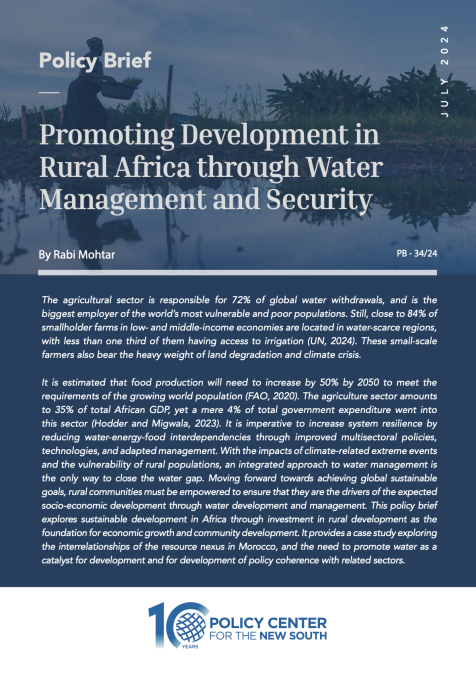 Policy BriefJuly 2, 2024The agricultural sector is responsible for 72% of global water withdrawals, and is the biggest employer of the world’s most vulnerable and poor populations. Still, close to 84% of smallholder farms in low- and middle-income economies are located in water-scarce regions, with less than one third of…Related topics:
 Policy BriefApril 5, 2024National and regional visions for the future of water and food security have been at the forefront of sustainability talks. Nevertheless, the role of soil in water and food security and carbon management needs to be highlighted and integrated into these discussions and visions. The dynamic…Related topics:
 Policy BriefJanuary 30, 2024Cette étude est consacrée à l’Éthiopie, pays dont l’histoire remonte à la nuit des temps et où l’agriculture représente 70 % à 80 % des emplois. Nation agricole, donc, mais aussi pays au potentiel minier connu, lequel demeure sous-exploité. Depuis le début du vingt-et-unième siècle, l…Related topics:
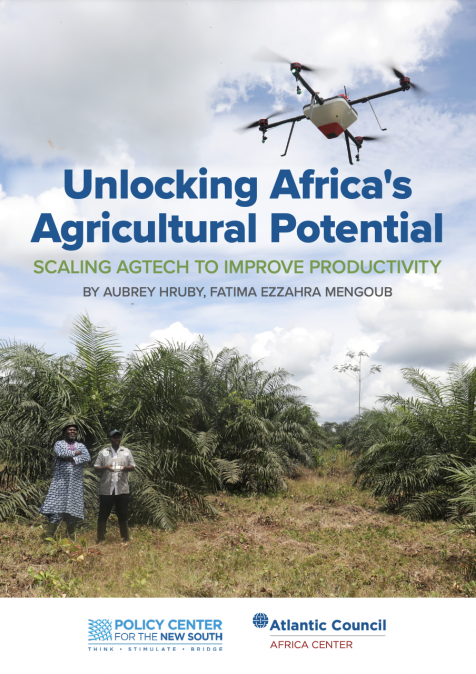 Book / ReportSeptember 20, 2023The rise of agriculture technology (AgTech) solutions in Africa has opened significant avenues to transform food systems and tackle long-standing obstacles to enhance smallholder productivity. To effectively expand these promising, yet nascent, AgTech solutions, collaborative efforts involving…Related topics:
 Policy BriefSeptember 12, 2023Nigeria has the potential to be an economic powerhouse, but food insecurity stalks a large share of its population. Over the last fifteen years, undernutrition has increased from over 7% (2004-06) to nearly 13% of the population (2017-2019). The COVID-19 pandemic of course exacerbated health and…Related topics:
 Policy BriefJuly 11, 2023Ghana achieved lower middle-income country status by 2011. However, its growth path in the previous decades did not lay the foundations for the economic transformation of Ghanaian agriculture and therefore its overall economy. It relied primarily on extractive and non-renewable resources (gold and…Related topics:
 Policy BriefJune 20, 2023This policy brief was originally published on T20 India website Supportive policies for tropical agriculture have helped millions of small-scale farmers in Brazil step out of poverty by improving government capacity to design legal frameworks to strengthen agricultural…Related topics:
 Policy BriefApril 26, 2023It is estimated that $1 trillion to $6 trillion per year (up to 2050) needs to be invested globally if the world is to stay below the 2°C global warming ceiling of the Paris Agreement and to meet its adaptation goals. Currently, investments stand at about $630 billion per year, way below the…
 Policy BriefFebruary 24, 2023Mauritius was on the brink of disintegration in the 1980s, but by 2019 had managed a peaceful transformation from a low income, monocrop, inward-oriented economy to a diversified, outward-oriented, upper middle-income country. Mauritius is now again at a crossroads, having to adapt to accelerating…Related topics:
 Paper in Academic JournalsFebruary 16, 2023This publication was originally published in https://www.mdpi.com/ The Moroccan agricultural cooperative sector is a key player in self-employment and income generation through territorial anchoring. The government’s “MOURAFAKA” program offers support for newly created cooperatives,…Related topics:
 Policy BriefFebruary 13, 2023The fundamental role that water resources play in human development has been highlighted in multiple ways; the United Nations SDGs underline 17 different goals and over a hundred targets to be achieved by 2030. Out of 169 SDG targets, 59 were found to have direct links and synergies with the water…Related topics:
 Research PaperFebruary 1, 2023La double crise actuelle de l’énergie et du conflit militaire en Ukraine freine énormément les processus qui se développaient dans l’ère post-Covid 19. Dans ce contexte fragile et tourmenté, la vulnérabilité touche également les chaînes globales de valeur et les systèmes agroalimentaires…Related topics:
 Policy BriefJanuary 26, 2023Si l’année 2021 fut marquée, dans une situation de rattrapage économique post-Covid, par la progression des cours de la quasi-totalité des matières premières agricoles, minérales ou énergétiques, tel ne fut pas le cas pour 2022, caractérisée, au contraire, par une grande…Related topics:
 Policy PaperJanuary 2, 2023Climate change threatens to reduce the water flow in the Nile and increase the frequency and severity of droughts and floods in Egypt, which already suffers from water scarcity. This threat is a looming crisis as it seriously undermines the Government of Egypt’s long standing food self-sufficiency…Related topics:
 Policy BriefNovember 11, 2022If the recent peaceful transfer of power in Madagascar heralds a new trend, then the Malagasy people can dream big. For decades, the exercise of economic-cum-political power in the hands of a tiny elite has held the entire nation hostage. Today, the high poverty rate—around 80% (2021) stands in…Related topics:
 Policy BriefNovember 2, 2022This brief argues for a pan-African food security initiative that would: 1). encourage free trade in food products between African countries; 2). promote multi-country regional investments in infrastructure to enhance agricultural productivity and resilience to climate change; 3). support public…Related topics:
 Policy BriefAugust 30, 2022Rwanda is famous for its remarkable socio-economic performance after the ravages of the Genocide against the Tutsis and moderate Hutus in 1994. Under the leadership of President Paul Kagame, Rwanda has followed a state-led development model with stunning results. Despite these substantial…Related topics:
 Policy BriefAugust 5, 2022Le conflit russo-ukrainien fragilise la sécurité alimentaire d'un grand nombre de pays africains, la Russie et l'Ukraine étant deux acteurs majeurs du marché agricole mondial, particulièrement celui du blé. C'est pourquoi, l'approvisionnement en blé du continent est au premier rang concerné par ce…Related topics:
 Policy BriefJuly 27, 2022Sleepless nights and the tireless search for compromise allowed WTO members to agree on concrete deliverables during the WTO 12th Ministerial Conference held last June. Those results reinforce Multilateralism. And this is a significant gain given the multiplicity of global crises that surround us.…
 Policy BriefJuly 20, 2022Implications of Food Systems for Food Security: The case of the Republic of Mozambique Mozambique is resource-rich and strategically located on the east coast of Africa between Tanzania and South Africa. Its mineral wealth includes coal, iron ore, bauxite, copper, gold, rubies, and natural gas.…Related topics:
 Policy BriefJune 21, 2022Oil dominates Nigeria’s economy- “Africa’s Giant”. Oil revenues are both a blessing and a curse: a blessing because they are the single most important contributor to government revenues; a curse because, through the Dutch Disease, they undermine the productivity and competitiveness of other non-oil…Related topics:
 Policy BriefApril 29, 2022Following on the heels of the COVID-19 pandemic and severe drought in North Africa, the Russian invasion of Ukraine – large exporters of food and, in the case of Russia, energy— may inflict increased hunger on the food insecure in Morocco – despite mitigating measures by the government. Morocco is…
 Policy BriefApril 21, 2022For the second time, Côte d'Ivoire is known for being a "miracle economy" –high aggregate GDP growth of 8% per year since 2012. Despite this achievement, its food systems are unable to deliver food security to most Ivoirians. These systems are being undermined by several structural factors, which…Related topics:
 Paper in Academic JournalsMarch 1, 2022Known for being a climate change hotspot, Morocco is at the forefront of a climate disaster. Consequences are already being felt, whether in the form of increasing temperature or a downward trend in precipitations, which directly threaten the water security and, by extension, the social-ecological…
 Book / ReportFebruary 22, 2022Le sommet afro-européen des 17 et 18 février 2022 à Bruxelles marque la sixième édition de la rencontre de haut niveau entre les deux continents. Ce sommet, organisé traditionnellement en alternance entre l’Afrique et l’Europe, intervient dans un contexte régional et international marqué…Related topics:
 Policy BriefDecember 10, 2021Addressing the increasing demands for water, energy, and food requires a coherent methodology to ensure that societies have access to them and that conflict over them is avoided. For example, agriculture and food production require water and energy; energy production also requires water…Related topics:
 Policy BriefOctober 28, 2021Mauritius is a refutation of the proposition that food self-sufficiency at all costs is the way to achieve food security. Mauritius, a trade-dependent island…Related topics:
 Policy PaperAugust 24, 2021The transformative potential of regional market integration for a large trading bloc is well exemplified by the European Union which started integration on a modest scale. The Association of Southeast Asian Nations (ASEAN) also started on a modest scale and has delivered benefits in terms of…Related topics:
 Paper in Academic JournalsJune 18, 2021This paper estimates the economic impacts of climate change over the Brazilian regions until the end of the century. We estimate the direct and indirect impact of the projected changes in climate on the yield of the country’s main crops. The results point to a broad spatial heterogeneity of impacts…
 Policy BriefMay 25, 2021Within the context of the United Nations Food Systems Summit taking place in September 2021, this brief discusses key drivers of food systems in Africa, as well as the challenges and opportunities for transformation. It concludes with specific policy options that could considerably accelerate…Related topics:
 Policy PaperMarch 17, 2021Cette étude concerne la Communauté économique des Etats d'Afrique de l'Ouest (CEDEAO), rappelant, tout d'abord, leur diversité géographique, démographique et économique. Montrant ce que ces Etats ont en commun mais, aussi, ce qui les différencie. La CEDEAO, qui réunit quinze pays parmi les plus…
 Policy BriefMarch 3, 2021Brazil, an oil-exporting nation, was still struggling to recover from the depression which started around 2014/15 when it was hit by a quick succession of shocks: the COVID-19 pandemic and the oil price collapse. The global pandemic triggered major economic dislocations and contractions in foreign…
 Policy BriefFebruary 16, 2021Selected experiences with GMOs in industrialized and developing countries show that the promise of bioengineering for strengthening food security cannot materialize unless and until GMOs are accepted by the vast majority of consumers as being safe and environmentally friendly. To date, the main…Related topics:
 Policy BriefFebruary 15, 2021The COVID-19 pandemic has exposed new vulnerabilities in social, infrastructure, and governance systems. In the first months of the pandemic, there was a genuine concern about the capacity of the Global South to contain the spread of the virus. African cities were particularly vulnerable, with some…Related topics:
 Policy BriefJanuary 8, 2021Building on decades of biochemistry research, bioengineers have successfully transferred genes across species to produce living organisms (plants and animals, including fish) with desired traits. Unlike traditional breeding practiced over 10,000 years, this process takes years not centuries from…Related topics:
 Policy PaperNovember 26, 2020Food security for all requires (i) sustained productivity growth and competitiveness, not only of agriculture but of the entire economy; (ii) a social safety net; and (iii) resilience in the face of periodic shocks. This is the central message of this review. Two popular concepts in food security…Related topics:
 Paper in Academic JournalsOctober 5, 2020Our Senior Fellow Rabi Mohtar has co-authored with our economist, Fatima Ezzahra Mengoub along other researchers a research paper entitled « A Water-Energy-Food Nexus approach for conducting trade-off analysis: Morocco’s phosphate industry in the Khouribga region » in Hydrology and Earth…Related topics:
 Policy BriefSeptember 4, 2020South Africa shows that being food self-sufficient is a far cry from being food secure when poverty is extensive, the majority of people suffer from the “quadruple burden of disease”1 , the economy is highly unequal, and when improving the quality of the public health infrastructure remains a major…Related topics:
 Research PaperJune 26, 2020The securitization of climate change has important implications in terms of how the issue is framed and addressed, at national and international policy levels. It has become clear that climate change poses multiple and overlapping security challenges, including in terms of livelihood insecurity,…Related topics:
 Policy PaperJune 25, 2020We are living through unprecedented times. The COVID-19 pandemic threatens not only our health, but the very foundation of life itself: our food security. Now more than ever, we are forced to rethink our food security as we witness the widespread dislocations to our food system, forcing millions to…Related topics:
 Policy BriefJune 8, 2020Low-productivity, subsistence-smallholder agriculture everywhere faces tremendous new challenges, in addition to decades-old constraints. Smallholders are threatened by being bypassed by the rise and dominance of domestic and global value chains (DVCs, GVCs). They are also being threatened by…Related topics:
 Policy BriefApril 10, 2020Food insecurity is not a new concern. Many people around the world are already undernourished because of several factors, including climatic, economic, and political factors. Unfortunately, in times of crisis, as currently with COVID-19, food insecurity becomes more acute and requires urgent…Related topics:
 Annual Report,Book / ReportDecember 11, 2019The Atlantic Current’s 6th edition provides overview, fresh insights, latest data, and broader analysis on the Atlantic space’s current challenges, as well as their implications for the South. Different chapters explore emerging trends and critical issues, such as the World Trade Organization…Related topics:
 Policy BriefOctober 30, 2019Subsidizing fertilizer prices has been a popular policy tool to increase fertilizer use, but should it be? The main message of this Policy Brief is that it should not be, despite its appeal to politicians and recipient farmers alike. Instead, policy makers should seriously consider a holistic…Related topics:
 Policy BriefOctober 15, 2019If the concern is solely to increase fertilizer use by Sub-Saharan Africa’s smallholders, price subsidy for inorganic fertilizer can be effective. The strengths and weaknesses of relying primarily on price subsidies to promote fertilizer use have been discussed at length and will therefore not be…Related topics:

