RELATED CONTENT : Armed conflicts

  • Authors
    May 6, 2026
    Trump’s Strategy of Overriding Constitutional SafeguardsPerhaps bearing in mind that only a minority of voters in the United States support U.S. military action against Iran, President Donald Trump has called the war a “short term excursion” and a “little journey” that may be over “pretty quickly”. The war is thus not a war, although Trump has said the U.S. will take Iran “back to the stone ages, where they belong”, and the U.S. military has admitted to attacks on 14,000 Irania ...
  • Authors
    April 1, 2026
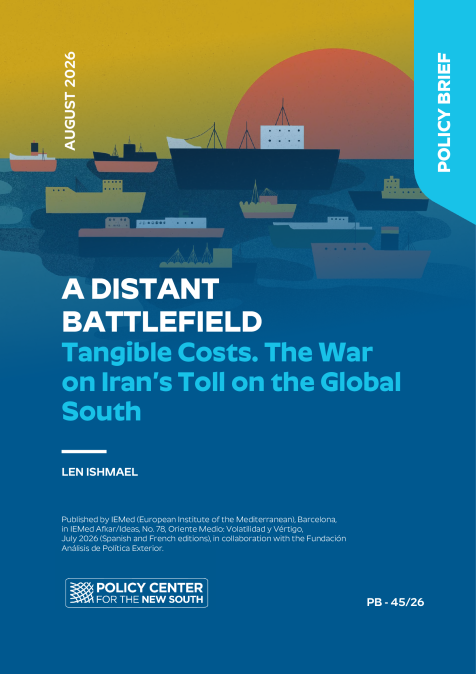
    We are now in the fifth week since the U.S. airstrike that killed top leaders of the Iranian regime, initiating a war involving the United States and Israel against the country. More than a month of mutual bombardments between Iran and Israel has ensued, extending to other Persian Gulf nations, U.S. military installations—and even Cyprus. From a global perspective, the impact has stemmed primarily from disruptions to regional production of goods and the blockade of the Strait of Hor ...
  • March 27, 2026
    This interview analyzes how tariff wars are transforming global power dynamics, disrupting trade systems, and redefining trade policy as a geopolitical tool, while examining the risks and opportunities for emerging economies and the Global South, the repositioning of regions like Latin ...
  • March 27, 2026
    Sous Trump II, la conflictualité s’affirme moins comme un simple effet de la polarisation partisane que comme un principe d’organisation de l’exercice du pouvoir. À partir des prises de parole présidentielles, ce Papier montre comment des enjeux distincts, tels que l’immigration, la fraude, la sécurité, les controverses culturelles ou les rivalités internationales, sont intégrés dans une même architecture discursive orientée vers la restauration de l’ordre. La conflictualité y appar ...
  • Authors
    March 25, 2026
    Les conflits armés ont toujours des coûts économiques exorbitants, sans parler des pertes humaines. Le coût de la guerre est difficilement chiffrable.  Il dépend de la durée de l'enlisement et des « à-côtés ».  En fait, les conséquences économiques, tout comme les causes des conflits armés sont toujours complexes à appréhender. Les risques liés aux conflits génèrent de nombreuses incertitudes économiques, directement perceptibles dans les contraintes budgétaires, ...
  • February 13, 2026
    Le général Olivier Tramond analyse la réduction de la présence militaire française en Afrique comme un changement stratégique profond plutôt qu’un renoncement. Au-delà des coups d’État et ...
  • Authors
    February 9, 2026
    L’arrestation du président vénézuélien Nicolàs Maduro a suscité la sidération internationale en interrogeant sur le respect du droit international ; puis, fort logiquement, cette opération a conduit à maintes analyses tant sur les arguments politiques, sécuritaires et géostratégiques avancés par Washington que sur les ambitions sous-jacentes ayant présidé à cette décision sans réel précédent dans l’histoire récente. Outre la lutte contre le narcotrafic, c’est bien évidemment la ...
  • Authors
    February 9, 2026
    The arrest of Venezuelan President Nicolàs Maduro caused international astonishment, raising questions about respect for international law. And, quite logically, the operation led to numerous analyses, both of the political, security and geostrategic arguments put forward by Washington, and of the underlying ambitions behind this decision, which has no real precedent in recent history. In addition to the fight against narco-trafficking, it was of course the oil issue that came first ...
  • January 29, 2026
    Le Mali, le Burkina Faso et le Niger, réunis au sein de l’Alliance des États du Sahel (AES), affirment l’ambition de bâtir une souveraineté nationale qui leur permettrait de s’émanciper de la domination et des influences extérieures et de se doter d’une liberté d’action dans les choix de développement politique et économique. Cependant, cette ambition se heurte à de nombreuses contraintes économiques et sécuritaires.La souveraineté ne peut se construire sans une base économique soli ...
  • January 6, 2026
    La création de l’Alliance des États du Sahel (AES) symbolise une rupture politique et géostratégique majeure, appuyée sur un discours souverainiste et anti-occidental. Deux ans après, Mali, Burkina Faso et Niger peinent à assurer leur intégrité territoriale, à stabiliser leur sécurité intérieure et à bâtir une gouvernance solide. L’intégrité territoriale est un problème commun aux trois États, car dans ces pays, la cohésion de l’État et le contrôle du territoire sont directement men ...
  • Authors
    Niccola Milnes
    December 30, 2025
    Fuel access has become a strategic pressure point across Mali and its neighbors. In 2025, Jama’t Nusrat al Islam wal- Muslimeen (JNIM) shifted from sporadic interdictions to a deliberate fuel-blockade strategy intended to pressure Bamako without holding territory. By selectively constraining movement along the Sikasso–Kayes–Bamako corridor, the group turned fuel scarcity into a tool of coercion, governance, and narrative control—shaping behavior in the capital while remaining largel ...
  • Authors
    Chaïma Jabbar
    December 23, 2025
    The member countries of the Alliance of Sahel States, Mali, Burkina Faso, and Niger, remain dependent on a limited number of maritime access corridors, a configuration that constrains their adjustment capacity in the event of disruption and heightens the vulnerability of their supply chains. The Jama’at Nusrat al-Islam wa al-Muslimin (JNIM) blockade of the Kayes-Nioro area revealed how critical the Dakar-Bamako corridor is for the political and economic stability of Mali. Its interr ...