Publications /
Policy Paper

Back
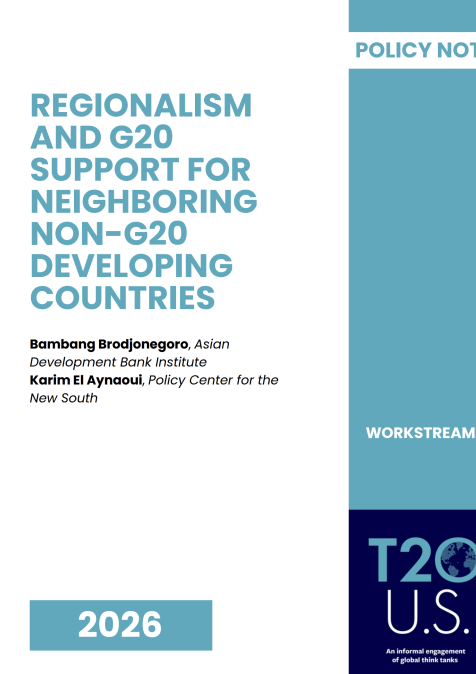
Regionalism and G20 Support for Neighboring Non-G20 Developing Countries
Authors
Bambang Brodjonegoro
November 2, 2026

This policy note was published as part of the T20 U.S. 2026 Workstreams, under the workstream “Fostering Trade and People-Centered Economic Growth,” which brings together policy experts to develop recommendations for G20 policymakers.


The Group of Twenty (G20) accounts for most of the world’s output, yet its decisions shape the prospects of 174 United Nations Member States without G20 membership, among them the great majority of least developed countries and small states. Many of these non-G20 economies are close trading neighbors of a large G20 member and depend on that neighbor for export demand, investment, remittances, and development finance. These links are increasingly exposed to fragmentation of the global economy. New trade restrictions nearly tripled between 2019 and 2022, and remained elevated in 2025. Under a two-bloc trade fragmentation scenario, low-income countries could lose more than 4 percent of output over the long run. Such risks compound debt vulnerabilities and food insecurity. 

External support is also contracting. Preliminary data show that official development assistance from Development Assistance Committee members and associates fell by 23.1 percent in real terms in 2025, the steepest annual fall on record, returning to its 2015 level. Developing countries also face an annual financing gap for the Sustainable Development Goals of around 4 trillion dollars. 

Regionalism offers G20 economies a durable channel to keep supporting their non-G20 neighbors even as multilateral cooperation weakens. Asia illustrates this approach, having built dense regional production networks, a large regional financial safety net, and shared institutions that allow larger economies to anchor smaller ones. In Africa, connector economies can link fragmented markets to wider production networks. Morocco exemplifies this potential through its logistics infrastructure, industrial capabilities, and access to European and United States markets, provided that firms in smaller African economies can participate in the resulting value chains. 

The G20 should finance regional public goods through regional platforms and reformed multilateral development banks, and expand the use of low-cost remittance services; design open and inclusive regional trade arrangements that allow smaller neighbors to join regional value chains; and strengthen regional financial safety nets and improve their coordination with the International Monetary Fund (IMF). Each recommendation builds on existing G20 workstreams and on an agenda centered on growth.
RELATED CONTENT

  • Authors
    Inkyo Cheong
    Lillyana Daza Jaller
    Siwook Lee
    Jean-Christophe Maur
    Martin Molinuevo
    Sahar Sajjad Hussain
    Pierre Sauvé
    Shane Sela
    Aleksandar Stojanov
    Iryna Klytchnikova
    Edited by Pierre Sauvé and Uri Dadush
    May 23, 2023
    The broad thrust of Morocco’s trade and industrial policies over the last thirty years has been to anchor Morocco into world flows of goods, services, and cross-border investment. Despite the challenges posed by the COVID-19 pandemic, rising international prices, and a complex geopolitical environment, Moroccans continue to derive significant benefits from their economy’s openness. These include improved consumer choice and welfare, the growing insertion of Moroccan firms into cross ...
  • April 10, 2023
    This policy paper examines India’s growing engagement in North Africa, focusing on five countries: Morocco, Algeria, Tunisia, Libya, and Egypt. Despite lacking a distinct regional policy for North Africa, India has amplified its bilateral engagement with these countries, underpinned by a steadfast commitment to the principle of South-South cooperation. Through its strategic moves in North Africa, India has established a powerful southern-west axis for its foreign policy that stretch ...
  • April 4, 2023
    Face à l’essor des cryptomonnaies, les banques centrales sont en train de réagir en lançant leurs propres monnaies numériques. L’objet de ce Policy Brief est de faire le point sur la préparation des monnaies numériques de banques centrales (MNBC) par les autorités monétaires, un processus qui concerne tous les pays, émergents, en développement, et plus avancés. Il s’agit aussi d’analyser les conditions et certaines des conséquences (pour les banques, pour l’inclusion fin ...
  • April 4, 2023
    Faced with the rise of cryptocurrencies, central banks are responding by launching their digital currencies. The purpose of this Policy Brief is to provide an update on the preparation of central bank digital currencies (CBDs) by monetary authorities, a process that concerns all emerging, developing, and more advanced countries. It is also about analyzing the conditions and some of the consequences (for banks, for financial inclusion, for the conduct of monetary policy...) of such a ...
  • Authors
    Selassie Tay
    February 15, 2023
    Background The African Union in 2018 agreed to implement the world’s second-largest free-trade area measured by number of countries, people, and geographical size, with the signing of the African Continental Free Trade Agreement (AfCFTA). This agreement will ultimately lead to a continent-wide free trade area consisting of 54 countries with 1.3 billion people and a combined GDP of $3.4 trillion[1]. This equates to about 19%-20% of the GDP of the European Union and China, which ...
  • Authors
    November 11, 2022
    If the recent peaceful transfer of power in Madagascar heralds a new trend, then the Malagasy people can dream big. For decades, the exercise of economic-cum-political power in the hands of a tiny elite has held the entire nation hostage. Today, the high poverty rate—around 80% (2021) stands in stark contrast to the natural resource abundance of this huge enormous island. There is hope, however, that with political stability, the Plan d’Émergence Madagascar (PEM) President Andry R ...
  • Authors
    Sous la direction de Larabi Jaïdi
    September 29, 2022
    La succession des chocs pandémique, climatique et géopolitique a éprouvé les économies africaines. Les liens commerciaux et financiers avec le monde ne sont plus seulement considérés comme des moteurs de performance, mais aussi comme des sources potentielles de vulnérabilité. La défiance à l’égard de la mondialisation s’est accrue. Parce qu’elle est venue souligner la dépendance du continent, le dérèglement de ses rapports à la nature et sa vulnérabilité face aux tensions géopolitiq ...
  • Authors
    September 26, 2022
    Le Maroc a entamé la libéralisation de son commerce extérieur dès le début des années 80 du XXième siècle. Les négociations commerciales des Accords de libre-échange et les engagements contractés auprès de l’Organisation mondiale du commerce (OMC) ont constitué des moments forts dans le processus d’introduction de réformes plus substantielles au régime du commerce extérieur (engagements sur des horizons de démantèlement, établissement des listes, réforme des barr ...
  • September 23, 2022
    Relations between Rabat and Seoul have been in a state of considerable flux in every aspect since the establishment of diplomatic relations between the two countries in July 1962. The Korean embassy in Rabat is Seoul's first permanent diplomatic representation on the African continent. ...