Publications /
Policy Paper

Back
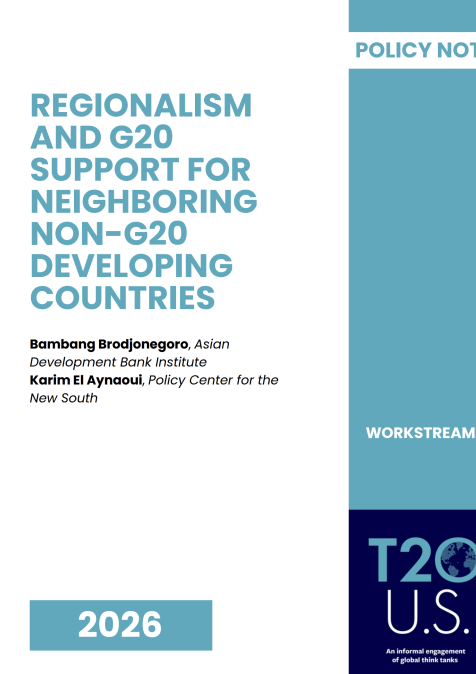
Regionalism and G20 Support for Neighboring Non-G20 Developing Countries
Authors
Bambang Brodjonegoro
November 2, 2026

This policy note was published as part of the T20 U.S. 2026 Workstreams, under the workstream “Fostering Trade and People-Centered Economic Growth,” which brings together policy experts to develop recommendations for G20 policymakers.


The Group of Twenty (G20) accounts for most of the world’s output, yet its decisions shape the prospects of 174 United Nations Member States without G20 membership, among them the great majority of least developed countries and small states. Many of these non-G20 economies are close trading neighbors of a large G20 member and depend on that neighbor for export demand, investment, remittances, and development finance. These links are increasingly exposed to fragmentation of the global economy. New trade restrictions nearly tripled between 2019 and 2022, and remained elevated in 2025. Under a two-bloc trade fragmentation scenario, low-income countries could lose more than 4 percent of output over the long run. Such risks compound debt vulnerabilities and food insecurity. 

External support is also contracting. Preliminary data show that official development assistance from Development Assistance Committee members and associates fell by 23.1 percent in real terms in 2025, the steepest annual fall on record, returning to its 2015 level. Developing countries also face an annual financing gap for the Sustainable Development Goals of around 4 trillion dollars. 

Regionalism offers G20 economies a durable channel to keep supporting their non-G20 neighbors even as multilateral cooperation weakens. Asia illustrates this approach, having built dense regional production networks, a large regional financial safety net, and shared institutions that allow larger economies to anchor smaller ones. In Africa, connector economies can link fragmented markets to wider production networks. Morocco exemplifies this potential through its logistics infrastructure, industrial capabilities, and access to European and United States markets, provided that firms in smaller African economies can participate in the resulting value chains. 

The G20 should finance regional public goods through regional platforms and reformed multilateral development banks, and expand the use of low-cost remittance services; design open and inclusive regional trade arrangements that allow smaller neighbors to join regional value chains; and strengthen regional financial safety nets and improve their coordination with the International Monetary Fund (IMF). Each recommendation builds on existing G20 workstreams and on an agenda centered on growth.

RELATED CONTENT

  • September 23, 2022
    A l’occasion de l’anniversaire des 60 ans des relations diplomatiques et économiques entre la République de Corée et le Royaume du Maroc, une rencontre est organisée par le Policy Center for the New South en collaboration avec le Korean Institute for International Economic Policy (KIEP)...
  • Authors
    Moubarack Lo
    Amaye SY
    September 5, 2022
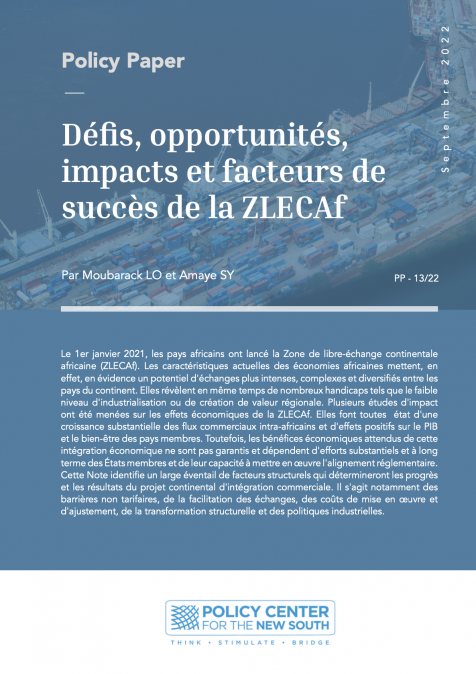
    Le 1er janvier 2021, les pays africains ont lancé la Zone de libre-échange continentale africaine (ZLECAf). Les caractéristiques actuelles des économies africaines mettent, en effet, en évidence un potentiel d'échanges plus intenses, complexes et diversifiés entre les pays du continent. Elles révèlent en même temps de nombreux handicaps tels que le faible niveau d'industrialisation ou de création de valeur régionale. Plusieurs études d'impact ont été menées sur les e ...
  • Authors
    August 30, 2022
    Rwanda is famous for its remarkable socio-economic performance after the ravages of the Genocide against the Tutsis and moderate Hutus in 1994. Under the leadership of President Paul Kagame, Rwanda has followed a state-led development model with stunning results. Despite these substantial accomplishments, Rwanda is still a low-income country with extensive poverty. Its agriculture is still of low productivity and highly vulnerable to climate change. Structural transformation has we ...
  • Authors
    Moubarack Lo
    Amaye SY
    August 1, 2022
    Avant la pandémie Covid-19, le continent abritait les économies à la croissance la plus rapide du monde et plusieurs pays africains montraient les premiers signes de transformation structurelle et de progrès vers l’émergence économique. Plus de deux ans après la pandémie et les ondes de choc qui en ont résulté, deux questions cruciales se posent : dans quelle mesure le choc sanitaire Covid-19, exacerbé par la crise ukrainienne, a-t-il constitué un tournant dans le processus général ...
  • July 29, 2022
    يخصص مركز السياسات من أجل الجنوب الجديد حلقة برنامجه الأسبوعي "حديث الثلاثاء"   لمناقشة آفاق التعاون بين كوريا الجنوبية و إفريقيا مع المصطفى الرزرازي، الباحث البارز بمركز السياسات من أجل الجنوب الجديد. شهدت العلاقات الكورية الإفريقية إنطلاقاً من العقد الأول من الألفية تط...
  • Authors
    Said El Hachimi
    July 27, 2022
    Sleepless nights and the tireless search for compromise allowed WTO members to agree on concrete deliverables during the WTO 12th Ministerial Conference held last June. Those results reinforce Multilateralism. And this is a significant gain given the multiplicity of global crises that surround us. The Outcome include 6 Agreements, Declarations and Ministerial Decisions that respond to some of today's challenges, notably on Fisheries and Ocean Sustainability as well as responses to P ...
  • May 20, 2022
    Traders have worried that the war involving Russia and Ukraine could stoke inflation, further disrupt supply chains and derail the global economic recovery. Scarcity of food has led ...
  • April 25, 2022
    Retrouvez en exclusivité l’interview de Abdelhak Bassou, Senior Fellow au Policy Center for the New South, qui se livre à Helmut Sorge, Columnist au Policy Center for the New South, au sujet des multi-disparités présentes en Afrique. Abdelhak Bassou est l’auteur du Chapitre 5 du rapport...
  • Authors
    March 11, 2022
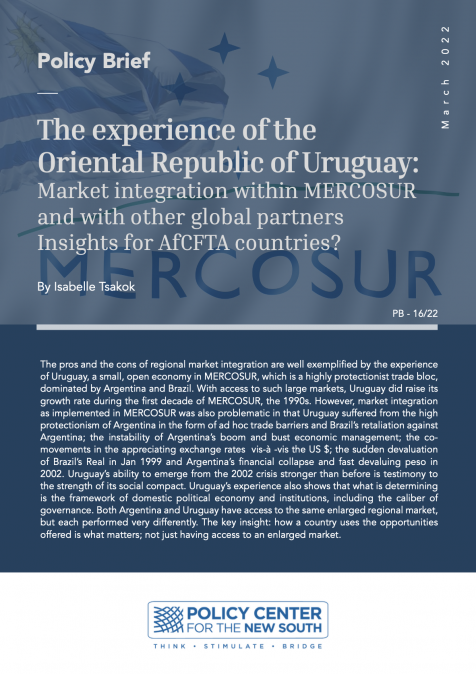
    The pros and the cons of regional market integration are well exemplified by the experience of Uruguay, a small, open economy in MERCOSUR, which is a highly protectionist trade bloc, dominated by Argentina and Brazil. With access to such large markets, Uruguay did raise its growth rate during the first decade of MERCOSUR, the 1990s. However, market integration as implemented in MERCOSUR was also problematic in that Uruguay suffered from the high protectionism of Argentina in the for ...
  • Authors
    March 8, 2022
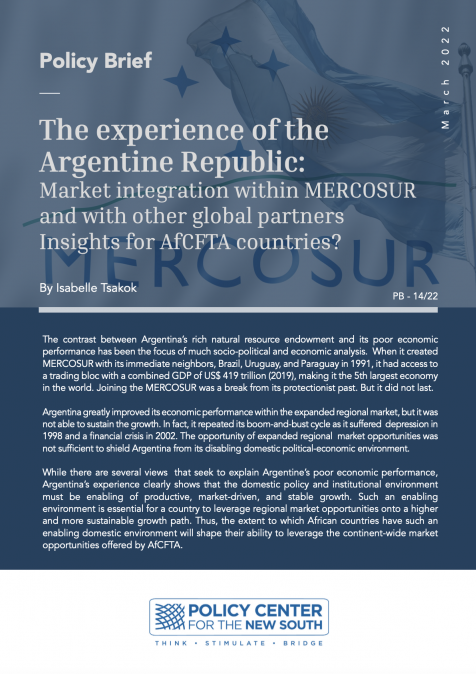
    The contrast between Argentina’s rich natural resource endowment and its poor economic performance has been the focus of much socio-political and economic analysis. When it created MERCOSUR with its immediate neighbors, Brazil, Uruguay, and Paraguay in 1991, it had access to a trading bloc with a combined GDP of US$ 419 trillion (2019), making it the 5th largest economy in the world. Joining the MERCOSUR was a break from its protectionist past. But it did not last. Argentina greatl ...