Publications /
Book / Report

Back
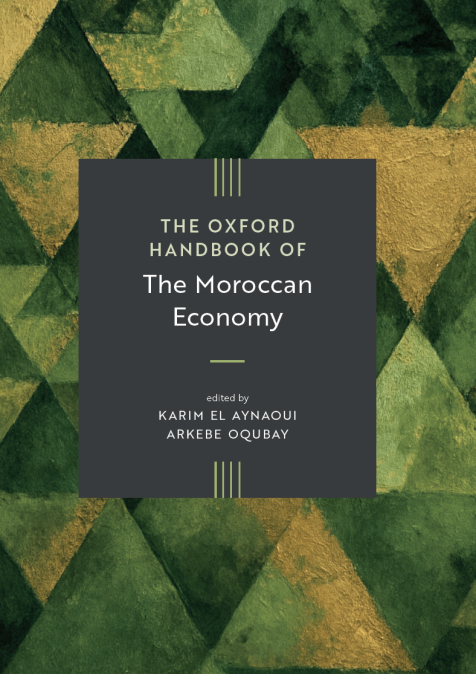
The Oxford Handbook of the Moroccan Economy
Authors
Edited by Karim El Aynaoui
Arkebe Oqubay
April 1, 2026

The Oxford Handbook of the Moroccan Economy provides a comprehensive and analytically grounded assessment of Morocco’s economic trajectory from 1960 to 2025. Bringing together 53 contributors across 34 chapters, the volume is conceived as a reference work, offering a structured analytical approach grounded in stylized facts, long-term trends, sectoral transformations, and the key public policy challenges shaping the country’s development path. It renews the stock of knowledge on the Moroccan economy by delivering a rigorous, structured, and accessible body of analysis.

Rather than focusing solely on macroeconomic aggregates or measurable social progress, the Handbook examines the deeper drivers of structural transformation, including productivity dynamics, diversification of the productive system, employment quality, technological capabilities, and institutional frameworks. It also addresses core dimensions such as industrial policy, research and innovation, private sector development, and integration into global value chains. The volume highlights Morocco’s growing integration into the global economy and the emergence of new industrial sectors, such as automotive and aeronautics, while critically assessing the limits of this transformation, particularly in terms of domestic spillovers, innovation capacity, private investment, and the creation of quality jobs.

A central contribution of the volume lies in identifying a new phase in Morocco’s development trajectory, moving beyond macroeconomic stabilization and external integration toward higher value-added production, stronger technological capabilities, increased investment in human capital, research and innovation, and a broader diffusion of structural change across the economy.

The Handbook emphasizes that economic development is neither linear nor reducible to a single model. It reflects a cumulative and context-specific process shaped by institutional capacity, policy learning, and structural constraints. In this respect, Morocco is analyzed not as a model to replicate, but as a development experience to be examined in its historical and institutional specificity.

The volume adopts a balanced, evidence-based perspective. It is neither a celebratory account nor a normative exercise, but a rigorous analytical account that captures both the progress achieved and the structural constraints that continue to shape Morocco’s economic development.

As such, it constitutes an essential reference for researchers, policymakers, practitioners, and students seeking to understand the Moroccan economy in its historical depth, sectoral complexity, and contemporary challenges.

This is an open access title. It is available to read and download as a free PDF version on Oxford Academic under a Creative Commons Attribution-Non-Commercial-No Derivatives 4.0 International licence.

RELATED CONTENT

  • Authors
    Sabine Cessou
    November 1, 2018
    Le séminaire de haut niveau, organisé par OCP Policy Center ce 2 novembre 2018 à Rabat, est axé sur « La migration : réconcilier les visions du Nord et du Sud ».  Il sera question dans cette rencontre, organisée en partenariat avec le Ministère délégué auprès du ministre des Affaires étrangères et de la Coopération internationale, Chargé des Marocains résidant à l’étranger, des affaires de la migration et l’IeMED, de la coopération internationale pour « lever les obstacle ...
  • Authors
    September 21, 2018
    This blog is based on remarks delivered at the Think-Tank Summit in Buenos Aires on 18 September 2018 held under the G-20’s Argentine Presidency.  Africa has an enormous infrastructure gap that impedes its development. The Compact with Africa (CwA) is an international policy initiative sponsored under the German presidency of the G-20 in 2017 designed to bridge that gap. Intended to draw in the private sector in developing Africa’s infrastructure through a combination of Priva ...
  • Authors
    Mokhtar Ghailani
    May 2, 2018
    La conférence-débat, organisée par l’OCP Policy Center, en association avec Sciences Po Paris Alumni Maroc (AMASP), le 26 avril 2018, autour du livre « Les enjeux du marché du travail au Maroc », et co-dirigé par Karim el Aynaoui et Aomar Ibourk, ne pouvait mieux tomber.  Le  pavé, de quelques 450 pages, bien structuré et fourni en données et en analyses « différenciées mais complémentaires » développées par une brochette d’experts et d’analystes, intervient dan ...
  • Authors
    Will Martin
    April 30, 2018
    Destination-based business cash-flow taxes have received a great deal of attention and are being widely considered as a replacement for traditional, origin-based, corporate taxes. These taxes combine the strong revenue-raising ability of a VAT with an enormously expensive tax deduction for wages. They would certainly be attractive to foreign investors by eliminating the burden of current corporate taxes. However, adopting them at the rates typically discussed would raise consumer pr ...
  • April 26, 2018
    This paper reports the results of an application using an interregional input-output matrix for Morocco together with regional information on water consumption by sectors. We develop a trade-based index that reveals the relative water use intensities associated with specific interregional and international trade flows. We estimate, for each flow associated with each origin-destination pair, measures of trade in value added and trade in water that are further used to calculate our in ...
  • Authors
    April 11, 2018
    Le récent échange entre deux institutions nationales sur la création d’emplois dans le secteur industriel pose de nouveau les questions du mode de conception et de production des statistiques mises à la disposition du public. Les informations statistiques constituent une base indispensable pour fournir au débat démocratique des références robustes. Or, le Haut-Commissariat au Plan (HCP), principal acteur du système statistique national, se trouve parfois confronté à des difficultés ...
  • Authors
    Thomas Pereira da Silva
    March 7, 2018
    This proposal seeks to contribute to reduce, in a cost-effective way, Morocco’s unusually high, persistent and growing unemployment level for university graduates1. It complements and enhances the existing Université Internationale de Rabat (UIR) Public-Private Partnership (PPP). Tertiary enrolment in Morocco has been increasing above what seems to be labor market absorptive capacity. Over the past decade, the share of the unemployed with university degrees as a percentage of total ...
  • February 22, 2018
    Cet ouvrage a pour objectif de produire et d’accumuler des connaissances utiles sur le marché du travail marocain, notamment la situation des jeunes dont les traits ont été beaucoup documentés. Les axes qui sont traités dans le cadre de ce travail portent sur la capacité du système éducatif et de formation à transmettre les compétences techniques et non techniques (soft skills) aux jeunes dans leurs parcours de scolarisation et de formation, le rôle des programmes de l’emploi dans l ...
  • Authors
    November 30, 2017
    The jobs markets across the Middle East North Africa region vary greatly, with some oil-rich countries importers of labor while others, including Morocco, are the source of emigrants. Morocco exhibits structural underemployment despite having grown quite rapidly. The reasons for Morocco’s job-poor growth run deep. Policies can mitigate the problem but are unlikely to solve it in the foreseeable future. ...