Publications /
Book / Report

Back
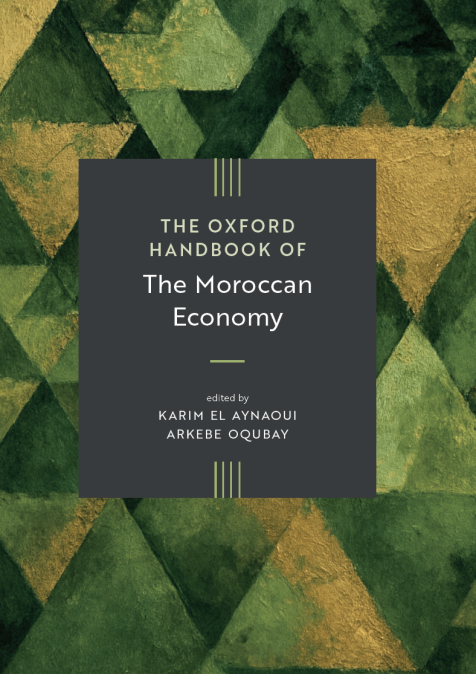
The Oxford Handbook of the Moroccan Economy
Authors
Edited by Karim El Aynaoui
Arkebe Oqubay
April 1, 2026

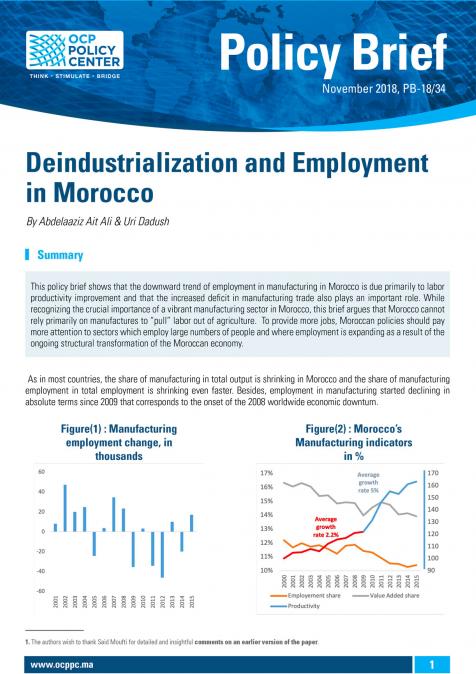
The Oxford Handbook of the Moroccan Economy provides a comprehensive and analytically grounded assessment of Morocco’s economic trajectory from 1960 to 2025. Bringing together 53 contributors across 34 chapters, the volume is conceived as a reference work, offering a structured analytical approach grounded in stylized facts, long-term trends, sectoral transformations, and the key public policy challenges shaping the country’s development path. It renews the stock of knowledge on the Moroccan economy by delivering a rigorous, structured, and accessible body of analysis.

Rather than focusing solely on macroeconomic aggregates or measurable social progress, the Handbook examines the deeper drivers of structural transformation, including productivity dynamics, diversification of the productive system, employment quality, technological capabilities, and institutional frameworks. It also addresses core dimensions such as industrial policy, research and innovation, private sector development, and integration into global value chains. The volume highlights Morocco’s growing integration into the global economy and the emergence of new industrial sectors, such as automotive and aeronautics, while critically assessing the limits of this transformation, particularly in terms of domestic spillovers, innovation capacity, private investment, and the creation of quality jobs.

A central contribution of the volume lies in identifying a new phase in Morocco’s development trajectory, moving beyond macroeconomic stabilization and external integration toward higher value-added production, stronger technological capabilities, increased investment in human capital, research and innovation, and a broader diffusion of structural change across the economy.

The Handbook emphasizes that economic development is neither linear nor reducible to a single model. It reflects a cumulative and context-specific process shaped by institutional capacity, policy learning, and structural constraints. In this respect, Morocco is analyzed not as a model to replicate, but as a development experience to be examined in its historical and institutional specificity.

The volume adopts a balanced, evidence-based perspective. It is neither a celebratory account nor a normative exercise, but a rigorous analytical account that captures both the progress achieved and the structural constraints that continue to shape Morocco’s economic development.

As such, it constitutes an essential reference for researchers, policymakers, practitioners, and students seeking to understand the Moroccan economy in its historical depth, sectoral complexity, and contemporary challenges.

This is an open access title. It is available to read and download as a free PDF version on Oxford Academic under a Creative Commons Attribution-Non-Commercial-No Derivatives 4.0 International licence.
RELATED CONTENT

  • Authors
    Vera Songwe
    December 23, 2016
    Partout dans le monde, l'intégration économique régionale permet d'accélérer la croissance et le développement en apportant une panoplie d'avantages liés à une meilleure coopération politique, à un commerce intra-régional accru et à la création d'emplois. Les régions qui sont plus intégrées se sont révélées capables de connaître une croissance plus rapide et ont fait preuve d'une plus grande capacité d'adaptation en période de ralentissement de l'économie mondiale. Alors que l'écono ...
  • Authors
    Karim EL Mokri
    October 13, 2016
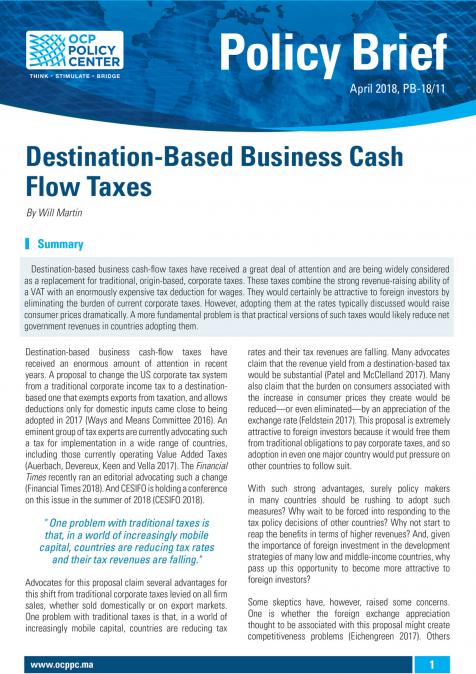
    Morocco is now more than ever threatened by the trap of middle-income economies. On one hand, it is caught between increased competition from low-income countries in low productivity and labor-intensive sectors and, on the other hand, the difficulty of accelerating its pace of structural transformation towards activities with higher value added and higher technological content. International experience shows that few countries have managed to climb to the status of an advanced econo ...
  • Authors
    June 16, 2016
    L’écart entre filles et garçons en termes de scolarisation, au Maroc, a longtemps préoccupé tant les académiciens que les décideurs. En revanche, très peu d’études se sont penchées sur l’analyse de cet écart sous une toile de fond quantitative. Ce présent travail s’intéresse à l’écart genre en termes d’acquis scolaires en lecture. La finalité étant de mettre en exergue les facteurs influençant les différences de performance entre les genres ainsi que leur ampleur. Pour ce faire, une ...
  • Authors
    May 20, 2016
    The 2015-2030 strategic vision innovates the Moroccan educational system. Unlike previous reforms, this vision addresses problems that have long been ignored. Among these problems is the quality of education. Although educational quality may have been included in previous reform programs, it is considered as one of the priorities in this new vision. The purpose of this Policy Brief is to assess the status of learning achievement, which is an integral part of educational quality, of ...
  • Authors
    December 23, 2015
    Global economic growth is likely to be a little better in 2016 than this year’s lackluster outcome. The ongoing slow recovery in the United States and Europe is likely to continue. However, weakness in China as well as several large emerging markets, and sluggishness of world trade, mean that risks are weighted on the downside of this forecast. Morocco, which is reliant on European markets, is a heavy importer of oil, and whose currency has devalued in effective terms, should find t ...
  • Authors
    Karim El Mokri
    Aziz Ragbi
    Said Tounsi
    November 23, 2015
    The issue of a powerful fiscal policy comeback is not only being debated in Europe. It is also interesting for Morocco, in many respects. If in Europe there is controversy between the proponents of the structural budgetary balance rule and critics of restrictive policies in the context of major financial and recessive shocks, in the South of the Mediterranean fiscal policy is caught between the multiple social and economic requirements and the constraint of sustainability. ...
  • Authors
    Edité par:
    Karim El Mokri
    Aziz Ragbi
    Said Tounsi
    November 23, 2015
    Depuis le déclenchement de la crise économique et financière internationale, la politique budgétaire a connu un vif regain d’intérêt dans les arènes académiques et dans les débats des policy-makers, aussi bien dans les pays avancés que ceux en voie de développement. Pour un pays en voie de développement comme le Maroc, l’importance de la politique budgétaire réside dans le potentiel qu’elle offre en matière de stabilisation du cycle économique et de relance de l’activité en période ...