Publications /
Book / Report

Back
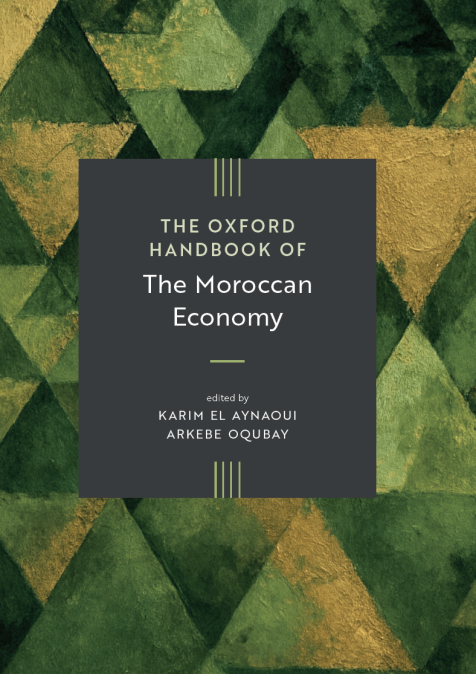
The Oxford Handbook of the Moroccan Economy
Authors
Edited by Karim El Aynaoui
Arkebe Oqubay
April 1, 2026

The Oxford Handbook of the Moroccan Economy provides a comprehensive and analytically grounded assessment of Morocco’s economic trajectory from 1960 to 2025. Bringing together 53 contributors across 34 chapters, the volume is conceived as a reference work, offering a structured analytical approach grounded in stylized facts, long-term trends, sectoral transformations, and the key public policy challenges shaping the country’s development path. It renews the stock of knowledge on the Moroccan economy by delivering a rigorous, structured, and accessible body of analysis.

Rather than focusing solely on macroeconomic aggregates or measurable social progress, the Handbook examines the deeper drivers of structural transformation, including productivity dynamics, diversification of the productive system, employment quality, technological capabilities, and institutional frameworks. It also addresses core dimensions such as industrial policy, research and innovation, private sector development, and integration into global value chains. The volume highlights Morocco’s growing integration into the global economy and the emergence of new industrial sectors, such as automotive and aeronautics, while critically assessing the limits of this transformation, particularly in terms of domestic spillovers, innovation capacity, private investment, and the creation of quality jobs.

A central contribution of the volume lies in identifying a new phase in Morocco’s development trajectory, moving beyond macroeconomic stabilization and external integration toward higher value-added production, stronger technological capabilities, increased investment in human capital, research and innovation, and a broader diffusion of structural change across the economy.

The Handbook emphasizes that economic development is neither linear nor reducible to a single model. It reflects a cumulative and context-specific process shaped by institutional capacity, policy learning, and structural constraints. In this respect, Morocco is analyzed not as a model to replicate, but as a development experience to be examined in its historical and institutional specificity.

The volume adopts a balanced, evidence-based perspective. It is neither a celebratory account nor a normative exercise, but a rigorous analytical account that captures both the progress achieved and the structural constraints that continue to shape Morocco’s economic development.

As such, it constitutes an essential reference for researchers, policymakers, practitioners, and students seeking to understand the Moroccan economy in its historical depth, sectoral complexity, and contemporary challenges.

This is an open access title. It is available to read and download as a free PDF version on Oxford Academic under a Creative Commons Attribution-Non-Commercial-No Derivatives 4.0 International licence.

RELATED CONTENT

  • May 20, 2026
    La participation des femmes au marché du travail au Maroc demeure l'un des défis les plus structurels du développement économique et social du pays. Avec un taux d'activité féminin de seulement 19 % en 2023, contre 69 % pour les hommes (HCP, 2024), le Maroc présente l'un des écarts de genre les plus prononcés parmi les économies en développement (Banque mondiale, 2024). Ce Research Paper propose une analyse économétrique rigoureuse et multiniveaux des déterminants de cette participa ...
  • Authors
    Eugène Berg
    May 19, 2026
    L’Organisation pour la coopération et le développement économiques (OCDE), forte de 38 membres, a longtemps fait figure d’Organisation regroupant les « démocraties industrielles développées ». Cette image n’est plus vraie, du fait de l’adhésion en son sein de pays, qualifiés jadis en développement, et que l’on considère souvent comme faisant partie du « Sud global ». C’est ainsi que l’ont intégrée : le Mexique (1994), qui lui a donné un Secrétaire général, Angel Gurria, la Corée du ...
  • Authors
    May 15, 2026
    This paper is the third in a series of country and comparative studies that together comprise a research program on services as drivers of economic growth and structural transformation in the Global South. The paper analyzes the pattern of Tunisia's services-led economic growth from 2012- 2022 using a specialized three-category framework: knowledge services (KS), enabling services (ES), and local services (LS). Using data from the OECD Trade in Value Added (TiVA), Trade in Employmen ...
  • Authors
    Hajar Kabbach
    May 11, 2026
    Closing Morocco's gender employment gap could increase GDP per capita by 40-50 percent; yet female labor force participation stands at just 19 percent—among the lowest in the world and still declining. This policy paper argues that investing in the care economy is not merely a social expenditure, but a productive economic strategy with measurable returns. Drawing on international evidence from Uruguay, Mexico, Colombia, and India, the brief demonstrates that well-designed care syste ...
  • April 30, 2026
    يشهد المغرب تحولًا سريعًا في صناعة السيارات الكهربائية، مدفوعًا باستثمارات كبيرة وطموح للانتقال من مجرد منصة تركيب إلى فاعل صناعي متكامل. وبين فرص بناء صناعة بطاريات محلية وخلق وظائف جديدة، تبرز أيضًا تحديات مرتبطة بنقل التكنولوجيا، والتشغيل، والاستدامة. في هذه الحلقة، نفكك هذا التحول و...
  • Authors
    April 20, 2026
    This paper was published as a book chapter in “The Economic Potential of Islamic Countries, Part B: Sustainability, Governance, Energy and Digital Transformation,” released by Emerald Publishing. The COVID-19 pandemic exposed significant deficiencies within social protection systems worldwide, especially in Middle Eastern and North African (MENA) countries. This underscores the urgent need to fortify these social protection schemes to ensure resilience in the face of crises (Sa ...
  • April 13, 2026
    Résumé exécutif stratégiqueLe Maroc s’est engagé avec détermination dans une trajectoire de modernisation fondée sur la transition numérique, la transition verte et l’innovation. Ces dynamiques sont devenues des leviers stratégiques pour la compétitivité, l’attractivité et la création d’emplois à forte valeur ajoutée. Pourtant, l’analyse des données microéconomiques récentes révèle un paradoxe préoccupant : les entreprises les plus modernisées, moteurs de la croissance de demain, re ...
  • Authors
    Edited by Karim El Aynaoui
    Arkebe Oqubay
    April 1, 2026
    The Oxford Handbook of the Moroccan Economy provides a comprehensive and analytically grounded assessment of Morocco’s economic trajectory from 1960 to 2025. Bringing together 53 contributors across 34 chapters, the volume is conceived as a reference work, offering a structured analytical approach grounded in stylized facts, long-term trends, sectoral transformations, and the key public policy challenges shaping the country’s development path. It renews the stock of knowledge on the ...
  • March 31, 2026
    تتناول هذه الحلقة كيفية إعادة صياغة السياسة الصناعية في المغرب في ظل التحولات العالمية وإعادة تشكيل سلاسل القيمة، مع التركيز على الانتقال من موقع إنتاجي إلى فاعل صناعي استراتيجي. كما تسلط الضوء على دور قطاعات السيارات والطاقات المتجددة والصناعات التكنولوجية في تعزيز تموقع المغرب دولياً....