Publications /
Book / Report

Back
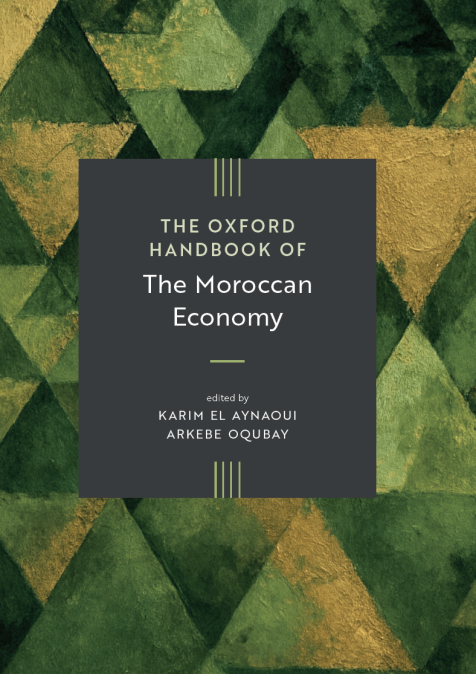
The Oxford Handbook of the Moroccan Economy
Authors
Edited by Karim El Aynaoui
Arkebe Oqubay
April 1, 2026

The Oxford Handbook of the Moroccan Economy provides a comprehensive and analytically grounded assessment of Morocco’s economic trajectory from 1960 to 2025. Bringing together 53 contributors across 34 chapters, the volume is conceived as a reference work, offering a structured analytical approach grounded in stylized facts, long-term trends, sectoral transformations, and the key public policy challenges shaping the country’s development path. It renews the stock of knowledge on the Moroccan economy by delivering a rigorous, structured, and accessible body of analysis.

Rather than focusing solely on macroeconomic aggregates or measurable social progress, the Handbook examines the deeper drivers of structural transformation, including productivity dynamics, diversification of the productive system, employment quality, technological capabilities, and institutional frameworks. It also addresses core dimensions such as industrial policy, research and innovation, private sector development, and integration into global value chains. The volume highlights Morocco’s growing integration into the global economy and the emergence of new industrial sectors, such as automotive and aeronautics, while critically assessing the limits of this transformation, particularly in terms of domestic spillovers, innovation capacity, private investment, and the creation of quality jobs.

A central contribution of the volume lies in identifying a new phase in Morocco’s development trajectory, moving beyond macroeconomic stabilization and external integration toward higher value-added production, stronger technological capabilities, increased investment in human capital, research and innovation, and a broader diffusion of structural change across the economy.

The Handbook emphasizes that economic development is neither linear nor reducible to a single model. It reflects a cumulative and context-specific process shaped by institutional capacity, policy learning, and structural constraints. In this respect, Morocco is analyzed not as a model to replicate, but as a development experience to be examined in its historical and institutional specificity.

The volume adopts a balanced, evidence-based perspective. It is neither a celebratory account nor a normative exercise, but a rigorous analytical account that captures both the progress achieved and the structural constraints that continue to shape Morocco’s economic development.

As such, it constitutes an essential reference for researchers, policymakers, practitioners, and students seeking to understand the Moroccan economy in its historical depth, sectoral complexity, and contemporary challenges.

This is an open access title. It is available to read and download as a free PDF version on Oxford Academic under a Creative Commons Attribution-Non-Commercial-No Derivatives 4.0 International licence.


RELATED CONTENT

  • Authors
    June 13, 2023
    Le Salon international de l’édition et du livre (SIEL), dont la 28ème édition  s’est achevée le 11 juin 2023, a une fois de plus été l'occasion pour le ‘’petit’’ monde de l'édition de s'interroger sur son avenir. Les rencontres du SIEL ont réuni les différents maillons de la chaîne de production du livre, des auteurs aux éditeurs en passant par les acteurs de la distribution et de la promotion. C’est l’une des rares occasions de prendre le pouls des transformations de cette cha ...
  • June 13, 2023
    يعد ميثاق الاستثمار الجديد، الصادر، في دجنبر 2022، والذي تم تطبيق أول مراسيمه، في يناير المنصرم، خارطة الطريق الإستراتيجية لإعطاء نفس جديد للاستثمار بالمغرب، الذي من شأنه أن يعزز تنافسية ...
  • Authors
    Abdelkhalek Touhami
    Dorothée Boccanfuso
    June 8, 2023
    The targeting of public policies, particularly those related to the reform of the social protection system in Morocco, is a major challenge, especially in assessing the impact of these measures on multidimensional poverty. By developing two targeting methods to approach the impact of the reform of the social protection system in Morocco on multidimensional poverty as measured by the Multidimensional Poverty Index (MPI), we show that the three simulated reforms on education and healt ...
  • June 6, 2023
      يعد ميثاق الاستثمار الجديد، الصادر، في دجنبر 2022، والذي تم تطبيق أول مراسيمه، في يناير المنصرم، خارطة الطريق الإستراتيجية لإعطاء نفس جديد للاستثمار بالمغرب، الذي من شأنه أن يعزز تنافسية الاقتصاد الوطني، فضلا عن تثمين دور الفاعلين في القطاع الخاص، وكذا منظومة الإنتاج المغربية. م...
  • May 30, 2023
    Depuis 2020, le Policy Center for the New South, le Programme des Nations unies pour le développement (PNUD) et la Banque mondiale ont lancé l'initiative « Parlons développement », qui consiste en une série de réflexions collectives sur les grands enjeux du développement durable. Cette ...
  • Authors
    Pierre Sauvé
    May 29, 2023
    Morocco has made important strides in reducing poverty in the last three decades, thanks in large part to trade and industrial policies aimed at durably inserting the country into world flows of goods, services, and cross-border investment. Since 1992, per capita incomes have tripled (in current US$), contributing to a threefold drop in the Kingdom’s poverty headcount. The country of 37 million features consistently as one of the better-performing and more stable economies in the No ...
  • Authors
    Inkyo Cheong
    Lillyana Daza Jaller
    Siwook Lee
    Jean-Christophe Maur
    Martin Molinuevo
    Sahar Sajjad Hussain
    Pierre Sauvé
    Shane Sela
    Aleksandar Stojanov
    Iryna Klytchnikova
    Edited by Pierre Sauvé and Uri Dadush
    May 23, 2023
    The broad thrust of Morocco’s trade and industrial policies over the last thirty years has been to anchor Morocco into world flows of goods, services, and cross-border investment. Despite the challenges posed by the COVID-19 pandemic, rising international prices, and a complex geopolitical environment, Moroccans continue to derive significant benefits from their economy’s openness. These include improved consumer choice and welfare, the growing insertion of Moroccan firms into cross ...
  • Authors
    Abdelmonim AMACHRAA
    May 17, 2023
    Nothing better illustrates the positive contribution of the integration of national economies into global value chains than the fact that in the 1990s, the automotive sector barely existed in Morocco. Now, it is the leading export sector, with a production and assembly capacity of 700,000 vehicles, making it an attractive and competitive hub linking Africa and Europe in the automotive value chain. However, the automotive industry is on the cusp of change, with advances in electric a ...