Publications /
Book / Report

Back
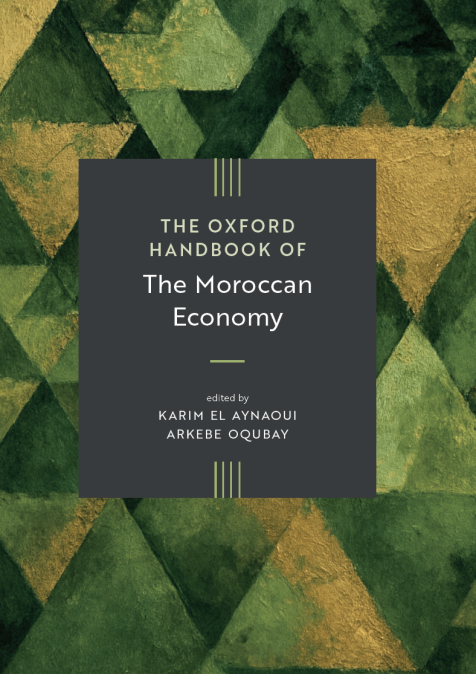
The Oxford Handbook of the Moroccan Economy
Authors
Edited by Karim El Aynaoui
Arkebe Oqubay
April 1, 2026

The Oxford Handbook of the Moroccan Economy provides a comprehensive and analytically grounded assessment of Morocco’s economic trajectory from 1960 to 2025. Bringing together 53 contributors across 34 chapters, the volume is conceived as a reference work, offering a structured analytical approach grounded in stylized facts, long-term trends, sectoral transformations, and the key public policy challenges shaping the country’s development path. It renews the stock of knowledge on the Moroccan economy by delivering a rigorous, structured, and accessible body of analysis.

Rather than focusing solely on macroeconomic aggregates or measurable social progress, the Handbook examines the deeper drivers of structural transformation, including productivity dynamics, diversification of the productive system, employment quality, technological capabilities, and institutional frameworks. It also addresses core dimensions such as industrial policy, research and innovation, private sector development, and integration into global value chains. The volume highlights Morocco’s growing integration into the global economy and the emergence of new industrial sectors, such as automotive and aeronautics, while critically assessing the limits of this transformation, particularly in terms of domestic spillovers, innovation capacity, private investment, and the creation of quality jobs.

A central contribution of the volume lies in identifying a new phase in Morocco’s development trajectory, moving beyond macroeconomic stabilization and external integration toward higher value-added production, stronger technological capabilities, increased investment in human capital, research and innovation, and a broader diffusion of structural change across the economy.

The Handbook emphasizes that economic development is neither linear nor reducible to a single model. It reflects a cumulative and context-specific process shaped by institutional capacity, policy learning, and structural constraints. In this respect, Morocco is analyzed not as a model to replicate, but as a development experience to be examined in its historical and institutional specificity.

The volume adopts a balanced, evidence-based perspective. It is neither a celebratory account nor a normative exercise, but a rigorous analytical account that captures both the progress achieved and the structural constraints that continue to shape Morocco’s economic development.

As such, it constitutes an essential reference for researchers, policymakers, practitioners, and students seeking to understand the Moroccan economy in its historical depth, sectoral complexity, and contemporary challenges.

This is an open access title. It is available to read and download as a free PDF version on Oxford Academic under a Creative Commons Attribution-Non-Commercial-No Derivatives 4.0 International licence.

RELATED CONTENT

  • Authors
    Aziz Ajbilou
    April 1, 2024
    اعتمادا على مختلف البيانات المتوفرة لدى المندوبية السامية للتخطيط ووزارة الصحة والمرصد الوطني للتنمية البشرية، يهدف هذا القال إلى دراسة مراحل تطور الخصوبة في المغرب. وعليه فمن خلال دراسة هذه البيانات يتضح أن الخصوبة سجلت منذ سنة 2010 نوعا من الاستقرار أوبالأحرى ارتفاعا طفيفا وخاصة بالمناطق الحضرية، حيث ارتفع معدل الخصوبة من 1.8 طفل لكل امرأة سنة 2010 إلى 2.2 طفل لكل امرأة سنة 2019. وعلى العكس من ذلك، استمر معدل الخصوبة في الانخفاض في المناطق القروية إلى غاية سنة 2014، ليصل إ ...
  • Authors
    Aziz Ajbilou
    April 1, 2024
    En utilisant des données, disponibles, provenant des recensements et enquêtes réalisés par le Haut- commissariat au plan (HCP), le ministère de la Santé, et l’Observatoire national du développent humain (ONDH), cet article se propose d’étudier les changements dans le temps connus par la fécondité au Maroc. La tendance qui se dégage de l’évolution récente de ce phénomène est qu’il enregistre, depuis 2010, une sorte de stagnation, voire une légère reprise. Une tendanc ...
  • March 26, 2024
    يعتبر المجال القروي بالمغرب ركيزة من ركائز الهوية الوطنية، حيث يتسم بثراء ثقافي يتجلى في عاداته الاقتصادية الخاصة وتنوعه الجغرافي المكون من جبال وسهول وصحاري، إضافةً إلى تعدد المجتمعات وأنماط العيش المختلفة. فكيف يتميز المجال القروي عن المجال الحضاري؟ وكيف تطورت المظاهر الاقتصادية والسي...
  • Authors
    March 13, 2024
    Le 20 février 2024, le Policy Center for the New South et la Banque mondiale ont mis à profit  l’organisation d’un événement pour échanger sur les résultats d'une récente évaluation du partenariat entre le Royaume et l’institution de Bretton Woods . Cette rencontre a été l’occasion de revenir sur les accomplissements, les défis rencontrés et les opportunités à venir afin d’orienter la collaboration future entre les deux parties. Au cours des 15 dernières années, le Maroc et la ...
  • February 20, 2024
    Le Policy Center for the New South et le Groupe d'évaluation indépendante (IEG) de la Banque mondiale organisent un évènement sous le thème «La Banque mondiale au Maroc : apprendre et s'adapter pour avoir un impact ». L'événement examine les conclusions d'une évaluation réce...
  • Authors
    Ali Elguellab
    Elhadj Ezzahid
    February 12, 2024
    Dans ce rapport, nous proposons d’utiliser une nouvelle approche pour analyser les structures productives au Maroc. Nous appliquons les outils de la théorie des réseaux aux tableaux des échanges inter-industriels de l'économie marocaine. Nos résultats montrent que le réseau national de production présente des caractéristiques intuitives dans le sens qu’elles sont liées aux processus de production. La structure de ce réseau peut être représentée sous la forme d'un papillon, avec les ...
  • Authors
    Ilham Najib
    January 29, 2024
    Morocco is positioned as a new global hub of the automotive industry in an increasingly volatile international context, with various emerging countries competing intensively to gain the best returns on openness and globalization. The Moroccan automotive industry’s recent performance shows it to be the most dynamic sector in the economy: from 2014 to 2019, value-added in the automotive sector increased by almost 70% while the overall national value-added increased by only 15%. In the ...
  • Authors
    Soukaina Raoui
    January 22, 2024
      This Paper was originally published on bera-journals.onlinelibrary.wiley.com   As a specific driver for the transformation of education systems in Morocco, inclusive education is a process that aims to reduce the exclusion of children with disabilities. Indeed, few studies have analysed the exclusion factors that cause children with disabilities not to pursue their education. Based on this, the present paper explores the spatial effect of factors related to acces ...
  • Authors
    Elhoussaine Wahyana
    January 12, 2024
    The debate on global value chains (GVCs) has emphasized countries’ contributions to value-added creation. From an intercountry perspective, a new body of research is addingto this debate by studying how subnational regions contribute to the indicators in specific countries. Proper assessment of economic contributions is essential for designing incentive policies. This paper analyzes the role played by the main trading partners of Moroccan regi ...