Publications /
Book / Report

Back
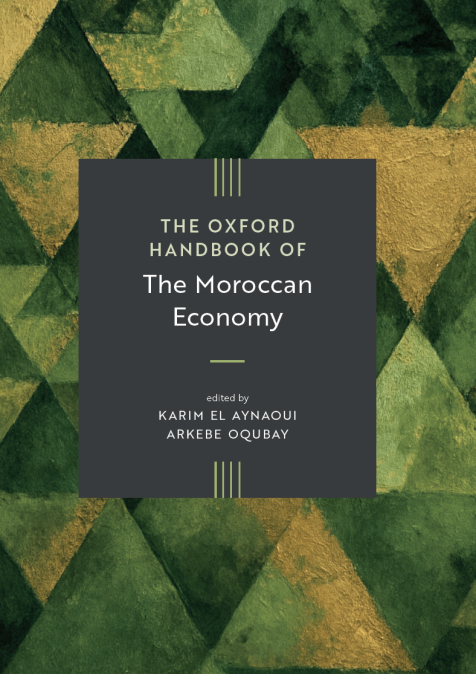
The Oxford Handbook of the Moroccan Economy
Authors
Edited by Karim El Aynaoui
Arkebe Oqubay
April 1, 2026

The Oxford Handbook of the Moroccan Economy provides a comprehensive and analytically grounded assessment of Morocco’s economic trajectory from 1960 to 2025. Bringing together 53 contributors across 34 chapters, the volume is conceived as a reference work, offering a structured analytical approach grounded in stylized facts, long-term trends, sectoral transformations, and the key public policy challenges shaping the country’s development path. It renews the stock of knowledge on the Moroccan economy by delivering a rigorous, structured, and accessible body of analysis.

Rather than focusing solely on macroeconomic aggregates or measurable social progress, the Handbook examines the deeper drivers of structural transformation, including productivity dynamics, diversification of the productive system, employment quality, technological capabilities, and institutional frameworks. It also addresses core dimensions such as industrial policy, research and innovation, private sector development, and integration into global value chains. The volume highlights Morocco’s growing integration into the global economy and the emergence of new industrial sectors, such as automotive and aeronautics, while critically assessing the limits of this transformation, particularly in terms of domestic spillovers, innovation capacity, private investment, and the creation of quality jobs.

A central contribution of the volume lies in identifying a new phase in Morocco’s development trajectory, moving beyond macroeconomic stabilization and external integration toward higher value-added production, stronger technological capabilities, increased investment in human capital, research and innovation, and a broader diffusion of structural change across the economy.

The Handbook emphasizes that economic development is neither linear nor reducible to a single model. It reflects a cumulative and context-specific process shaped by institutional capacity, policy learning, and structural constraints. In this respect, Morocco is analyzed not as a model to replicate, but as a development experience to be examined in its historical and institutional specificity.

The volume adopts a balanced, evidence-based perspective. It is neither a celebratory account nor a normative exercise, but a rigorous analytical account that captures both the progress achieved and the structural constraints that continue to shape Morocco’s economic development.

As such, it constitutes an essential reference for researchers, policymakers, practitioners, and students seeking to understand the Moroccan economy in its historical depth, sectoral complexity, and contemporary challenges.

This is an open access title. It is available to read and download as a free PDF version on Oxford Academic under a Creative Commons Attribution-Non-Commercial-No Derivatives 4.0 International licence.
RELATED CONTENT

  • Authors
    December 2, 2025
    This paper assesses the economic and environmental implications of Morocco’s strategic transition from internal combustion engine vehicle (ICEV) manufacturing to electric vehicle (EV) production, with a particular focus on the regional impacts of localizing high-value battery manufacturing. Using an interregional input-output model, extended with environmental satellite accounts, the study simulates a structural shock related to the wholesale substitution of ICEV-specific inputs wit ...
  • December 2, 2025
    في هذه الحلقة، نحاول اكتشاف ما الذي يجعل المغرب يعيش اليوم تحولاً لافتاً في عالم المدفوعات الرقمية. كيف أصبحت التكنولوجيا المالية أحد مفاتيح الشمول المالي ومحركاً لنمو جديد؟ وكيف يغيّر الاعتماد المتزايد لوسائل الدفع الحديثة حياة التجار الصغار والمقاولات الصغيرة والمتوسطة ويخلق لهم فرصاً...
  • Authors
    Arkebe Oqubay
    November 17, 2025
    Morocco has emerged as one of Africa's success stories, achieving significant progress in economic transformation and the green transition over the past 25 years. Continuing and deepening this transformation is essential to reach the country’s goal of becoming a high-income economy in the coming decades. Significant challenges include managing the risk of the middle-income trap, addressing demographic pressures, promoting inclusive growth, ensuring environmental sustainability, and ...
  • November 4, 2025
    في هذه الحلقة، نناقش مستجدّات قانون المالية لسنة 2026، بما يشمل الإصلاحات الضريبية والتعديلات على الضرائب المباشرة وغير المباشرة، سياسات الإنفاق العمومي الجديدة، التحفيزات الاقتصادية للاستثمار والابتكار، والتدابير الاجتماعية لدعم الفئات الهشة، مع إبراز التحديات والآفاق المستقبلية للاقتص...
  • Authors
    October 3, 2025
    En dépit des progrès sociaux, le Maroc reste confronté à une série de défis. Le chômage persiste à un niveau inacceptable, l’adéquation entre la formation et l’emploi est insatisfaisante, l’accès aux soins est contrarié par maintes contraintes, les disparités territoriales demeurent flagrantes. Pourtant, que de réformes, que de programmes sociaux sont financés depuis des décennies pour couvrir les déficits accumulés par le passé. Beaucoup de ces secteurs névralgiques pour le bi ...
  • September 26, 2025
    Morocco’s strong macroeconomic performance over the past two decades—anchored in infrastructure modernization, industrial diversification, and renewable energy leadership—has positioned it as a success story in the Global South. Yet these achievements mask persistent regional disparities that undermine inclusive development. Coastal regions such as Casablanca-Settat and Tangier-Tétouan-Al Hoceima dominate economic activity, while hinterland and southern provinces face structural dis ...
  • September 23, 2025
    في هذا العدد من برنامجنا، نسلّط الضوء على موقع المغرب الاستراتيجي الذي يجعله حلقة وصل بين الأطلسي والمتوسط، ودوره المتصاعد في التجارة الدولية والاقتصاد البحري. نناقش التحديات والفرص التي تطرحها هذه الدينامية، من تطوير البنية التحتية وتأهيل الكفاءات، إلى استكشاف آفاق الاقتصاد الأزرق وضما...
  • Authors
    September 19, 2025
    Le constat est unanime et est constamment souligné : le modèle de développement en vigueur au Maroc a atteint ses limites. La Vision Royale, refusant « un Maroc à deux vitesses », vient formaliser au plus haut niveau cette préoccupation systémique, documentée par une décennie de rapports officiels. La  Vision de Sa Majesté le Roi Mohammed VI est un hymne à une dynamique de croissance dont les retombées doivent être plus équitablement réparties et à un développement te ...
  • Authors
    September 16, 2025
    Les questions des inégalités sociales et des inégalités territoriales sont profondément liées.  Les politiques publiques ne peuvent réduire l’une sans s’attaquer à l’autre.  Le phénomène des inégalités peut s’accentuer avec la fragilité de la situation socio-économique de certains territoires d’autant que le développement territorial n’est pas spontanément équitable. La réduction de ces inégalités, un des enjeux majeurs des politiques publiques, oblige à con ...