Publications /
Book / Report

Back
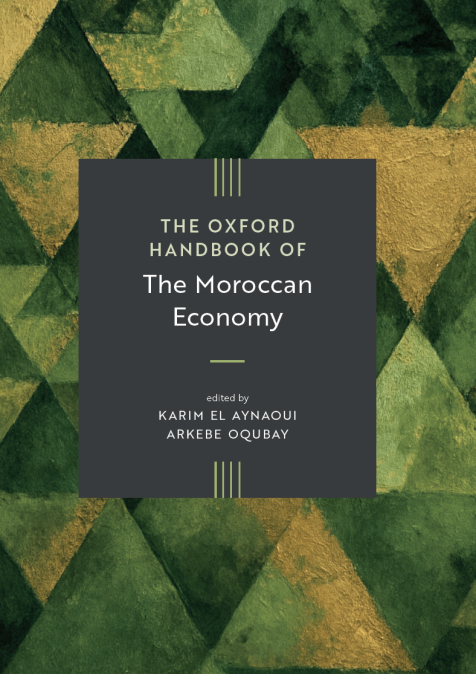
The Oxford Handbook of the Moroccan Economy
Authors
Edited by Karim El Aynaoui
Arkebe Oqubay
April 1, 2026

The Oxford Handbook of the Moroccan Economy provides a comprehensive and analytically grounded assessment of Morocco’s economic trajectory from 1960 to 2025. Bringing together 53 contributors across 34 chapters, the volume is conceived as a reference work, offering a structured analytical approach grounded in stylized facts, long-term trends, sectoral transformations, and the key public policy challenges shaping the country’s development path. It renews the stock of knowledge on the Moroccan economy by delivering a rigorous, structured, and accessible body of analysis.

Rather than focusing solely on macroeconomic aggregates or measurable social progress, the Handbook examines the deeper drivers of structural transformation, including productivity dynamics, diversification of the productive system, employment quality, technological capabilities, and institutional frameworks. It also addresses core dimensions such as industrial policy, research and innovation, private sector development, and integration into global value chains. The volume highlights Morocco’s growing integration into the global economy and the emergence of new industrial sectors, such as automotive and aeronautics, while critically assessing the limits of this transformation, particularly in terms of domestic spillovers, innovation capacity, private investment, and the creation of quality jobs.

A central contribution of the volume lies in identifying a new phase in Morocco’s development trajectory, moving beyond macroeconomic stabilization and external integration toward higher value-added production, stronger technological capabilities, increased investment in human capital, research and innovation, and a broader diffusion of structural change across the economy.

The Handbook emphasizes that economic development is neither linear nor reducible to a single model. It reflects a cumulative and context-specific process shaped by institutional capacity, policy learning, and structural constraints. In this respect, Morocco is analyzed not as a model to replicate, but as a development experience to be examined in its historical and institutional specificity.

The volume adopts a balanced, evidence-based perspective. It is neither a celebratory account nor a normative exercise, but a rigorous analytical account that captures both the progress achieved and the structural constraints that continue to shape Morocco’s economic development.

As such, it constitutes an essential reference for researchers, policymakers, practitioners, and students seeking to understand the Moroccan economy in its historical depth, sectoral complexity, and contemporary challenges.

This is an open access title. It is available to read and download as a free PDF version on Oxford Academic under a Creative Commons Attribution-Non-Commercial-No Derivatives 4.0 International licence.
RELATED CONTENT

  • September 19, 2023
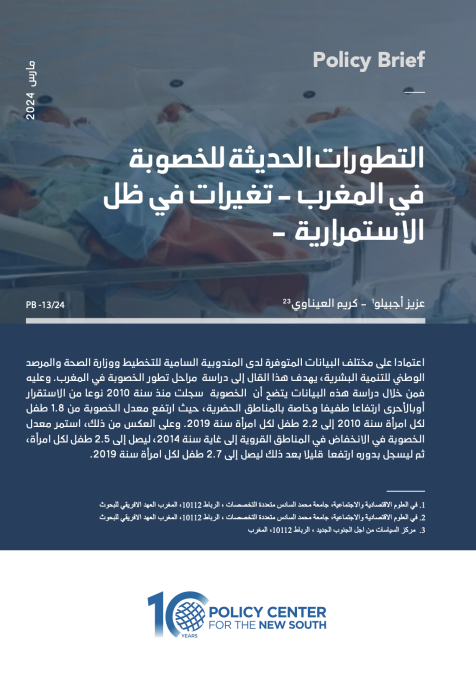
      من الجدير بالتذكير أن زلزال المغرب الذي استهدف إقليمي الحوز وتارودانت ليلة يوم الجمعة الموافق للتاسع من شتنبر سيفاقم من الصعوبات التي يواجهها اقتصاد البلاد الذي لازال يعاني من عبء كبير جراء الضغوطات التي أحدثتها الأوضاع الجيوسياسية في العالم،  بما فيها تداعيات الصراع ف...
  • August 28, 2023
    Le secteur informel joue un rôle crucial dans le développement économique et social du Maroc en tant que filet de sécurité pour de nombreux travailleurs. Cependant, sa concentration dans de petites entreprises qui manquent de moyens de production sophistiqués peut entraver la croissance...
  • Authors
    August 18, 2023
    Industrial history was written on Monday, May 15, 2023. Mohammed VI, the king of Morocco, celebrated in the Royal Palace a car from Neo Motors, the first ‘Made in Morocco’ car brand, helping drive the nation towards economic prosperity and social stability. Neo Motors vehicles, financed and built by Moroccan entrepreneurs, will soon compete globally with German, Italian, Japanese and Korean cars. The ‘Neon’ (offered for an estimated 170,000 dirhams, or $15,000) will be assembled and ...
  • August 16, 2023
    L’amélioration de la qualité des apprentissages constitue un défi majeur pour le système éducatif marocain, qui, d'après de nombreuses évaluations qualitatives et quantitatives, se positionne parmi les moins performants en termes de compétences scolaires. Les résultats des tests internationaux tels que TIMSS et PIRLS mettent en évidence des scores préoccupants en mathématiques, sciences et lecture, démontrant que plus de 40 % des élèves ne parviennent pas à atteindre ...
  • Authors
    Inácio F. Araújo
    Chaimaa Chawki
    Rachida El-Mansouma
    Marouane Masnaoui
    August 1, 2023
    This Paper was originally published on sciencedirect.com   The closing of Samir's Mohammedia refinery in August 2015 due to financial constraints has dramatically affected the fuel oil market in Morocco. In this paper, we assess the economic and environmental impacts of the disruption of Morocco's only refinery activities. We can isolate the oil refinery sector associated with Samir in a fully specified interregional input-output database, considering 20 indust ...
  • July 18, 2023
    Le secteur informel est une composante essentielle de l'économie marocaine, employant une large partie de la population, mais nuisant à la productivité, aux recettes fiscales de l’État et à la croissance économique à long terme. Sur la base de la définition adoptée dans cette étude et qui définit les travailleurs informels comme étant ceux qui ne sont pas couverts par les régimes contributifs de sécurité sociale de la Caisse nationale de sécurité sociale (CNSS) et d ...
  • Authors
    Zakaria Elouaourti
    July 13, 2023
    This paper was originally published on tandfonline.com   This paper explores new pathways to women's empowerment, including household structure, family support, satisfaction and self-esteem, and trust in institutions and politicians, and their impact on labor market participation, with a specific focus on gender differences. Using a microeconomic database of 7,860 individuals from North Africa and employing a Probit model, we find that gender significantly influences lab ...
  • Authors
    Zakaria Elouaourti
    July 1, 2023
    This paper was originally published on erf.org.eg   The digital divide in the financial sector has occurred through the development of financial technologies. These latest “FinTech” refers to technological innovations that have emerged in the financial system in recent years, which are the new channels for providing financial services. These innovations have disrupted traditional financing models by making financial transactions more secure and by reducing spatiotemporal ...
  • June 26, 2023
    L’amélioration de la qualité des apprentissages constitue un défi majeur pour le système éducatif marocain. D’après de nombreuses évaluations, aussi bien qualitatives que quantitatives, le Maroc se place parmi les pays les moins performants en matière de qualité des acquis scolaires. Un autre aspect des faibles réalisations du pays au niveau des tests internationaux est le poids des élèves dits « peu performants1 », et considérés comme particulièrement à risque. L’importance de ce ...
  • Authors
    Gladys Lopez-Acevedo
    Marco Ranzani
    Nistha Sinha
    Adam Elsheikh
    June 23, 2023
    This report was originally published on openknowledge.worldbank.org The long-standing informality debate in the Middle East and North Africa (MENA) Region has taken on a new urgency as it looks for a pathway to more socially inclusive growth that is less reliant on fossil fuels. This is occurring against a backdrop of subpar labor market outcomes, further growth setbacks, and deteriorating fiscal and current account de ficits in the aftermath of the COVID-19 pandemic—and in the wak ...