Publications /
Book / Report

Back
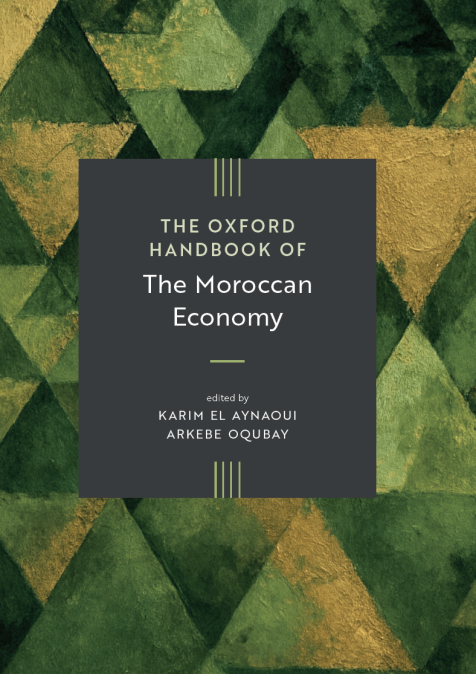
The Oxford Handbook of the Moroccan Economy
Authors
Edited by Karim El Aynaoui
Arkebe Oqubay
April 1, 2026

The Oxford Handbook of the Moroccan Economy provides a comprehensive and analytically grounded assessment of Morocco’s economic trajectory from 1960 to 2025. Bringing together 53 contributors across 34 chapters, the volume is conceived as a reference work, offering a structured analytical approach grounded in stylized facts, long-term trends, sectoral transformations, and the key public policy challenges shaping the country’s development path. It renews the stock of knowledge on the Moroccan economy by delivering a rigorous, structured, and accessible body of analysis.

Rather than focusing solely on macroeconomic aggregates or measurable social progress, the Handbook examines the deeper drivers of structural transformation, including productivity dynamics, diversification of the productive system, employment quality, technological capabilities, and institutional frameworks. It also addresses core dimensions such as industrial policy, research and innovation, private sector development, and integration into global value chains. The volume highlights Morocco’s growing integration into the global economy and the emergence of new industrial sectors, such as automotive and aeronautics, while critically assessing the limits of this transformation, particularly in terms of domestic spillovers, innovation capacity, private investment, and the creation of quality jobs.

A central contribution of the volume lies in identifying a new phase in Morocco’s development trajectory, moving beyond macroeconomic stabilization and external integration toward higher value-added production, stronger technological capabilities, increased investment in human capital, research and innovation, and a broader diffusion of structural change across the economy.

The Handbook emphasizes that economic development is neither linear nor reducible to a single model. It reflects a cumulative and context-specific process shaped by institutional capacity, policy learning, and structural constraints. In this respect, Morocco is analyzed not as a model to replicate, but as a development experience to be examined in its historical and institutional specificity.

The volume adopts a balanced, evidence-based perspective. It is neither a celebratory account nor a normative exercise, but a rigorous analytical account that captures both the progress achieved and the structural constraints that continue to shape Morocco’s economic development.

As such, it constitutes an essential reference for researchers, policymakers, practitioners, and students seeking to understand the Moroccan economy in its historical depth, sectoral complexity, and contemporary challenges.

This is an open access title. It is available to read and download as a free PDF version on Oxford Academic under a Creative Commons Attribution-Non-Commercial-No Derivatives 4.0 International licence.

RELATED CONTENT

  • January 31, 2023
    كثيرا ما ركّزت التعليقات والتحليلات على الأسباب المباشرة وشبه المباشرة والظرفية والدولية ألتي أدت الى موجة التضخم التي يشهدها العالم. في هذه الحلقة من برنامج حديث الثلاثاء، نقترح رؤية اكا ...
  • January 31, 2023
    كثيرا ما ركّزت التعليقات والتحليلات على الأسباب المباشرة وشبه المباشرة والظرفية والدولية ألتي أدت الى موجة التضخم التي يشهدها العالم. في هذه الحلقة من برنامج حديث الثلاثاء، نقترح رؤية اكاديمية وعلمية للمفهوم، مقسّمين الظاهرة الى أجزاء ومكوّنات مختلفة. كما ستركّز هذه الحلقة على المغرب با...
  • December 30, 2022
    Le rôle des Investissements directs étrangers (IDE), comme catalyseur de croissance économique et facteur fondamental d’intégration dans l’économie mondiale, fait l’objet d’un grand consensus. Ce Policy Brief se focalise sur une dimension des IDE qui est le réinvestissement des bénéfices comme, non seulement une source de financement supplémentaire à travers l’expansion des IDE existants, mais également un fort signal des opportunités d’investissement pour les nouveaux i ...
  • Authors
    December 29, 2022
    The current bleak outlook for the world economy, with a likely recession in major economies, high inflation, rising interest rates, and slow productivity growth, will adversely emerging market and developing countries (EMDE) over the next few years. Unfortunately, these countries emerged from COVID-19 with less fiscal space and rising debt service payments. Policies to insulate the domestic economy from these external shocks will present policymakers with difficult choices among exc ...
  • November 24, 2022
    This chapter was originally published in the book "Africa–Europe Cooperation and Digital Transformation", co-edited by Chux Daniels, Benedikt Erfoth, and Chloe Teevan Since the mid-2010s, North African countries have been pursuing what some observers have called a “return to Africa” (Dworkin, 2020). Egypt, Morocco, and Tunisia have attempted to position themselves as major components of Europe- Mediterranean-Africa infrastructure and supply chains corridors (Tanchum, 2020). The thr ...
  • November 22, 2022
      يعتمد مشروع قانون المالية لسنة 2023 أولويات يمكن تلخيصها في أربعة محاور تهم "ترسيخ ركائز الدولة الاجتماعية، وإنعاش الاقتصاد الوطني من خلال دعم الاستثمار، وتكريس العدالة المجالية، واستعادة الهوامش المالية من أجل ضمان استدامة الإصلاحات". ونظرا لأهمية النظام الضريبي في تحقيق الانت...
  • Authors
    October 28, 2022
    Le débat parlementaire sur la loi de Finances va bientôt entamer son cycle annuel. L'examen de la loi de Finances est un temps fort du débat budgétaire. Il est indéniable que la finalité de la représentation nationale est de promouvoir une logique d'efficacité des institutions du Royaume. Le débat déborde naturellement le cadre de travail des commissions et des séances publiques parlementaires pour irradier la presse, les acteurs économiques et sociaux et l'opinion publique. La diff ...
  • Authors
    October 18, 2022
     This publication was originally published in the IEMed Mediterranean Yearbook 2022   The informal sector plays a major role in most MENA economies. It employs a large share of the total population and, on average, accounts for about 22% of GDP. According to the International Labour Organization (ILO), which defines informal employment as the proportion of workers without access to social security, the share of informal employment in total employment in MENA countries ra ...
  • October 18, 2022
    وجدت الحكومة المغربية نفسها بعد عام من بداية عملها أمام مجموعة من التحديات نتيجة سلسلة الأزمات الدولية التي اندلعت خلال السنوات الأخيرة وتداعياتها. فبعد الطموحات والأهداف المعلن عنها في البرنامج الحكومي، علاوة على الأوضاع الدولية تُطرح جملة من الإشكاليات التي تسبّبت في إعادة النظر وفي ت...