Publications /
Book / Report

Back
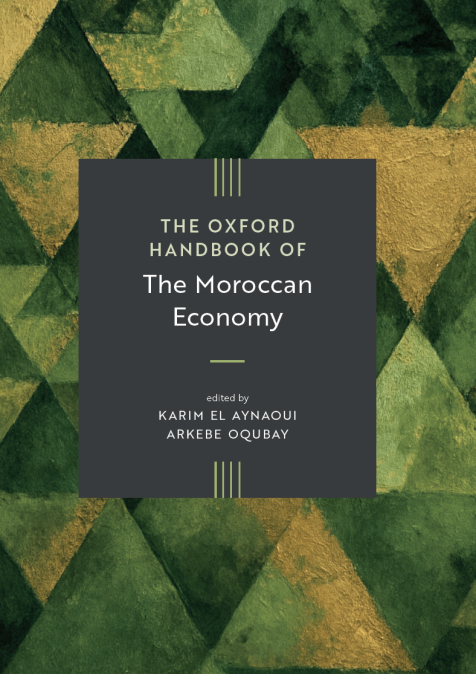
The Oxford Handbook of the Moroccan Economy
Authors
Edited by Karim El Aynaoui
Arkebe Oqubay
April 1, 2026

The Oxford Handbook of the Moroccan Economy provides a comprehensive and analytically grounded assessment of Morocco’s economic trajectory from 1960 to 2025. Bringing together 53 contributors across 34 chapters, the volume is conceived as a reference work, offering a structured analytical approach grounded in stylized facts, long-term trends, sectoral transformations, and the key public policy challenges shaping the country’s development path. It renews the stock of knowledge on the Moroccan economy by delivering a rigorous, structured, and accessible body of analysis.

Rather than focusing solely on macroeconomic aggregates or measurable social progress, the Handbook examines the deeper drivers of structural transformation, including productivity dynamics, diversification of the productive system, employment quality, technological capabilities, and institutional frameworks. It also addresses core dimensions such as industrial policy, research and innovation, private sector development, and integration into global value chains. The volume highlights Morocco’s growing integration into the global economy and the emergence of new industrial sectors, such as automotive and aeronautics, while critically assessing the limits of this transformation, particularly in terms of domestic spillovers, innovation capacity, private investment, and the creation of quality jobs.

A central contribution of the volume lies in identifying a new phase in Morocco’s development trajectory, moving beyond macroeconomic stabilization and external integration toward higher value-added production, stronger technological capabilities, increased investment in human capital, research and innovation, and a broader diffusion of structural change across the economy.

The Handbook emphasizes that economic development is neither linear nor reducible to a single model. It reflects a cumulative and context-specific process shaped by institutional capacity, policy learning, and structural constraints. In this respect, Morocco is analyzed not as a model to replicate, but as a development experience to be examined in its historical and institutional specificity.

The volume adopts a balanced, evidence-based perspective. It is neither a celebratory account nor a normative exercise, but a rigorous analytical account that captures both the progress achieved and the structural constraints that continue to shape Morocco’s economic development.

As such, it constitutes an essential reference for researchers, policymakers, practitioners, and students seeking to understand the Moroccan economy in its historical depth, sectoral complexity, and contemporary challenges.

This is an open access title. It is available to read and download as a free PDF version on Oxford Academic under a Creative Commons Attribution-Non-Commercial-No Derivatives 4.0 International licence.


RELATED CONTENT

  • December 16, 2021
    حدد المغرب أهدافه للتنمية الإقليمية استنادا على مختلف أدوات التدخل كسياسات التنمية القروية وبرامج الهياكل الأساسية والخدمات الاجتماعية، وكذلك برامج التنمية المستدامة والبرامج المتعلقة بأقاليم محددة كالواحات والجبال والمناطق الحدودية. وقد أكد تقرير نموذج التنمية الجديد على ضرورة تعزيز قد...
  • Authors
    Raffaele Della Croce
    Miguel Vazquez
    September 29, 2021
    In order to close the financing gap in green technologies, finding new mechanisms to enhance the participation of the private sector, combined with that of the public sector, in financing sustainable and climate-resilient infrastructure is a must. In this context, some unlisted instruments are going to be needed to enhance financing of green infrastructure. Besides, the development of properly structured projects, with risks and returns in line with the preferences of the different ...
  • August 24, 2021
    تجدون أقوى لحظات حديث الثلاثاء حول المواضيع الاقتصادية لهذه السنة : رؤى استشرافية لما بعد الجائحة، الاقتصاد غير المهيكل، دور القطاع الثالث، المغرب وسلاسل القيمة الاقليمية مع خبراء وباحثين اقتصادين ...
  • Authors
    Chami Abdelilah
    Derj Atar
    Hammi Ibtissem
    Morazzo Mariano
    Naciri Yassine
    with the technical support of AFRY
    July 29, 2021
    As decarbonization is a long-term process and requires significant investments, specific financial and non- financial measures will need to be implemented, both in the short and long term, to facilitate this transition. In Part II of Morocco’s decarbonization pathway Policy Brief series, an update of the decarbonization scenarios was presented. It revealed that the Increased Ambition and Green Development scenarios achieve higher decarbonization targets than current policy. It showe ...
  • Authors
    Chami Abdelilah
    Derj Atar
    Hammi Ibtissem
    Morazzo Mariano
    Naciri Yassine
    with the technical support of AFRY
    July 23, 2021
    La décarbonisation est un processus à long terme qui nécessite des investissements importants. Ainsi, des mesures financières et non financières spécifiques devront être mises en œuvre, à la fois à court et à long termes, pour faciliter cette transition. Dans la deuxième partie de la série de Policy Briefs sur la trajectoire de décarbonisation du Maroc, une mise à jour des scénarios de décarbonisation a été présentée. Elle révèle que les scénarios « Ambition accélérée » et « Dévelop ...
  • Authors
    Chami Abdelilah
    Derj Atar
    Hammi Ibtissem
    Morazzo Mariano
    Naciri Yassine
    with the technical support of AFRY
    July 19, 2021
    Morocco's significant renewable energy resources offer an unprecedented opportunity to anchor the country’s economic and political choices in the energy transition, and to turn the transition into an essential lever for economic development. This is all the more relevant as the costs of renewable energies have dropped over the past 10 years2, and now offer strong potential, not only for creating green jobs but for ensuring a dynamic and resilient economic growth as well. In 2020, ne ...
  • Authors
    Chami Abdelilah
    Derj Atar
    Hammi Ibtissem
    Morazzo Mariano
    Naciri Yassine
    with the technical support of AFRY
    July 9, 2021
    Les importantes ressources en énergies renouvelables du Maroc offrent une opportunité sans précédent d’ancrer les choix économiques et politiques du pays dans la transition énergétique, et de faire de cette transition un levier essentiel du développement économique. Ceci est d’autant plus important que le coût des énergies renouvelables a baissé au cours des 10 dernières années2 et présente désormais un fort potentiel, non seulement de création d’emplois verts mais aussi de croissan ...
  • Authors
    Chami Abdelilah
    Derj Atar
    Hammi Ibtissem
    Morazzo Mariano
    Naciri Yassine
    with the technical support of AFRY
    July 9, 2021
    Les conséquences du changement climatique sont de plus en plus visibles au Maroc. Le schéma changeant des précipitations et de la sécheresse, l'augmentation des températures moyennes et des canicules, les inondations et l'augmentation du niveau de la mer affectent de plus en plus de nombreuses régions. Et pourtant, le taux d'émission de gaz à effet de serre (GES) du Maroc est relativement faible, comparé à celui d'autres pays. En 20162, les émissions totales de GES du Maroc ont atte ...