Publications /
Book / Report

Back
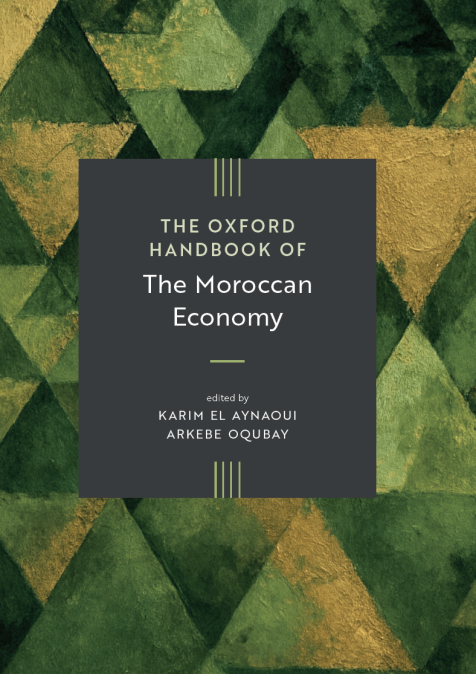
The Oxford Handbook of the Moroccan Economy
Authors
Edited by Karim El Aynaoui
Arkebe Oqubay
April 1, 2026

The Oxford Handbook of the Moroccan Economy provides a comprehensive and analytically grounded assessment of Morocco’s economic trajectory from 1960 to 2025. Bringing together 53 contributors across 34 chapters, the volume is conceived as a reference work, offering a structured analytical approach grounded in stylized facts, long-term trends, sectoral transformations, and the key public policy challenges shaping the country’s development path. It renews the stock of knowledge on the Moroccan economy by delivering a rigorous, structured, and accessible body of analysis.

Rather than focusing solely on macroeconomic aggregates or measurable social progress, the Handbook examines the deeper drivers of structural transformation, including productivity dynamics, diversification of the productive system, employment quality, technological capabilities, and institutional frameworks. It also addresses core dimensions such as industrial policy, research and innovation, private sector development, and integration into global value chains. The volume highlights Morocco’s growing integration into the global economy and the emergence of new industrial sectors, such as automotive and aeronautics, while critically assessing the limits of this transformation, particularly in terms of domestic spillovers, innovation capacity, private investment, and the creation of quality jobs.

A central contribution of the volume lies in identifying a new phase in Morocco’s development trajectory, moving beyond macroeconomic stabilization and external integration toward higher value-added production, stronger technological capabilities, increased investment in human capital, research and innovation, and a broader diffusion of structural change across the economy.

The Handbook emphasizes that economic development is neither linear nor reducible to a single model. It reflects a cumulative and context-specific process shaped by institutional capacity, policy learning, and structural constraints. In this respect, Morocco is analyzed not as a model to replicate, but as a development experience to be examined in its historical and institutional specificity.

The volume adopts a balanced, evidence-based perspective. It is neither a celebratory account nor a normative exercise, but a rigorous analytical account that captures both the progress achieved and the structural constraints that continue to shape Morocco’s economic development.

As such, it constitutes an essential reference for researchers, policymakers, practitioners, and students seeking to understand the Moroccan economy in its historical depth, sectoral complexity, and contemporary challenges.

This is an open access title. It is available to read and download as a free PDF version on Oxford Academic under a Creative Commons Attribution-Non-Commercial-No Derivatives 4.0 International licence.

RELATED CONTENT

  • Authors
    Chami Abdelilah
    Derj Atar
    Hammi Ibtissem
    Morazzo Mariano
    Naciri Yassine
    with the technical support of AFRY
    July 9, 2021
    The consequences of climate change are becoming progressively more visible in Morocco. Changes in rainfall patterns and drought, increases in average temperatures and heatwaves, flooding, and rising sea levels are increasingly affecting several regions. Yet, Morocco has a relatively low greenhouse gas (GHG) emission rate, compared to other countries. In 20162, Morocco’s total GHG emissions reached 86127.7 gigagram of carbon dioxide equivalent (Gg CO2-eq), totaling around 0.2% of glo ...
  • Authors
    Chami Abdelilah
    Derj Atar
    Hammi Ibtissem
    Morazzo Mariano
    Naciri Yassine
    with the technical support of AFRY
    June 28, 2021
    During the 2015 Paris Conference of the Parties to the United Nations Framework Convention on Climate Change (UNFCCC), governments pledged to limit the global temperature increase to well below 2°C above pre- industrial levels, to peak emissions as soon as possible, and to achieve carbon neutrality in the second half of the century. Yet, even assuming full implementation of the commitments made by governments in Paris, the global concentration of greenhouse-gas (GHG) emissions will ...
  • Authors
    Chami Abdelilah
    Derj Atar
    Hammi Ibtissem
    Morazzo Mariano
    Naciri Yassine
    with the technical support of AFRY
    June 28, 2021
    Lors de la Conférence des Parties à la Convention-cadre des Nations unies sur les changements climatiques (CCNUCC) qui s'est tenue à Paris en 2015, les gouvernements se sont engagés à limiter l'augmentation de la température mondiale à un niveau bien inférieur à 2°C par rapport aux niveaux préindustriels. Ils se sont également engagés à atteindre, dès que possible, un pic de leurs émissions et à parvenir à la neutralité carbone au cours de la seconde moitié du siècle. Pour autant, m ...
  • June 15, 2021
    يخصص مركز السياسات من أجل الجنوب الجديد حلقة خاصة من برنامجه الأسبوعي "حديث الثلاثاء" لقراءة وتأمل بعض دعامات تقرير اللجنة الخاصة بالنموذج التنموي الجديد الذي يحمل تشخيصاً للأوضاع الاقتصادية والاجتماعية والسياسية بالمغرب، ويقدّم رؤية عن التوجهات، التي ينبغي أن تسير عليها البلاد في أفق 2...
  • May 31, 2021
    La Diaspora marocaine, qui compte aujourd’hui près de 5 millions de ressortissants à l’étranger, contribue de manière significative au développement économique du Maroc.  Leurs transferts de fonds jouent un rôle crucial dans la réduction de la pauvreté, surtout en milieu rural.  Ils permettent également d’améliorer l’accès à l'éducation et à la santé. Les transferts des Marocains du monde qui, généralement, occupaient le deuxième poste de recettes dans la balance des paiem ...
  • May 20, 2021
    The Policy Brief ‘Pandemic, Preparedness, Morocco, and Africa’ by Uri Dadush provoked a personal reaction: Morocco may never be crowned football’s world champions, alas, but which nation, besides China, New Zealand, Israel, Japan, Denmark, Vietnam, organized its anti-COVID-19 offensive more digitally and in a more modern way than the Kingdom? Morocco’s bureaucracy is at times suffocating and unpleasant, its public hospital system stressed and underfunded. But today I can v ...
  • April 26, 2021
    La Tunisie a fêté récemment le 10ème anniversaire de la révolution qui a mis fin à l’ancien régime bénalien et défini les principes de la IIème République. Ayant pour principales doléances la croissance économique et la justice sociale, la révolution tunisienne était exclusivement sociale. Or, l’appropriation de la révolution par l’Assemblée nationale constituante (ANC) et le quartet du dialogue national qui ont privilégié le chantier des réformes démocratiques au détriment des réfo ...
  • Authors
    Attioui Abdelali
    Billaudot Bernard
    Chafiq Adnane
    December 30, 2020
    Le présent rapport a pour objet d’analyser les implications sur la croissance et le développement du Maroc de son insertion dans l’économie mondiale. Cette analyse est menée en comparant la dynamique économique observée après 1998 à celle qui l’a été avant. En effet, la période 1998-2018 est celle au cours de laquelle se sont manifestés les effets du choix acté et assumé politiquement de l’ouverture (ou du libre-échange, si on préfère). Pour avant, nous nous en tenons à la période 1 ...
  • December 16, 2020
    The COVID-19 pandemic has hit the Moroccan economy hard, as elsewhere in the world. A collapse in external demand and a lockdown lasting more than three months have profoundly altered economic activity in Morocco, causing its first recession since 1995. The implementation of the confinement and social distancing measures was strict and came two weeks after the detection of the first cases of COVID-19 in Morocco on March 2, 2020. The lockdown was extended three times and lasted aroun ...
  • Authors
    December 14, 2020
    L’économie marocaine fait face à une année 2020 extrêmement difficile et complexe. La crise provoquée par le choc de la Covid-19 est singulière, multicanale et fondamentalement différente des crises précédentes. Elle altère le système productif par un double choc d’offre et de demande, amplifié, de passage, par une crise de confiance. Alors que l’année 2020 touche à sa fin, il est crucial de dresser une première évaluation circonstanciée des ramifications de cette crise, qui permett ...