Publications /
Policy Paper

Back
MOROCCO AS A CONNECTOR STATE: A Winning Strategy in a Fragmented World
July 3, 2026

Morocco offers a compelling example of how a middle-income economy can navigate a more fragmented global environment, characterized by weak growth and slower convergence. Since 2022, economic activity has remained relatively strong, with growth exceeding that of many comparable economies. Non-agricultural growth has averaged 4.4% since 2022, around 1.3 percentage points above its historical average, and has accelerated to 4.8% since 2024. This performance has allowed Morocco to gradually recover from output losses incurred during the pandemic. 

The recovery has been mainly driven by capital accumulation, supported by a strong public investment effort and an investment rate expected to remain close to 30% of GDP. Yet this pattern also raises a familiar issue: investment-led growth can generate limited domestic spillovers when it relies heavily on imports. This weakens its impact on local production and puts pressure on the external balance. Consequently, net exports have continued to weigh on growth despite the solid performance of export-oriented sectors. At the same time, the external environment has also opened new opportunities. The reconfiguration of global value chains has increased Morocco’s attractiveness for foreign direct investment, particularly from China. In parallel, resilient remittances from Moroccans living abroad and more favorable terms of trade have supported income and domestic demand. 

The key concern now lies in the sustainability of this trajectory. Maintaining the current pace will require Morocco to convert the public investment impulse into stronger private investment and productivity gains, to support a structural transformation that remains incomplete. This transformation will also need to be reconsidered considering the demonstrated potential of certain tradable service activities, whose role could complement traditional manufacturing drivers. Otherwise, the current recovery may remain a phase of sustained growth, but without a sufficiently durable anchor.
RELATED CONTENT

  • July 3, 2026
    Morocco offers a compelling example of how a middle-income economy can navigate a more fragmented global environment, characterized by weak growth and slower convergence. Since 2022, economic activity has remained relatively strong, with growth exceeding that of many comparable economies. Non-agricultural growth has averaged 4.4% since 2022, around 1.3 percentage points above its historical average, and has accelerated to 4.8% since 2024. This performance has allowed Morocco to grad ...
  • Authors
    June 12, 2026
    This essay argues that the current debate about the future of the international monetary system is not really about Gulf currencies, oil pricing, or de-dollarization in the narrow technical sense. It is about something deeper and more important: whether institutional trust can survive when geopolitical certainty is eroding.The Gulf monarchies—Saudi Arabia, the United Arab Emirates, Qatar, Kuwait, Bahrain, and Oman—increasingly exist in a world where the United States no longer looks ...
  • June 5, 2026
    Driven by its mission to reflect on and analyze the major geopolitical, economic, and societal transformations shaping the contemporary world, and with a view to contributing to knowledge-sharing and disseminating the main outcomes of its research program, the Policy Center for the New South regularly publishes collective volumes addressing issues of particular importance to Morocco, Africa, and the broader Global/New South. In this spirit, the Center has recently released two volum ...
  • Authors
    Liel Maghen
    May 11, 2026
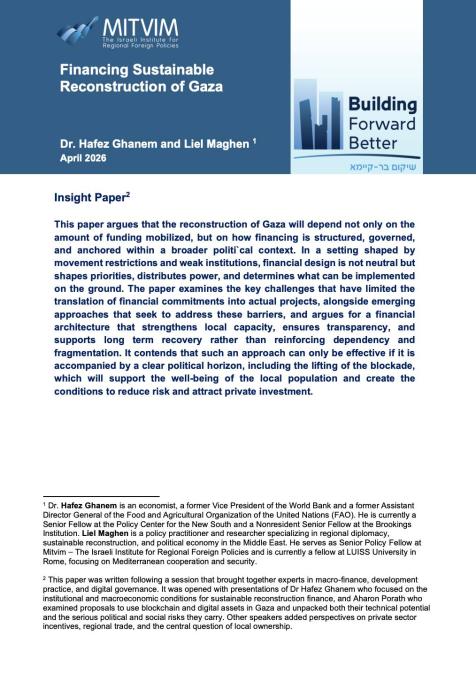
    This Paper was originally published on mitvim.org.il This paper argues that the reconstruction of Gaza will depend not only on the amount of funding mobilized, but on how financing is structured, governed, and anchored within a broader politi`cal context. In a setting shaped by movement restrictions and weak institutions, financial design is not neutral but shapes priorities, distributes power, and determines what can be implemented on the ground. The paper examines the key cha ...
  • Authors
    April 1, 2026
    We are now in the fifth week since the U.S. airstrike that killed top leaders of the Iranian regime, initiating a war involving the United States and Israel against the country. More than a month of mutual bombardments between Iran and Israel has ensued, extending to other Persian Gulf nations, U.S. military installations—and even Cyprus. From a global perspective, the impact has stemmed primarily from disruptions to regional production of goods and the blockade of the Strait of Hor ...
  • Authors
    March 13, 2026
    While acknowledging the centrality of security tensions and potential conflict in the Gulf, this essay intentionally sets aside a detailed treatment of military and hard-power dynamics, concentrating instead on the geoeconomic logics of capital, infrastructure, energy, and connectivity, through which Gulf states now articulate power in a fragmented world order.It examines the emergence of a new tripartite or three-pillar power configuration in the Gulf, arguing that Saudi Arabi ...
  • Authors
    February 13, 2026
    On January 27, 2026, the Spanish government adopted a Royal Decree for the extraordinary regularization of persons in an irregular administrative situation or involved in an international protection procedure. The choice of a royal decree allows for the rapid implementation of the measure, without the need for parliamentary debate, in a political context that is highly polarized on migration issues.Regularization applies to people who can prove their presence on Spanish territory be ...
  • Authors
    February 13, 2026
    Le 27 janvier 2026, le gouvernement espagnol a adopté par décret royal une mesure de régularisation extraordinaire visant les personnes en situation administrative irrégulière ou engagées dans une procédure de protection internationale. Le choix du décret royal permet une mise en œuvre rapide de la mesure, sans passage par un débat parlementaire, dans un contexte politique fortement polarisé sur les questions migratoires.La régularisation concerne les personnes pouvant justifier d’u ...
  • Authors
    November 28, 2025
    The adoption of United Nations Security Council Resolution 2803 on November 17, 2025, endorsing the “Comprehensive Plan to End the Gaza Conflict,” is a step in the right direction, but it must be accompanied by the implementation of a Gaza development and post-conflict reconstruction program. Paragraph 6 of Resolution 2803 “calls upon the World Bank and other financial institutions to facilitate and provide financial resources to support the reconstruction and development of Ga ...
  • Authors
    October 28, 2025
    Now that a cease-fire is in place, it is time to consider Gaza’s reconstruction. This will be the fifth such effort in less than twenty years. Lessons from the previous four indicate that rebuilding houses, bridges, and roads is relatively straightforward. Far more challenging is building a thriving Gazan economy and society—one where young people live with dignity, have jobs, feel heard and included in their communities, and are hopeful about their future. Achieving this requires n ...