Publications /
Policy Paper
This Policy Paper has also been published in French and Spanish by Le Grand Continent
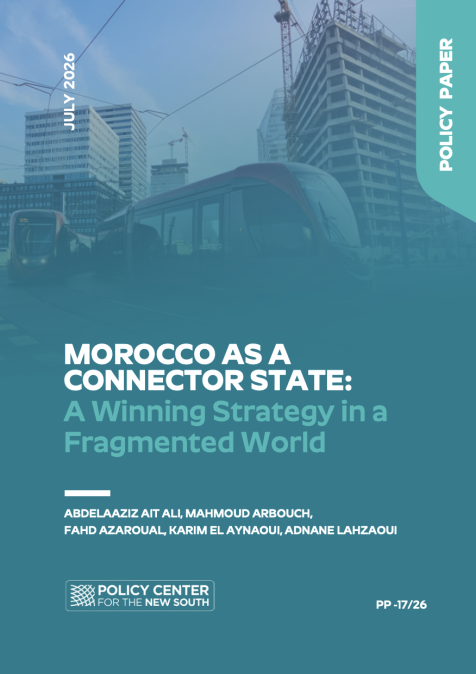
Morocco offers a compelling example of how a middle-income economy can navigate a more fragmented global environment, characterized by weak growth and slower convergence. Since 2022, economic activity has remained relatively strong, with growth exceeding that of many comparable economies. Non-agricultural growth has averaged 4.4% since 2022, around 1.3 percentage points above its historical average, and has accelerated to 4.8% since 2024. This performance has allowed Morocco to gradually recover from output losses incurred during the pandemic.
The recovery has been mainly driven by capital accumulation, supported by a strong public investment effort and an investment rate expected to remain close to 30% of GDP. Yet this pattern also raises a familiar issue: investment-led growth can generate limited domestic spillovers when it relies heavily on imports. This weakens its impact on local production and puts pressure on the external balance. Consequently, net exports have continued to weigh on growth despite the solid performance of export-oriented sectors. At the same time, the external environment has also opened new opportunities. The reconfiguration of global value chains has increased Morocco’s attractiveness for foreign direct investment, particularly from China. In parallel, resilient remittances from Moroccans living abroad and more favorable terms of trade have supported income and domestic demand.
The key concern now lies in the sustainability of this trajectory. Maintaining the current pace will require Morocco to convert the public investment impulse into stronger private investment and productivity gains, to support a structural transformation that remains incomplete. This transformation will also need to be reconsidered considering the demonstrated potential of certain tradable service activities, whose role could complement traditional manufacturing drivers. Otherwise, the current recovery may remain a phase of sustained growth, but without a sufficiently durable anchor.