Publications /
Book / Report

Back
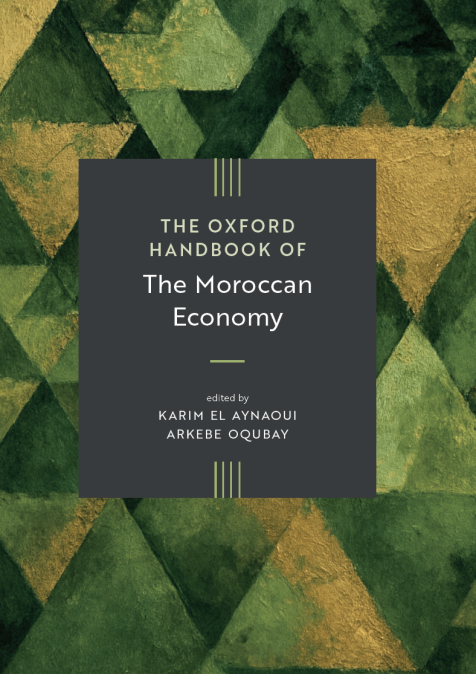
The Oxford Handbook of the Moroccan Economy
Authors
Edited by Karim El Aynaoui
Arkebe Oqubay
April 1, 2026

The Oxford Handbook of the Moroccan Economy provides a comprehensive and analytically grounded assessment of Morocco’s economic trajectory from 1960 to 2025. Bringing together 53 contributors across 34 chapters, the volume is conceived as a reference work, offering a structured analytical approach grounded in stylized facts, long-term trends, sectoral transformations, and the key public policy challenges shaping the country’s development path. It renews the stock of knowledge on the Moroccan economy by delivering a rigorous, structured, and accessible body of analysis.

Rather than focusing solely on macroeconomic aggregates or measurable social progress, the Handbook examines the deeper drivers of structural transformation, including productivity dynamics, diversification of the productive system, employment quality, technological capabilities, and institutional frameworks. It also addresses core dimensions such as industrial policy, research and innovation, private sector development, and integration into global value chains. The volume highlights Morocco’s growing integration into the global economy and the emergence of new industrial sectors, such as automotive and aeronautics, while critically assessing the limits of this transformation, particularly in terms of domestic spillovers, innovation capacity, private investment, and the creation of quality jobs.

A central contribution of the volume lies in identifying a new phase in Morocco’s development trajectory, moving beyond macroeconomic stabilization and external integration toward higher value-added production, stronger technological capabilities, increased investment in human capital, research and innovation, and a broader diffusion of structural change across the economy.

The Handbook emphasizes that economic development is neither linear nor reducible to a single model. It reflects a cumulative and context-specific process shaped by institutional capacity, policy learning, and structural constraints. In this respect, Morocco is analyzed not as a model to replicate, but as a development experience to be examined in its historical and institutional specificity.

The volume adopts a balanced, evidence-based perspective. It is neither a celebratory account nor a normative exercise, but a rigorous analytical account that captures both the progress achieved and the structural constraints that continue to shape Morocco’s economic development.

As such, it constitutes an essential reference for researchers, policymakers, practitioners, and students seeking to understand the Moroccan economy in its historical depth, sectoral complexity, and contemporary challenges.

This is an open access title. It is available to read and download as a free PDF version on Oxford Academic under a Creative Commons Attribution-Non-Commercial-No Derivatives 4.0 International licence.

RELATED CONTENT

  • Authors
    Ian Lesser
    November 18, 2013
    This policy brief argues for a closer relationship between Morocco and the United States. Morocco’s geo-economic position is evolving in ways that will shape U.S. and international interests in the country and open new avenues for cooperation. Key drivers of change in this context include Morocco’s stake in greater economic integration in the Maghreb, a growing role in Africa, new energy and infrastructure projects, and the emergence of Morocco as a hub for communications around th ...
  • Authors
    Mihoub Mezouaghi
    November 1, 2013
    Le discours sur la « colocalisation » est chargé de bonnes intentions à l’attention des pays du sud de la Méditerranée qui, depuis quelques années, réclament avec insistance une contrepartie à l’accès à leur marché (notamment en matière de transfert de technologie pour permettre d’accélérer leur industrialisation). La « colocalisation » est alors présentée comme une « forme avancée de la délocalisation ». Mais, ce discours s’adresse en même temps à l’opinion publique française lorsq ...
  • Authors
    Françoise Nicolas
    January 1, 2011
    La montée en puissance de la Chine et de l’Inde domine les débats économiques depuis quelques années déjà. Poursuivant une stratégie d’internationalisation résolue, les entreprises chinoises et indiennes sont désormais présentes dans bon nombre de régions du globe. Ce dynamisme n’a pas manqué de susciter des inquiétudes mais aussi des espoirs, notamment dans le monde en développement, où ces deux pays sont perçus comme des partenaires potentiellement plus bienveillants que les pays ...
  • Authors
    Kassim Bouhou
    September 17, 2010
    Before the 9/11 events, US-Maghreb relations were growing stronger, especially after the United States had long left the floor to the Maghreb’s “natural” European partner. Therefore the American action in this region was in line with a mechanism previously set off by Clinton Administration member, Stuart Eizenstat, which aimed at reducing intra regional obstacles and stimulating American investments towards an area where Americans were little-represented. Hence Washington seemed mor ...
  • Authors
    Flore Gubert
    September 1, 2010
    The potential synergy between development and migration has become a key feature of most international migration politics. However, this relationship is far from evident. Flore Gubert helps better understand the complexity of this relationship through the comparison of two regional contexts (Mexico and North Africa), and shows how the political and economic context prevailing in the countries of origin modifies the link between migration and development. This Note de l'Ifri is the ...
  • From

    14
    2:00 pm February 2022
    Aomar Ibourk, Senior Fellow au Policy Center for the New South, interviendra lors d’une table ronde dans le cadre d’un webinaire de présentation du rapport « Paysage de l’emploi au Maroc » organisé par la Banque mondiale et le Haut-Commissariat au Plan. L’objectif du webinaire sera de présenter les résultats clés du rapport « Paysage de l’emploi au Maroc » par le Haut-Commissariat au Plan et par la Banque mondiale, suivi par une discussion sur les principaux faits saillants du rapport et la présentation des points de vue des différents panélistes sur le marché du travail marocain et les perspectives de l’emploi au Maroc. A l’issue de ces présentations, une table ronde de discussion autour du rapport sera animée. Cet évènement aura lieu le Lundi 14 Février 2022 à 14 :0 ...