Publications /
Book / Report

Back
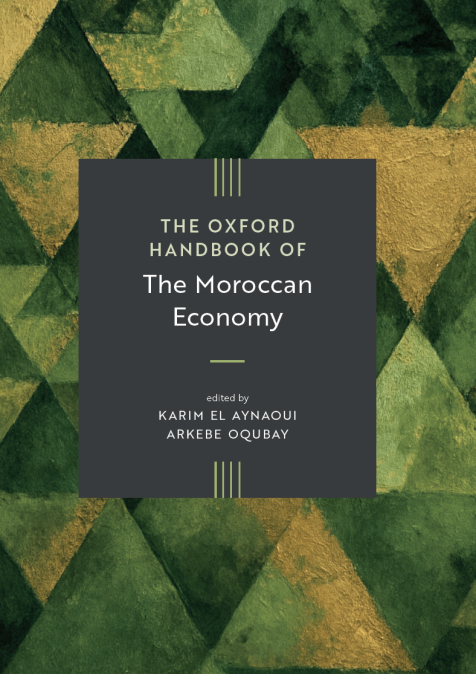
The Oxford Handbook of the Moroccan Economy
Authors
Edited by Karim El Aynaoui
Arkebe Oqubay
April 1, 2026

The Oxford Handbook of the Moroccan Economy provides a comprehensive and analytically grounded assessment of Morocco’s economic trajectory from 1960 to 2025. Bringing together 53 contributors across 34 chapters, the volume is conceived as a reference work, offering a structured analytical approach grounded in stylized facts, long-term trends, sectoral transformations, and the key public policy challenges shaping the country’s development path. It renews the stock of knowledge on the Moroccan economy by delivering a rigorous, structured, and accessible body of analysis.

Rather than focusing solely on macroeconomic aggregates or measurable social progress, the Handbook examines the deeper drivers of structural transformation, including productivity dynamics, diversification of the productive system, employment quality, technological capabilities, and institutional frameworks. It also addresses core dimensions such as industrial policy, research and innovation, private sector development, and integration into global value chains. The volume highlights Morocco’s growing integration into the global economy and the emergence of new industrial sectors, such as automotive and aeronautics, while critically assessing the limits of this transformation, particularly in terms of domestic spillovers, innovation capacity, private investment, and the creation of quality jobs.

A central contribution of the volume lies in identifying a new phase in Morocco’s development trajectory, moving beyond macroeconomic stabilization and external integration toward higher value-added production, stronger technological capabilities, increased investment in human capital, research and innovation, and a broader diffusion of structural change across the economy.

The Handbook emphasizes that economic development is neither linear nor reducible to a single model. It reflects a cumulative and context-specific process shaped by institutional capacity, policy learning, and structural constraints. In this respect, Morocco is analyzed not as a model to replicate, but as a development experience to be examined in its historical and institutional specificity.

The volume adopts a balanced, evidence-based perspective. It is neither a celebratory account nor a normative exercise, but a rigorous analytical account that captures both the progress achieved and the structural constraints that continue to shape Morocco’s economic development.

As such, it constitutes an essential reference for researchers, policymakers, practitioners, and students seeking to understand the Moroccan economy in its historical depth, sectoral complexity, and contemporary challenges.

This is an open access title. It is available to read and download as a free PDF version on Oxford Academic under a Creative Commons Attribution-Non-Commercial-No Derivatives 4.0 International licence.

RELATED CONTENT

  • Authors
    October 27, 2015
    International trade has become a pervasive feature of our lives, yet it remains controversial and resisted across the world. High and rising income inequality, which is often blamed on international trade, especially trade with China, is one reason. But the main driver of inequality is new technology, not international trade. Although trade interacts with new technology in ways that often lead to higher inequality, trade and technology also lie at the root of economic advance. So th ...
  • Authors
    October 2, 2015
    Récemment parue parmi la série de Policy Briefs publiés par OCP Policy Center, une étude réalisée conjointement par Prakash Loungani et Saurabh Mishra a mis l’accent sur la réaction du chômage et l’emploi par rapport à la croissance économique dans les pays du G-20. L’objectif est de quantifier l’apport d’un point supplémentaire de croissance sur l’évolution du taux d’emploi, et sur le taux du chômage sur la période 1980-2014.  Sur la période 1980-2007, les ...
  • Authors
    April 30, 2015
    Pour une économie ouverte, l’analyse des échanges internationaux recèle une importance capitale pour analyser ses perspectives de croissance. Bien des décisions individuelles portant sur la consommation, l’épargne et l’investissement sont, en effet, liées aux termes de l’échange. L’évolution de ces derniers, définis comme le rapport entre les prix à l’exportation et ceux à l’importation, est considérée comme un indicateur du pouvoir d’achat d’un pays et constitue une variable fort ...
  • Authors
    March 25, 2015
    The strategy to vertically integrate mining producers requires the identification of the right conditions for its financing. Many approaches are possible and the technique of securitization, although widely stigmatized since the financial crisis of 2008, must be considered. Several conditions are however necessary. It is unlikely that the off-balance sheet securitization is currently positioned as an important means to finance this sector’s production capacity. Whatever the scope of ...
  • Authors
    Pierre-Richard Agénor
    February 18, 2015
    Cet article propose, dans un premier temps, une revue de la littérature analytique et empirique récente sur les gains et coûts potentiels associés à l’intégration financière internationale, ainsi que les enjeux de politique économique créés ou exacerbés par cette intégration. En particulier, l’analyse fait ressortir le fait que, pour un pays en développement, les gains associés à cette intégration se matérialisent surtout sur le long terme, tandis que les coûts (liés notamment aux r ...
  • January 26, 2015
    OCP Policy Center vient de rendre public le 10 janvier son premier Policy Brief de l’année 2015, qui traite de la question de la baisse significative des prix des produits pétroliers, ses causes, et ses conséquences macroéconomiques pour les producteurs et les consommateurs de ce produit.  Yves Jégourel, Senior Fellow à OCP Policy Center et auteur du Policy Brief en question, a accumulé une expertise dans le domaine de l’analyse des marchés des matières premières. Il ...
  • Authors
    Pierre-Richard Agénor
    January 24, 2015
    The Moroccan economy is currently facing the risk of becoming caught between the rapid-growing low-income countries with abundant and cheap labor, and middle-income countries that are able to innovate quickly. In addition, China’s massive investments in Sub-Saharan Africa have accelerated the participation of some countries in the region in a new international division of labor, especially in low-skill-intensive light manufacturing. In parallel, through the structure of its trade a ...