Publications /
Book / Report
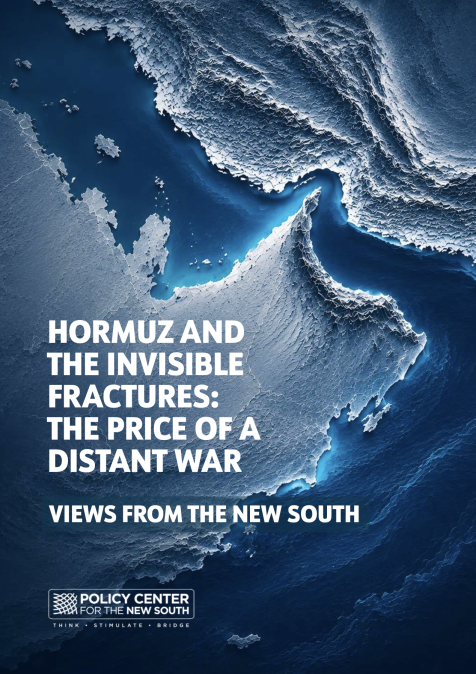
Driven by its mission to reflect on and analyze the major geopolitical, economic, and societal transformations shaping the contemporary world, and with a view to contributing to knowledge-sharing and disseminating the main outcomes of its research program, the Policy Center for the New South regularly publishes collective volumes addressing issues of particular importance to Morocco, Africa, and the broader Global/New South. In this spirit, the Center has recently released two volumes entitled “The 2022 EU–AU Summit: Towards a Renewed Partnership” and “The State Through the Lens of COVID-19”. Today, the Center presents a new contribution examining the impact of the conflict between the United States, Iran and Israel on different regions of the world, with a particular focus on Morocco and Africa.
This conflict, together with the tensions surrounding the Strait of Hormuz, represents far more than a regional crisis: it reveals a profound transformation of the international order, energy security, and global economic interdependence. The contributions gathered in this volume seek to apprehend the consequences of these overlapping conflicts from different angles, geographical perspectives, and intellectual sensibilities. They collectively demonstrate that the Strait of Hormuz—through which a vital share of the world’s oil, gas, fertilizers, maritime trade, and strategic infrastructure flows—has become a symbol of a vulnerable globalization in which the capacity to disrupt global flows now matters as much as conventional military power.
At the global level, several contributions underline the systemic nature of the crisis and its implications for the evolving international order. in “Dire Strait of Hormuz: A Chokepoint for Global Food and Energy,” Otaviano Canuto argues that the Middle East conflict and disruptions in the Strait of Hormuz have produced a major global economic shock extending far beyond oil markets. The crisis affects food supplies, industrial inputs, and global supply chains, while intensifying inflationary pressures and financial volatility, especially in developing and energy-importing countries. According to the author, a prolonged disruption could lead to stagflation, slower global growth, and major shifts in trade patterns, while also accelerating long-term transformations in energy diversification, trade routes, and geopolitical competition.
Ferid Belhaj, in “The Hormuz Test: Power, Law and the Fragmentation of Trade and Connectivity: A Triple Fracture”, also interprets the 2026 Iran–U.S.–Israel war as a systemic turning point rather than a purely regional conflict. Centered on the militarization of the Strait of Hormuz, the essay highlights the weakening of globalization, alliance solidarity, international law, and traditional deterrence mechanisms. The author argues that the international system is evolving toward fragmented and transactional alliances, where power is increasingly measured not by territorial domination but by the capacity to disrupt strategic networks related to energy, trade, finance, and digital infrastructure.
This transformation of the global order is further explored in Marcus Vinicius De Freitas’s “The US–Israel War Against Iran: China’s Strategic Calculus and Diplomatic Imperatives”. The author contends that the conflict signals the decline of the rules- based international order and the emergence of a fragmented system in which conflicts are managed rather than resolved. China’s response is presented as central to this transition: Beijing adopts a position of “qualified neutrality”, condemning the strikes while maintaining pragmatic relations with all regional actors and avoiding direct military alignment. The study concludes that the global system is increasingly multipolar, fragmented, and governed by flexible coexistence rather than stable rules.
Beyond the global order, the conflict has also deeply affected major geopolitical alliances and strategic balances, particularly within the transatlantic relationship. Addressing “the impact of the war on transatlantic relations”, Ian Lesser argues that the Iran war has significantly strained relations between the United States and Europe by exposing profound disagreements over the use of force, strategic priorities, and global leadership. While both sides recognize the threat posed by Iran, they diverge sharply on the appropriate response: the United States favors military escalation, whereas most European states view such actions as legally questionable and strategically risky. According to the author, the conflict has heightened Europe’s exposure to security and economic vulnerabilities, intensified tensions within NATO, weakened transatlantic trust, and reinforced European doubts regarding U.S. reliability and alliance cohesion.
At the strategic and military level, Abdelhak Bassou’s “Chess vs. Poker: Military and Strategic Lessons from the U.S.–Iran War (February–April 2026)” examines the conflict through the lens of military doctrine and strategic culture. The study highlights the growing gap between tactical military superiority and strategic victory. Despite overwhelming technological and military advantages, the United States failed to secure a decisive political outcome against a weakened but resilient Iran. Tehran’s endurance relied on a “mosaic defense” doctrine, asymmetric cost strategies, decentralized security structures, and ideological resilience. Bassou contrasts Iran’s “chess-like” strategy—based on patience, planning, and strategic depth—with the United States’ “poker-like” approach characterized by uncertainty, bluff, and shifting objectives. The article ultimately demonstrates that in the 21st century, battlefield dominance alone no longer guarantees lasting political or strategic success.
As to the impact of this conflict on Africa, Hafez Ghanem presents a policy discussion on how the Iran conflict may affect Africa’s energy security, emphasizing the central challenge of expanding reliable energy access while strengthening resilience to external shocks such as global supply disruptions and price volatility. He suggests key policy directions likely focused on diversifying energy sources, improving infrastructure and investment capacity, and reinforcing institutional frameworks to manage uncertainty.
According to Hinh T. Dinh, the regional economic repercussions of the crisis are particularly visible in North Africa. In “Oil Shocks and Structural Resilience in North Africa”, the author analyzes the impact of the 2026 oil shock on Morocco, Tunisia, and Egypt using an input-output model. The study shows how a 20% increase in oil prices affects value added and employment across interconnected sectors, revealing hidden vulnerabilities in agriculture, construction, transport, and other downstream industries. The effects vary significantly across countries: Morocco emerges as the most vulnerable economy, Tunisia experiences a near balance between gains and losses despite important internal disparities, while Egypt records net national gains due to state oil revenues, even though the private sector remains under pressure. Overall, the article highlights important structural differences in economic resilience across North African economies.
Further South, in the Sahel region, Rida Lyammouri considers that, despite the geographical distance, the crisis risks further isolating Sahelian states as Western powers redirect their strategic attention toward the Middle East and NATO priorities. This evolving context may compel Sahel countries to diversify their partnerships beyond traditional Western allies in order to address persistent security threats and maintain regional stability.
Finally, the repercussions of the Hormuz crisis extend beyond the Middle East and North Africa to other regions integrated into global commodity and energy networks. In “The Hormuz Shock and South America’s Mineral Reckoning”, Otaviano Canuto and Hugo A. Mansilla explain that the 2026 Strait of Hormuz crisis generated a global energy shock with mixed consequences for South American economies. Higher commodity prices benefited exporters such as Brazil, Chile, Peru, Colombia, and Guyana, but rising costs for imported energy, fertilizers, and industrial inputs also created major economic pressures. The article highlights uneven national vulnerabilities, particularly Brazil’s dependence on imported fertilizers, and warns that temporary export gains may ultimately be offset by stagflation, weaker global demand, and supply-chain disruptions.
More broadly, the study underscores South America’s strategic role in supplying critical minerals necessary for the global energy transition, while emphasizing the need for long-term structural policies capable of transforming short-term commodity booms into sustainable development.
This collective endeavour should be understood as a provisional and immediate intellectual snapshot of an evolving geopolitical moment. Far from constituting a definitive assessment, it reflects an ongoing historical process whose strategic, political, economic, and security implications are likely to unfold over an extended period of time. The dynamics generated by this confrontation are expected to leave enduring marks on the international order, reshaping regional balances of power, altering patterns of alliance formation, and intensifying debates surrounding sovereignty, deterrence, and the legitimacy of military intervention. Beyond the immediate theater of conflict, the consequences are likely to provoke profound transformations in both the domestic and foreign policies of states, compelling governments from the Global north to the Global South to reassess security doctrines, energy strategies, economic dependencies, and diplomatic alignments.
While this volume does not claim to exhaust the key dimensions and implications of the issues addressed, it seeks above all to stimulate reflection and foster informed debate on the policies and strategies required to manage and respond effectively to similar crises in the future.
Mohammed Loulichki Senior Fellow, Policy Center for the New South | Karim El Aynaoui Executive President, Policy Center for the New South |