(FR) Fiscal policy in Morocco

June 12, 2026

Cet épisode revient sur les principaux défis de la politique budgétaire au Maroc, à partir du chapitre consacré au sujet dans le Oxford Handbook of the Moroccan Economy. Les intervenants soulignent le caractère largement structurel des déficits, la difficulté à sortir d’une politique budgétaire procyclique, ainsi que l’étroitesse de l’espace budgétaire face aux grandes réformes sociales et aux investissements à venir. Ils insistent enfin sur la nécessité d’élargir l’assiette fiscale, de mieux mobiliser le potentiel fiscal existant et de renforcer la gouvernance pour préserver la soutenabilité budgétaire à long terme.

Speakers

Idriss El Abbassi
Professor of economics, Mohammed V University
Idriss El Abbassi is a Professor of Economics at Mohammed V University in Rabat and coordinator of the Master’s programme in economics. He holds a PhD from Florida State University, and his research focuses on open-economy macroeconomics, growth, and structural transformation. He teaches at both the Master’s and PhD levels and is a founding member of the Laboratory of Applied Economics. A former director of the EMPRETEC/UNCTAD programme in Morocco, he has also been a visiting professor in London. He co-authored Human Capital and Economic and Social Development in Morocco and has recently published in The Economic and Labour Relations Review and Structural Change and Economic Dynamics. ...
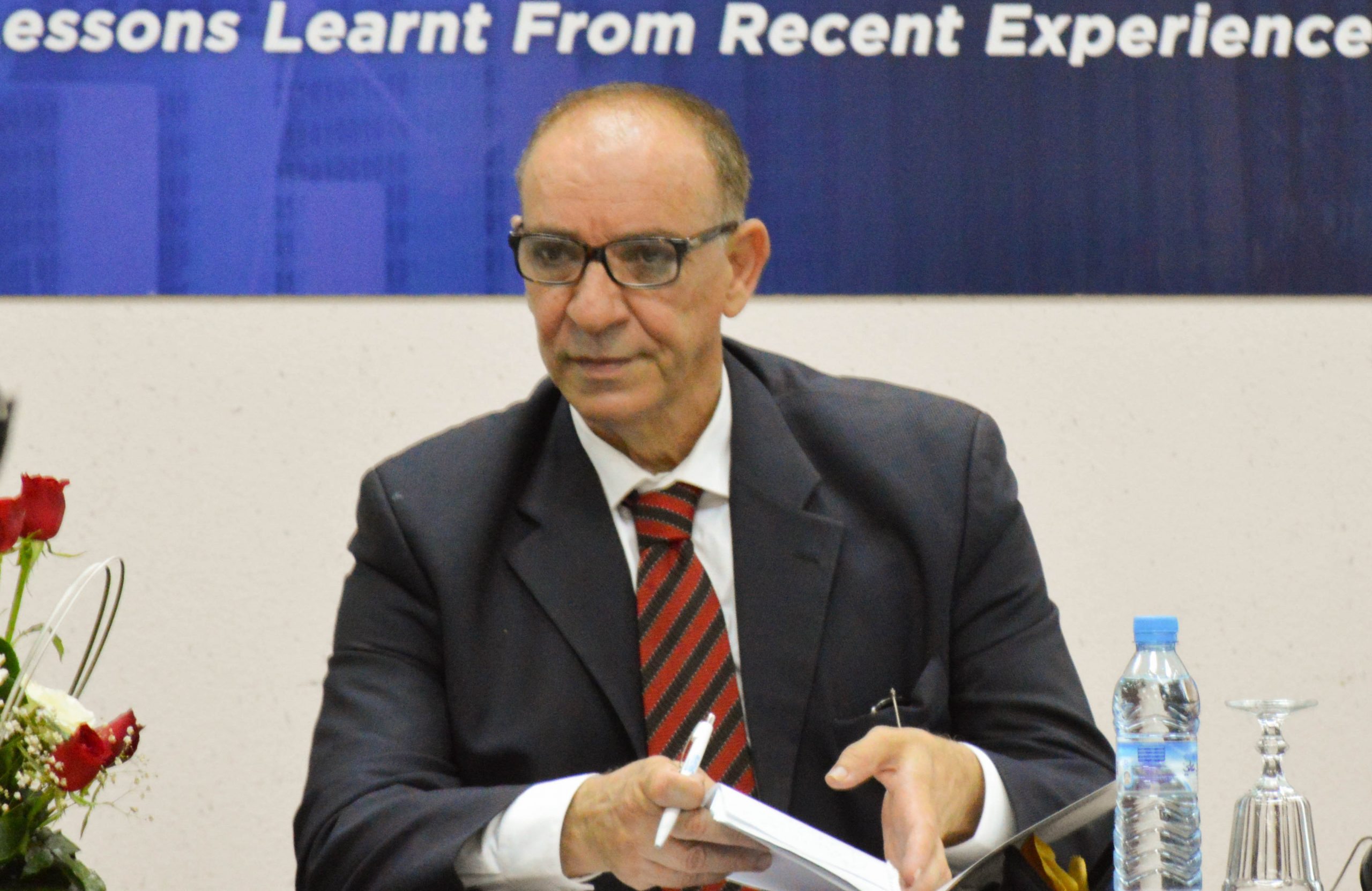
Saïd Tounsi
Professor and Researcher, Mohammed V University
Saïd Tounsi is a Professor and Researcher at Mohammed V University in Rabat. A specialistin economic policies, particularly fiscal policy, he has authored several studies onpublic debt sustainability and exchange rate regimes in developing countries. He has alsoco-edited collective volumes on macroeconomic policies in Morocco. A former trainer atthe IGF and Bank Al-Maghrib, he combines academic expertise with institutional experiencein analysing national and international economic dynamics. ...

RELATED CONTENT

  • Authors
    El Hussein Fouad
    June 17, 2025
    This paper analyses the stabilization experience in the MENA region, focusing on Egypt, Morocco, Tunisia, and Jordan over the past century. It seeks to answer the question: To what extent have these countries succeeded in achieving resilience to shocks and stresses? Key policy elements included significant fiscal adjustments—varying in scale across countries—and exchange rate developments supported by monetary policies aimed at combating inflationary pressures. The outcomes involved ...
  • Authors
    Sérgio R. R. de Queiroz
    Nicholas S. Vonortas
    May 9, 2025
    This paper aims to demonstrate how certain transformations in the international economy since the 1980s¾notably the globalization of firms and industries¾combined with a set of domestic challenges, disrupted the path of industrial and technological development that Brazil had pursued since the 1930s. In essence, growth strategies based on the scale of the domestic market ceased to be effective. The innovation and economic challenges the country now faces cannot be addressed without ...
  • Authors
    Under the supervision of
    July 12, 2024
    The 2024 Annual Report on the African Economy is dedicated to monetary and financial issues on the Continent. There are three reasons for this choice. African economies are exposed to macro-financial instabilities partly generated by global monetary and financial turbulence. The Continent’s currencies and financial systems are engaged in very different dynamics, where routine methods and daring, if not risky, practices coexist. The question of the architecture of the internationa ...
  • February 8, 2024
    Depuis 2016, on assiste à une dynamique de création de fonds souverains africains. En 2023, on recense 21 pays et 24 fonds souverains. Sur la seule période 2016-23, celle de la deuxième vague, huit pays vont se doter d’un premier fonds souverain, et d’un deuxième, dans le cas du Maroc, en 2022. Cette étude rappelle tout d’abord l’historique d’une création qui commence, dès 1994, au Botswana, avec le Pula Fund, précisant pour chacun des 24 fonds leur date de création, leur ...
  • November 22, 2023
    As part of the webinar series: “The Global Economy in Transition : Implications for Developing Countries”, the Policy Center for the New South is organizing a webinar titled: " The Future of Central Banks in Emerging Markets and Developing Countries” to contribute to the ...
  • Authors
    November 21, 2023
    Multiple shocks faced by the global economy over the past three years have apparently shaken the conventional wisdom on gains from economic integration, and have sparked widespread calls for protectionist and nationalist policies. Is there already evidence of some ‘deglobalization’, or do the factors that underlie globalization remain strong enough despite the shocks? So far, there are no signs of an overall reversal in the long-term trend of greater global trade integration. Howev ...
  • Authors
    Ali Elguellab
    Elhadj Ezzahid
    November 1, 2023
    The role of the production network in shock propagation has been an issue of considerable interest since the Great Recession. However, the empirical literature has only focused on advanced and emerging countries. This paper aims to contribute to filling this gap by examining the case of Morocco, a developing country belonging to the lower-middle-income group. The question is whether its production network is a factor in amplifying idiosyncratic industry-level shocks or, conversely, ...
  • Authors
    Xiaofeng Wang
    October 13, 2023
    The surprising victory of Javier Milei, the unconventional ‘anarcho-capitalist’ candidate, in the August primaries ahead of Argentina’s October 2023 general election, can be largely credited to his commitment to dollarize the Argentine economy, a move perceived as the ultimate solution to bring an end to the nation's economic turmoil. The potential shift from the local currency to the dollar has sparked concerns about Argentina's bilateral currency swap line with China. This swap l ...
  • Authors
    Sous la direction de
    September 21, 2023
    Cette édition du Rapport économique de l’Afrique est construite autour d’une thématique d’une grande actualité : les conséquences des incertitudes et des risques aussi bien sanitaires que climatiques et sécuritaires sur les économies du continent. L’exercice est d’autant plus légitime que la recomposition de l’ordre mondial questionne la place du continent à l’échelle planétaire, sur les plans économique, social et environnemental. L’économie mondiale est confrontée à des défis glo ...