(FR) Fiscal policy in Morocco

June 12, 2026

Cet épisode revient sur les principaux défis de la politique budgétaire au Maroc, à partir du chapitre consacré au sujet dans le Oxford Handbook of the Moroccan Economy. Les intervenants soulignent le caractère largement structurel des déficits, la difficulté à sortir d’une politique budgétaire procyclique, ainsi que l’étroitesse de l’espace budgétaire face aux grandes réformes sociales et aux investissements à venir. Ils insistent enfin sur la nécessité d’élargir l’assiette fiscale, de mieux mobiliser le potentiel fiscal existant et de renforcer la gouvernance pour préserver la soutenabilité budgétaire à long terme.

Speakers

Idriss El Abbassi
Professor of economics, Mohammed V University
Idriss El Abbassi is a Professor of Economics at Mohammed V University in Rabat and coordinator of the Master’s programme in economics. He holds a PhD from Florida State University, and his research focuses on open-economy macroeconomics, growth, and structural transformation. He teaches at both the Master’s and PhD levels and is a founding member of the Laboratory of Applied Economics. A former director of the EMPRETEC/UNCTAD programme in Morocco, he has also been a visiting professor in London. He co-authored Human Capital and Economic and Social Development in Morocco and has recently published in The Economic and Labour Relations Review and Structural Change and Economic Dynamics. ...
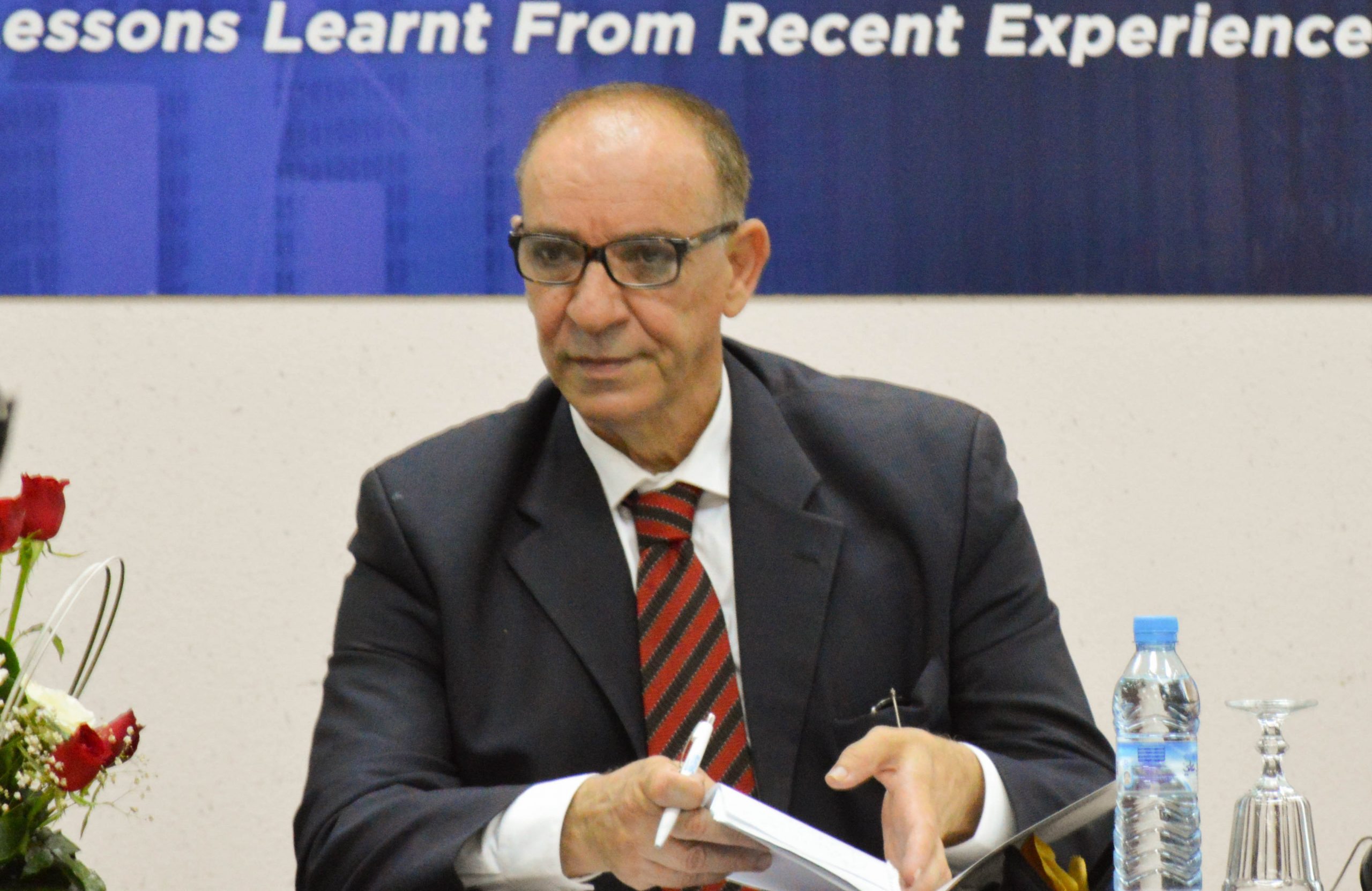
Saïd Tounsi
Professor and Researcher, Mohammed V University
Saïd Tounsi is a Professor and Researcher at Mohammed V University in Rabat. A specialistin economic policies, particularly fiscal policy, he has authored several studies onpublic debt sustainability and exchange rate regimes in developing countries. He has alsoco-edited collective volumes on macroeconomic policies in Morocco. A former trainer atthe IGF and Bank Al-Maghrib, he combines academic expertise with institutional experiencein analysing national and international economic dynamics. ...

RELATED CONTENT

  • May 18, 2023
    Le Policy Center for the New South (PCNS) et le Fonds Monétaire International (FMI) ont organisé, le 28 avril, à Rabat, une table ronde d'experts sur le thème "Fighting Inflation and Building Resilience : the Outlook for MENA and Morocco". Au niveau international, la lutte contre l’inflation constitue la principale préoccupation des politiques économiques dans la majorité des pays. La détection des risques inflationnistes a pris du retard après la crise sanitaire parce que les aut ...
  • Authors
    April 27, 2023
    Recent initiatives and policy moves by China and other countries to extend the reach of use of the renminbi in the international monetary system, while the U.S. dollar share in global reserves has slightly shrunk in relative terms, have sparked frequent discussions about a hypothetical “de-dollarization” of the global economy. We approach here what that would mean in terms of global currency functions as means of payment and store of value. While we point out a relative decline of ...
  • Authors
    April 5, 2023
    The Policy Center for the New South and the Economic Research Forum held on March 20 a workshop titled ‘Stabilization and adjustment towards inclusive and sustainable policies in MENA: The Moroccan case study’. The event took place at the PCNS headquarters in Rabat, Morocco. It brought together renowned Moroccan economists and scholars to discuss the issue of public debt sustainability in the context of the Moroccan economy. It was an occasion to revisit the main features of the Mor ...
  • February 27, 2023
    In this interview recorded during the Atlantic Dialogues, Mr. Helmut Sorge, Columnist at the PCNS interviews Mr. Masood Ahmed, President of the Center for Global Development about his insights on Globalization between yesterday and tomorrow. In fact, although the process of linking coun...
  • Authors
    January 20, 2023
    This paper was originally published as a chapter within the Book, Foreign Exchange Constraint and Developing Economies, published on January 2023 (ISBN  978 1 80088 049 8).   The decade after the global financial crisis (GFC) of 2007–2009 saw signifi- cant changes in the volume and composition of capital flows in the global economy. Portfolio investments and other non-bank financial intermediaries (NBFIs) are behind an increasing share of foreign capital flows, while ban ...
  • Authors
    December 27, 2022
    En Afrique, le niveau de la vulnérabilité économique des pays reste élevé et représente un obstacle à la croissance économique et à la réduction de la pauvreté. Ce constat nous mène à étudier cette problématique pour un échantillon des pays africains les plus exposés aux chocs économiques. En effet, ce travail a pour objectif principal d’identifier les effets des composantes des deux indicateurs de vulnérabilité et de résilience économique sur le niveau de reve ...
  • Authors
    November 22, 2022
    The US dollar has risen dramatically in value against other currencies recently. Three channels through which factors affecting bilateral exchange rates operate have been pulling up the U.S. dollar: yield differentials, liquidity differentials, and growth differentials. The strong appreciation of the US dollar against other currencies recently reinforced the contractionary pressures present in the global economy. Ultimately, the “turn” or “pivot” of the dollar will most likely occur ...
  • November 4, 2022
    Panel 2: Les Communautés Economiques Régionales : Quel apport à la résilience africaine dans un contexte de chocs multidimensionnels ? Modérateur:            Abdelaaziz Aït Ali, Manager – Département d’économie, Pol...