Publications /
Policy Paper
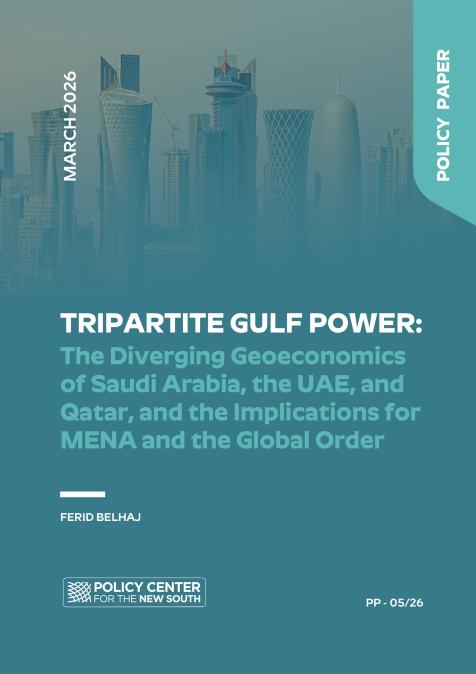
While acknowledging the centrality of security tensions and potential conflict in the Gulf, this essay intentionally sets aside a detailed treatment of military and hard-power dynamics, concentrating instead on the geoeconomic logics of capital, infrastructure, energy, and connectivity, through which Gulf states now articulate power in a fragmented world order.
It examines the emergence of a new tripartite or three-pillar power configuration in the Gulf, arguing that Saudi Arabia, the United Arab Emirates, and Qatar have moved decisively beyond a shared Gulf identity toward competing geoeconomic models of power. Far from being a transient phase of intra-Gulf Cooperation Council discord, this divergence reflects a structural transformation in how these Gulf states conceive their sovereignty, influence, and global relevance in a fragmented, multipolar world.
The paper advances three core claims:
1- Gulf competition is no longer primarily ideological or security-driven, but geoeconomic. It is expressed through infrastructure, ports, corridors, energy contracts, sovereign wealth, and regulatory influence. Saudi Arabia pursues a model of sovereign scale and territorial anchoring, centered on its Vision 2030 strategy, industrial policy, and corridor-building. The UAE advances a platform-state model, leveraging logistics, finance, climate diplomacy, and global intermediation to exercise influence disproportionate to its size. Qatar, by contrast, relies on asymmetric niche power, using dominance in liquified natural gas, long-term contracts, mediation, and media outreach to achieve contractual indispensability, rather than regional primacy.
2- The influence of this Gulf divergence is increasingly being seen across Turkey, South Asia, the Eastern Mediterranean, and Africa. Turkey is a non-Gulf pole with industrial and security capabilities that align closely with Qatar, while constraining Saudi and Emirati ambitions. South Asia differentiates Gulf strategies further: Pakistan functions as a stabilization and security interface where financial leverage is deep but brittle, while India represents a scale, technology, and corridor prize that reinforces competitive interdependence rather than alignment. These arenas transform Gulf rivalry into a multi-pillar power system involving multiple middle powers with agency.
3- Gulf geoeconomics now has global governance consequences. Saudi Arabia positions itself as a voice of the New South in debates on the G20, International Monetary Fund reform, and BRICS+. The UAE reframes climate governance through pragmatic energy-transition leadership. Qatar shapes Europe’s energy transition through long-term LNG lock-in. Together, these strategies illustrate how Gulf states are shifting from rule-takers to selective rule-shapers, influencing global finance, energy security, climate diplomacy, and connectivity without seeking ideological dominance.
The Gulf’s evolving three-way competition represents re-composition rather than disorder. Power is exercised less through military dominance or ideology, than through ports, balance sheets, contracts, and convening authority. For MENA and the Global South, engaging with this new Gulf triad offers opportunities for diversification and leverage, but also introduces new asymmetries and strategic trade-offs in navigating the multipolar century ahead.