Publications /
Policy Paper

Back
Dubai Port World ou le levier diplomatique émirati en Afrique
Authors
September 22, 2021

Face à la concurrence mondiale croissante, les Emirats arabes unis (EAU) ont pu constater le retard enregistré dans le domaine maritime dans les points stratégiques traditionnels au début du 21ème siècle. Pour autant, le pays détient une position importante sur la scène internationale en ce qui concerne le transport maritime. Grâce à la DP World, instrument diplomatique émirati, le lancement d’initiatives permettant au pays de regagner une place et une implantation dans différents pays a été rendu possible au cours de la dernière décennie. A l’instar des grandes puissances, les Emirats se sont tournés vers des territoires offrant de grandes opportunités. C’est justement ce qui explique l’intérêt nouveau et croissant des grandes puissances pour le continent africain, du fait des nombreuses opportunités qu’il renferme. A cet effet, on observe davantage d’opérateurs portuaires diversifiant leurs activités sur le continent en intégrant l’ensemble de la chaîne de valeur de transport et logistique. Il ne s’agit plus seulement de s’implanter dans des ports mais également de doter les pays d’infrastructures adéquates qui leur permettent d’atteindre un développement dans plusieurs domaines.
RELATED CONTENT

  • July 3, 2026
    Ce Policy Paper a également été publiée en anglais et en espagnol par Le Grand Continent Le Maroc offre un exemple éclairant parmi les pays à revenu intermédiaire, dans un contexte marqué par une fragmentation croissante de l’environnement international, une croissance mondiale atone et un ralentissement de la convergence. Depuis 2022, sa trajectoire se distingue par une certaine robustesse, avec un rythme d’expansion supérieur à celui des autres économies de même catégorie. Dé ...
  • July 3, 2026
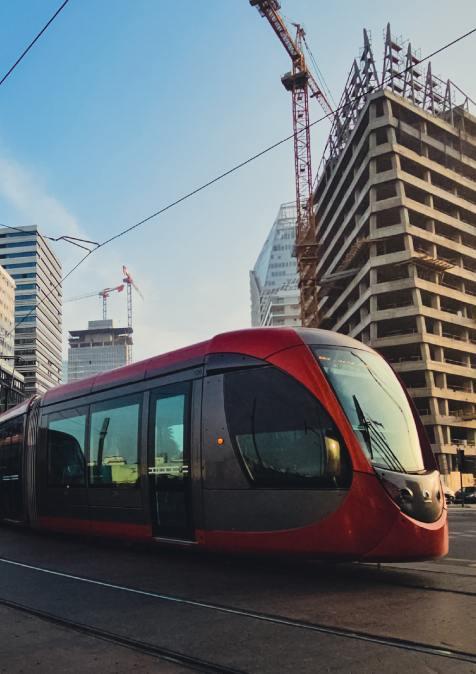
    This Policy Paper has also been published in French and Spanish by Le Grand Continent Morocco offers a compelling example of how a middle-income economy can navigate a more fragmented global environment, characterized by weak growth and slower convergence. Since 2022, economic activity has remained relatively strong, with growth exceeding that of many comparable economies. Non-agricultural growth has averaged 4.4% since 2022, around 1.3 percentage points above its historical av ...
  • July 3, 2026
    Este Policy Paper también ha sido publicado en inglés y francés por Le Grand Continent La economía marroquí constituye un caso ilustrativo entre las economías de renta media, en un contexto marcado por una creciente fragmentación del entorno internacional, un crecimiento mundial anémico y una desaceleración de la convergencia. Desde 2022, su trayectoria se caracteriza por una relativa solidez, con un crecimiento superior a la media de las economías de la misma categoría. Superi ...
  • Authors
    Mehran Haghirian
    June 15, 2026
    This article draws in part on perspectives shared by members of the Rihla Initiative for Green Economic Growth, whose regional insights helped inform the sections on how the costs of the war are being felt across the Global South. The war on Iran and in the Gulf has made it impossible to treat the Strait of Hormuz as a regional issue. The disruption around the Strait has moved through the world economy in concrete ways, from higher fuel bills and pressure on food and fertilizer ...
  • Authors
    June 12, 2026
    This essay argues that the current debate about the future of the international monetary system is not really about Gulf currencies, oil pricing, or de-dollarization in the narrow technical sense. It is about something deeper and more important: whether institutional trust can survive when geopolitical certainty is eroding.The Gulf monarchies—Saudi Arabia, the United Arab Emirates, Qatar, Kuwait, Bahrain, and Oman—increasingly exist in a world where the United States no longer looks ...
  • June 11, 2026
    The global energy system has entered a period of acute structural stress following the strikes by the United States and Israel on Iran in late February 2026, and the subsequent disruption of flows through the Strait of Hormuz. According to the International Energy Agency, the resulting shock marks the most severe disruption to global energy markets since the 1970s oil crises, with systemic characteristics comparable to the combined effects of those crises and the 2022 Russia-Ukraine ...
  • June 5, 2026
    Driven by its mission to reflect on and analyze the major geopolitical, economic, and societal transformations shaping the contemporary world, and with a view to contributing to knowledge-sharing and disseminating the main outcomes of its research program, the Policy Center for the New South regularly publishes collective volumes addressing issues of particular importance to Morocco, Africa, and the broader Global/New South. In this spirit, the Center has recently released two volum ...
  • Authors
    April 1, 2026
    We are now in the fifth week since the U.S. airstrike that killed top leaders of the Iranian regime, initiating a war involving the United States and Israel against the country. More than a month of mutual bombardments between Iran and Israel has ensued, extending to other Persian Gulf nations, U.S. military installations—and even Cyprus. From a global perspective, the impact has stemmed primarily from disruptions to regional production of goods and the blockade of the Strait of Hor ...
  • Authors
    July 24, 2025
    This Paper was originally published on ilo.org A guide by the Mainstreaming Employment into Trade and Investment in the Southern Mediterranean (METI) Programme to advise policymakers on how to develop and implement trade, investment and employment.The PRG is a strategic framework designed to align trade and investment policies with employment goals in the Southern Mediterranean. The guide promotes practical solutions and supports policies that foster economic growth, empow ...
  • Authors
    February 14, 2024
    Greater female participation in the labor market and in international trade have been recognized as important drivers for economic growth and essential targets in the context of the United Nations Sustainable Development Goals (SDGs). However, achieving both targets simultaneously will be difficult, if not impossible, in most Middle East and North African (MENA) countries without additional policies to eliminate the remarkably high levels of gender inequality in the labor market. I ...