Publications /
Policy Brief

Back
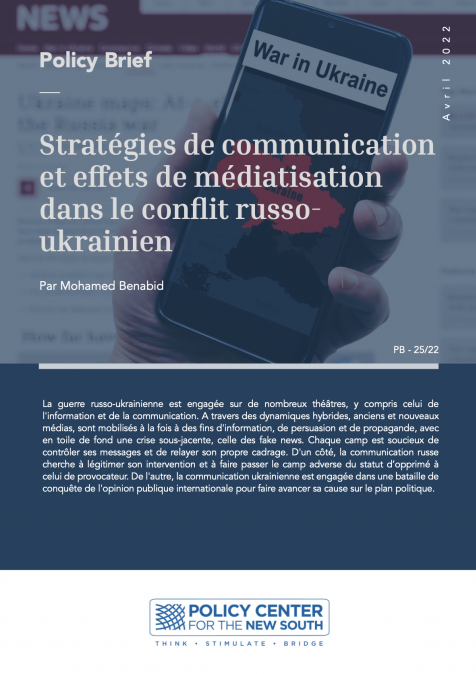
Stratégies de communication et effets de médiatisation dans le conflit russo-ukrainien
Authors
Mohamed Benabid
April 13, 2022

La guerre russo-ukrainienne est engagée sur de nombreux théâtres, y compris celui de l'information et de la communication. A travers des dynamiques hybrides, anciens et nouveaux médias, sont mobilisés à la fois à des fins d'information, de persuasion et de propagande, avec en toile de fond une crise sous-jacente, celle des fake news. Chaque camp est soucieux de contrôler ses messages et de relayer son propre cadrage. D'un côté, la communication russe cherche à légitimer son intervention et à faire passer le camp adverse du statut d’opprimé à celui de provocateur. De l'autre, la communication ukrainienne est engagée dans une bataille de conquête de l'opinion publique internationale pour faire avancer sa cause sur le plan politique.
RELATED CONTENT

  • Authors
    August 12, 2026
    When a crisis erupts, it sets crisis-management reflexes in motion and prompts efforts to contain its effects. Analysts then begin looking for the malfunctions, oversights, and failures that caused it. In some cases, conspiracy theories creep in, and speculation turns to who engineered the crisis, and to what end. Crisis-management theory teaches us, however, that a crisis unfolds under conditions that favor its emergence. Crises take shape in an environment where latent vulnerabil ...
  • Authors
    July 27, 2026
    Is Europe Prepared for War?European public opinion is moving from treating a major conflict as unthinkable to regarding it as a possibility for which governments must prepare. Attention is increasingly focused on Russian hybrid operations, vulnerabilities in critical infrastructure and the risk of fragmentation within NATO. European defence policy is consequently undergoing a rapid transition from post-Cold War complacency towards preparations for high-intensity warfare. Recent ...
  • Authors
    July 15, 2026
    We Are Watching You In April 2026, the UK Ministry of Defence revealed that it had tracked a covert Russian submarine operation apparently intended to map critical undersea cables and pipelines in the North Atlantic and the North Sea. A Russian attack submarine and two specialised intelligence vessels operated by the Main Directorate of Deep-Sea Research, commonly known as GUGI, were reportedly monitored for four weeks by the Royal Navy, including HMS St Albans and P-8 Poseidon ...
  • Authors
    July 13, 2026
    On “marinetraffic.com”, thousands of triangles fill a map of the world’s ports and oceans, each representing the active location and destination of a ship, reported the “McGill International Review” (April 16, 2026) adding,” suspicious tankers are plentiful among them.” One of these vessels, marked by a red triangle, appears, zoomed, as “Monique”, a twenty-year-old vessel, aka Tokyo, Phuket and Elysia. Its old age and the frequent name change, suspects reporter Julnar Alzuki, “indic ...
  • Authors
    June 30, 2026
    The inventory is worrisomely low The US military has fired off more than 1000 Tomahawk cruise missiles, roughly ten times the number it currently buys each year. The Pentagon used more than 1200 Patriot interceptor missiles, "more than three million dollars a pop", and more than 1000 precision strike, ground based missiles, "leaving the inventories worrisomely low." US commanders were forced to ration interceptors by letting unguided or less destructive missiles hit empty or no ...
  • Authors
    June 19, 2026
    The early March 2026 Pentagon briefings were tuned towards triumph and surrender - unconditional. The white flag of defeat was visible on the Iran horizon, and America's commander in chief needed only a few more weeks to declare "their military is gone. Wiped out". His secretary of war, Pete Hegseth, added to Trump's assessment his own, the Iranian navy was "decimated, destroyed and defeated", the naval fleet of the enemy rested on the bottom of the Persian Gulf. Iran's defense indu ...
  • Authors
    Niagalé Bagayoko
    Christophe Chabert
    Sara Hasnaa Mokaddem
    Alain Oudot de Dainville
    Anne-Sophie Raujol
    Hassane Saoud
    Olivier Tramond
    Emmanuel Véron
    May 6, 2026
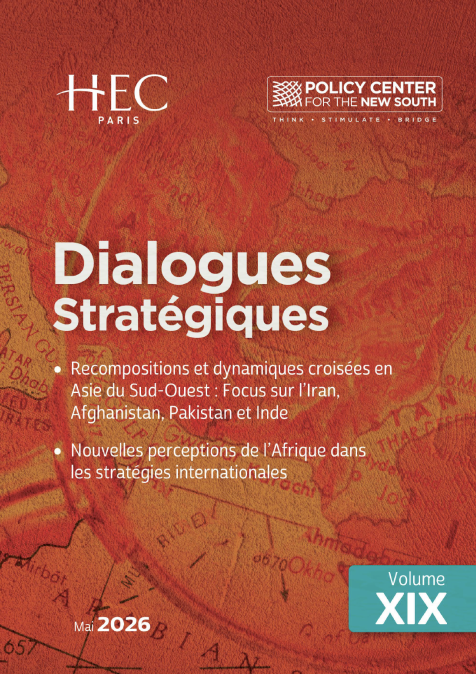
    Cette publication est le résultat de la 19° édition des Dialogues Stratégiques, organisée le 24 octobre 2025, où ont été présentés et débattus 15 chapitres autour de deux thématiques majeures: « Recompositions et dynamiques croisées en Asie du Sud-Ouest : Focus sur PIran, l'Afghanistan, le Pakistan et l'Inde » et « Nouvelles perceptions de l'Afrique dans les stratégies internationales».Au croisement de ces discussions, émerge une interrogation centrale: comment les États et les régi ...
  • February 13, 2026
    Le général Olivier Tramond analyse la réduction de la présence militaire française en Afrique comme un changement stratégique profond plutôt qu’un renoncement. Au-delà des coups d’État et ...
  • Authors
    December 18, 2025
    The return of President Donald Trump to the White House at the start of 2025 was expected to signal an American retreat from international engagement, especially in regions of traditional security interest, such as southern Europe, North Africa, and the Middle East. To the surprise of many observers around the Mediterranean, and perhaps to the dismay of some in the Trump administration’s ideological orbit, this has not happened. If anything, the second half of 2025 has seen a high d ...