Publications /
Opinion
Is Europe Prepared for War?
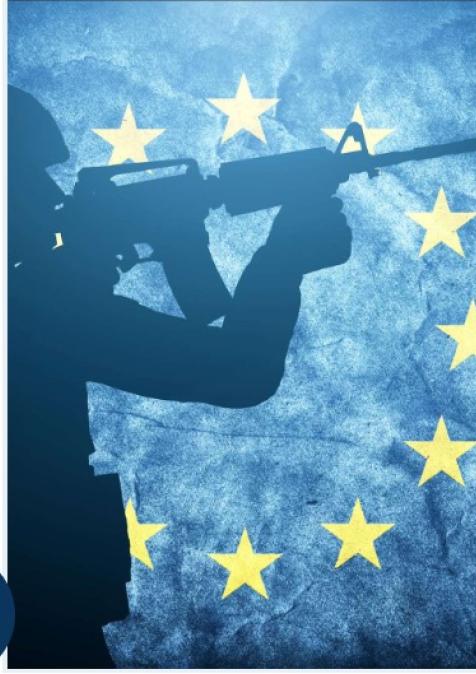
European public opinion is moving from treating a major conflict as unthinkable to regarding it as a possibility for which governments must prepare. Attention is increasingly focused on Russian hybrid operations, vulnerabilities in critical infrastructure and the risk of fragmentation within NATO.
European defence policy is consequently undergoing a rapid transition from post-Cold War complacency towards preparations for high-intensity warfare. Recent studies have emphasised the need to improve military mobility, expand ammunition production, reinforce territorial defence and strengthen the protection of NATO’s eastern borders.
Russia’s full-scale invasion of Ukraine in February 2022 fundamentally transformed European defence planning. It destroyed the assumption that a large conventional war on the continent had become impossible.
“Is Europe prepared for war?” asked the Financial Times on 30 June 2025. The newspaper warned that the Russian economy was already increasingly organised around military production and that Vladimir Putin’s expansionist ambitions could eventually extend beyond Ukraine.
For the countries closest to Russia, “elsewhere” is not an abstract geographical concept. It could mean Finland, Norway, Poland or one of the Baltic states: Estonia, Latvia and Lithuania.
Let Us Not Kid Ourselves
Russia remains heavily committed to its invasion of Ukraine. Nevertheless, many governments along NATO’s eastern and northern borders expect that President Putin could eventually redirect his attention towards the alliance’s eastern flank.
NATO Secretary-General Mark Rutte has warned that Russia could be capable of using military force against the alliance within five years.
“Let’s not kid ourselves. We are all on the eastern flank now,” Rutte said during a speech at Chatham House on 25 June 2025.
At the northernmost point of that flank is Norway. The country shares a border of approximately 200 kilometres with Russia and exemplifies the efforts now being made by European governments to reinforce their armed forces.
Norway plans to expand its army from one brigade to three by 2032, with two stationed in the north. Its forces in Finnmark, the border region where many road signs appear in both Norwegian and Russian, are expected to receive additional air-defence systems, artillery, light-infantry units, intelligence capabilities and a dedicated rapid-reaction force. A new heavy-infantry brigade is also planned elsewhere in northern Norway.
Norwegian Prime Minister Jonas Gahr Støre told the Financial Times that although his country faced no immediate threat, governments across the region were closely monitoring Russia’s military reorganisation. Moscow’s decision to re-establish separate Moscow and Leningrad military districts has raised concerns that the number of Russian troops positioned opposite Northern Europe could eventually rise significantly above pre-2022 levels.
“Norway is a threat to nobody, but it is our responsibility to ensure that nobody comes up with the idea of threatening us,” Støre said.
Thirty Metres of Granite Above
Finland, Norway’s neighbour in the far north, understands the consequences of territorial confrontation with Moscow. Although Finland resisted the Soviet Union during the Winter War of 1939–1940, it was ultimately forced to surrender almost 10 per cent of its territory during the Second World War.
For much of the following eight decades, Finland maintained extensive defence preparations against the possibility of another attack from the east.
Finnish officials expect Russia eventually to increase the number of troops and military equipment stationed along the border, although many believe that Moscow would require several years after the end of the war in Ukraine to rebuild its full conventional strength. Finland has already reinforced physical barriers in several areas and increased border patrols.
Jarmo Lindberg, Finland’s former Chief of Defence and now a member of parliament, told the Financial Times that the country maintains enough fuel and lubricants to last approximately six months and sufficient grain reserves for almost nine months. Finland also has agreements with private companies allowing production lines to be converted rapidly to meet wartime requirements.
“All our operational centres have 30 metres of granite on top of them,” Lindberg said. “Russia could drop a nuclear bomb, and you would notice it, but survive. We have bomb shelters for 4.4 million people. All our fighter jets are under 30 metres of granite too.”
The remarks may sound dramatic, but they reflect Finland’s long-standing model of comprehensive national defence. Preparedness is understood not only as the responsibility of the armed forces but as a shared obligation involving government institutions, businesses, local authorities and citizens.
A Joint Mass-Evacuation Plan
Latvia, Estonia and Lithuania face a different strategic reality. Their limited geographical depth and proximity to Russia and Belarus leave them particularly exposed.
The Estonian city of Narva lies directly on the Russian border. Vilnius, the Lithuanian capital, is only a short distance from Belarus, a state closely aligned with Moscow. Lithuania is connected to Poland and the rest of NATO territory through the narrow Suwałki Gap, which lies between the Russian exclave of Kaliningrad and Belarus.
The geography of the region complicates its defence. Estonia’s border with Russia includes rivers, Lake Peipus and extensive wetlands. Latvia and Lithuania also contain forests and marshlands that can obstruct military movement while creating vulnerabilities in transport and communications.
Each Baltic country is strengthening its own military capabilities. Lithuania intends to establish a national division of approximately 17,500 troops by 2030. Estonia can mobilise a force of around 43,000 personnel, while Latvia has reintroduced compulsory military service. The three governments are also cooperating on a joint plan for the mass evacuation of civilians in the event of a major conflict.
The Baltic states and Poland are reinforcing their borders with Russia and Belarus. The Baltic Defence Line, currently under construction, includes border fences, bunkers and anti-tank obstacles commonly known as dragon’s teeth (L’Europeista, 10 December 2025).
Poland has constructed a steel fence approximately 5.5 metres high along 186 kilometres of its border with Belarus. Warsaw has reinforced the barrier with night-vision equipment, thermal cameras and new patrol roads.
Poland’s proximity to Ukraine and its long border with Belarus make it a central component of NATO’s eastern defences. Prime Minister Donald Tusk has been one of the strongest advocates for higher military expenditure among EU member states. Poland now spends a larger proportion of its gross domestic product on defence than any other NATO member.
Germany, meanwhile, is undertaking its most substantial military expansion since the Second World War and has declared its ambition to build Europe’s strongest conventional army. Berlin is preparing to station a permanent brigade of approximately 5,000 soldiers in Lithuania.
These measures demonstrate that Europe is no longer dismissing the possibility of a major conflict. Nevertheless, military spending, fortified borders and emergency booklets cannot by themselves guarantee security. Europe must also maintain credible deterrence, political cohesion and functioning diplomatic channels.
The danger lies not only in failing to prepare, but also in allowing fear, speculation and inflammatory rhetoric to make confrontation appear unavoidable. Europe must strengthen its capacity to defend itself without treating war as a predetermined outcome. Vigilance is necessary, but so are restraint, accuracy and political judgement.