Publications /
Policy Paper

Back
From Syria to Libya: Russia’s Adapted Mediterranean Strategy in the Post-Assad Era
Authors
Lina Jaoid
October 8, 2026

In the two years since the fall of Bashar al-Assad in Syria, Russia has restructured its Mediterranean presence. Although Russia’s limited and increasingly conditional access to the Khmeimim and Tartus facilities in Syria has been preserved, its presence in the country has morphed from Assad’s ‘patron-client’ configuration to a more negotiated engagement. Simultaneously, Russia has upgraded its force-projection and logistical infrastructure in eastern Libya, giving it an access path through the Mediterranean to its African theater.

This policy paper argues that these strategic adjustments represent more of a redistribution of Russia’s regional stake, rather than an exit from Syria and its replacement with Libya. It maintains that the new geometry has increased both the geographic reach and the risks associated with Russian operations. Thus, Russia’s new Mediterranean strategy appears to be a logical adaptation to achieve a less-concentrated and more-elastic posture at the expense of increased reliance on negotiated basing.
RELATED CONTENT

  • Authors
    Lina Jaoid
    October 8, 2026
    In the two years since the fall of Bashar al-Assad in Syria, Russia has restructured its Mediterranean presence. Although Russia’s limited and increasingly conditional access to the Khmeimim and Tartus facilities in Syria has been preserved, its presence in the country has morphed from Assad’s ‘patron-client’ configuration to a more negotiated engagement. Simultaneously, Russia has upgraded its force-projection and logistical infrastructure in eastern Libya, giving it an access path ...
  • Authors
    September 30, 2026
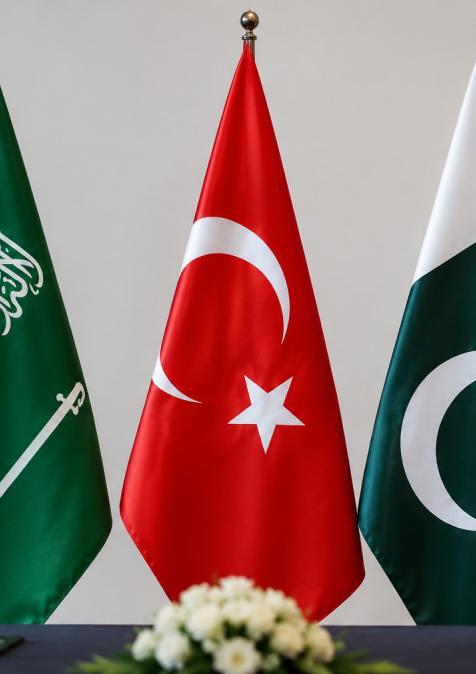
    On August 7, 2026, Saudi Arabia, Turkey, and Pakistan signed the Mecca Joint Défense Agreement, a collective-defense pact widely compared to NATO’s Article 5. This essay argues that the comparison is misleading. Mecca borrows NATO’s language of solidarity without yet possessing NATO’s institutional machinery, and the Houthi offensive against Saudi Arabia in September 2026 provided an early and revealing test of what the agreement actually means in practice. Neither Pakistan nor Turk ...
  • Authors
    September 23, 2026
    Since around 2010, it has been known that the Eastern Mediterranean is a new gas province. Gas resources have indeed been discovered offshore four countries or territories: Egypt, Israel, Cyprus and Gaza. Two of them have become producers and exporters of natural gas, Egypt and Israel. Off the coast of Gaza, the Gaza Marine gas field has never been developed, and it is highly unlikely to be developed anytime soon given the very high tensions between the State of Israel and Hamas. By ...
  • Authors
    September 23, 2026
    Depuis 2010, environ, on sait que la Méditerranée orientale est une nouvelle province gazière. Des ressources gazières ont en effet été découvertes au large de quatre pays ou territoires, l’Égypte, Israël, Chypre et Gaza. Deux d’entre eux sont devenus producteurs et exportateurs de gaz naturel, l’Égypte et Israël. Au large de Gaza, le champ gazier de Gaza Marine n’a jamais été développé et il est très peu probable qu’il le soit prochainement en raison des très fortes tensions entre ...
  • Authors
    August 11, 2026
    The Mecca Agreement: A First Step Towards a New Regional Security Architecture? On 7 August, Saudi Arabia, Türkiye and Pakistan signed the Mecca Agreement, a trilateral defense pact aimed at strengthening collective security and defense cooperation between the three countries. At its core lies a collective defense commitment under which an attack on one member is considered an attack on all three. While many details concerning its practical implementation remain unclear, the agreeme ...
  • Authors
    August 7, 2026
    THE END OF AN ERAThe US-Israeli war on Iran, a 'little excursion' envisaged to be over within a matter of weeks, has entered its fourth month. Shock waves ripple across the globe. This war is just one in a series of recent crises which have fractured the international community, making the decades of the 2020's among the most disruptive in recent history. Each crisis compounds the deleterious effects of those which came before. The war in Iran is no exception. It abruptly stalled ec ...
  • Authors
    July 17, 2026
    The close relationship between energy and geopolitics is well established. The same holds true for several armed conflicts. In recent years, however, the conflict most closely intertwined with energy has been the 2026 Iran War, which began on February 28. A ceasefire has been in effect since April 8, and a Memorandum of Understanding (MoU) was signed by Iran and the United States on June 17. Nevertheless, as demonstrated by Iran's attacks on commercial vessels and recent U.S. strike ...
  • Authors
    July 17, 2026
    Les relations, très étroites, entre l’énergie et la géopolitique sont bien connues. Cela vaut aussi pour plusieurs conflits armés. Mais, dans la période récente, le conflit le plus lié à l’énergie est la guerre d’Iran de 2026, qui a débuté le 28 février. Un cessez-le-feu est en vigueur depuis le 8 avril et un protocole d’accord a été signé le 17 juin par l’Iran et les États-Unis. Mais, comme le montrent les attaques de l’Iran contre des navires et les frappes américaines de ces dern ...
  • Authors
    June 19, 2026
    At the end of May 2026, Israeli airstrikes targeted the surroundings of Beaufort Castle (Qalaat al-Chaqif), near Nabatiyeh, before the Israeli army announced that it had captured the site. This development raises a fundamental question: why does a medieval fortified hilltop retain military value in the age of satellites, drones, and cruise missiles?This Policy Brief argues that Beaufort's significance is geographical before it is ideological or technological. Overlooking the Litani ...