Publications /
Policy Paper

Back
The Mecca Joint Défense Agreement: A New Geometry of Middle Eastern Power?
Authors
September 30, 2026

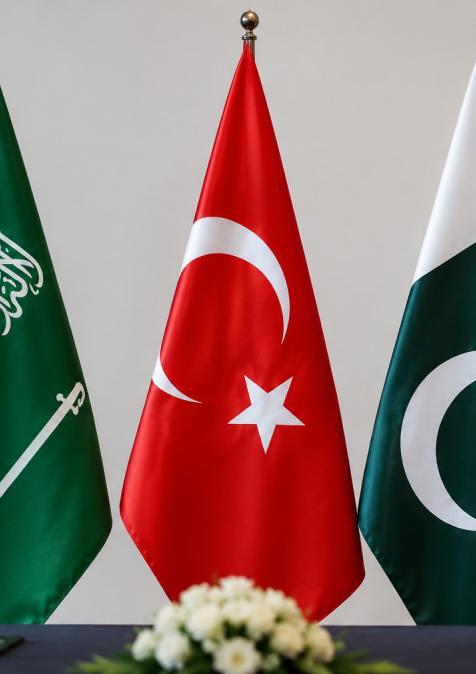
On August 7, 2026, Saudi Arabia, Turkey, and Pakistan signed the Mecca Joint Défense Agreement, a collective-defense pact widely compared to NATO’s Article 5. This essay argues that the comparison is misleading. Mecca borrows NATO’s language of solidarity without yet possessing NATO’s institutional machinery, and the Houthi offensive against Saudi Arabia in September 2026 provided an early and revealing test of what the agreement actually means in practice. Neither Pakistan nor Turkey automatically entered the fight on Saudi Arabia’s behalf, and Washington, despite an initial reluctance to strike directly, remained indispensable through intelligence support and a major proposed F-35 sale. Drawing on realist alliance theory — Hans Morgenthau, Kenneth Waltz, Stephen Walt, Glenn Snyder, and Steven David — and on the precedent of the Central Treaty Organization (CENTO), the essay contends that the Middle East is not dividing into rival blocs but moving from hierarchy toward a looser, overlapping geometry of hedged partnerships, in which American exclusivity is eroding considerably faster than American primacy.
RELATED CONTENT

  • Authors
    September 30, 2026
    On August 7, 2026, Saudi Arabia, Turkey, and Pakistan signed the Mecca Joint Défense Agreement, a collective-defense pact widely compared to NATO’s Article 5. This essay argues that the comparison is misleading. Mecca borrows NATO’s language of solidarity without yet possessing NATO’s institutional machinery, and the Houthi offensive against Saudi Arabia in September 2026 provided an early and revealing test of what the agreement actually means in practice. Neither Pakistan nor Turk ...
  • Authors
    August 11, 2026
    The Mecca Agreement: A First Step Towards a New Regional Security Architecture? On 7 August, Saudi Arabia, Türkiye and Pakistan signed the Mecca Agreement, a trilateral defense pact aimed at strengthening collective security and defense cooperation between the three countries. At its core lies a collective defense commitment under which an attack on one member is considered an attack on all three. While many details concerning its practical implementation remain unclear, the agreeme ...
  • April 27, 2022
    Le retrait des troupes américaines d’Afghanistan et la reconquête, rapide et sans résistance notable, du pouvoir par les Talibans, a ouvert un nouveau chapitre dans l’histoire particulièrement tumultueuse de ce pays. La mise en oeuvre de la décision américaine a suscité des remous sur le plan interne et des critiques sur le plan extérieur, particulièrement de la part des alliés et des partenaires de Washington. Les engagements pris par les Talibans en vertu de l’Accord signé le 29 f ...
  • Authors
    Sabine Cessou
    April 13, 2018
    L’avenir de l’Inde a fait débat le 11 avril en présence de 110 personnes, lors des 5èmes Dialogues stratégiques, une rencontre biannuelle organisée à Paris par l’OCP Policy Center et le Centre HEC de géopolitique.  En 2050, l’Inde comptera 17 % de la population globale et aura le troisième PIB mondial. « Le ralentissement de la croissance en Chine n’occultera peut-être plus l’essor de cette grande démocratie », a noté Jacques Gravereau, président du HEC Eurasia Institute. Soul ...