Publications /
Policy Paper

Back
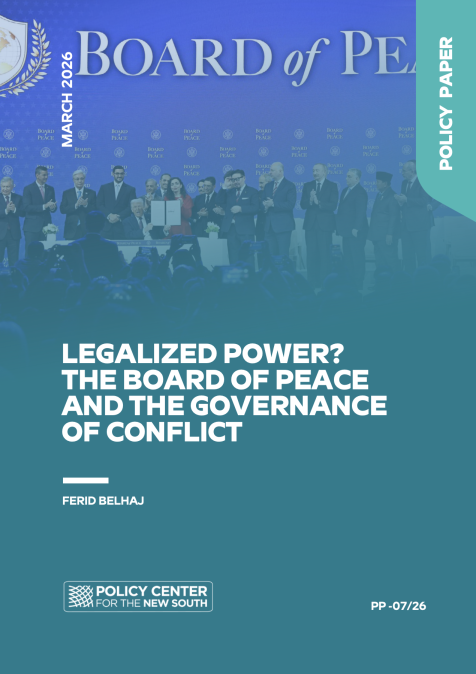
Legalized Power? The Board of Peace and the Governance of Conflict
Authors
March 30, 2026

This essay examines the establishment of the Board of Peace as a test case in contemporary peace governance and hegemonic experimentation. While the Board, politically activated in early 2026 and formally anchored in a resolution of the United Nations Security Council, benefits from derivative legality under the UN Charter, its legal foundation remains constitutionally fragile, its mandate ambiguously constrained, and its accountability architecture underdeveloped, notwithstanding explicit Security Council authorization.

Moving beyond a binary assessment of legality versus illegality, the essay situates the Board of Peace within a broader historical pattern of incremental institutional creation in international relations. Drawing on comparative examples such as the G7/G8, the Shanghai Cooperation Organization, and ASEAN’s late-stage legal codification, the analysis shows that many influential international arrangements emerged through crisis-driven political practice before hardening into legally constituted organizations, or, in some cases, evolving into parallel governance centers that diluted the authority of their parent institutions.

From a realist perspective—augmented by insights from critical legal realism—the Board of Peace is best understood as a legalized instrument of power management operating through international law while simultaneously testing its limits. Under President Donald Trump’s second administration, the Board reflects a broader hegemonic impulse: not an outright rejection of legality per se, but a strategic preference for flexible, sponsor-driven governance mechanisms that can bypass procedural constraints, re-center the agenda-setting power of the United States, and externalize political risk. It is an example of selective implementation of the so called ‘rules-based international order’. In this sense, the Board carries an inherent tension: while formally authorized by the Security Council, it has the potential to compete with it, gradually displacing deliberative multilateralism and potentially replacing it with executive-style peace and security management.

Yet the Israeli–Palestinian context, which is the departure point and original rationale of the Board of Peace, imposes non-derogable constraints. Occupation, self-determination, and the two-state framework cannot be neutralized by managerial governance without legal and political consequences. The sustainability of the Board will therefore depend less on its founding moment (adoption of UN Security Council resolution 2803) and more on its capacity to evolve from hegemonic expediency into rule-constrained institutional practice oriented toward ending occupation rather than stabilizing it. Absent such evolution, the Board risks entrenching questionable governance without sovereignty, hollowing out Security Council authority, and accelerating the drift toward fragmented, plurilateral peace and security management under hegemonic sponsorship.

Finally, it is important to clarify that this essay is not a polemical critique of the Board of Peace as a political stunt, nor a personalized indictment of the ad-hoc and visibly fragile governance mechanics surrounding a sui generis leader-centric governance experiment. While the legal and institutional shortcomings of the Board are acknowledged, the purpose of this analysis is neither to dismiss the initiative outright nor to adjudicate its immediate political legitimacy. Rather, the Board of Peace is treated as an analytical entry point: a contemporary case through which to examine the varied pathways by which international groupings and organizations come into being, evolve, and acquire authority. The essay’s central concern is structural and comparative: how crisis-driven arrangements, informal clubs, hegemon-sponsored mechanisms, and restraint-based regional orders differ in their relationships to legality, power, and endurance, and what these differences reveal about the changing architecture of international governance in an era of fragmentation.

RELATED CONTENT

  • Authors
    March 30, 2026
    This essay examines the establishment of the Board of Peace as a test case in contemporary peace governance and hegemonic experimentation. While the Board, politically activated in early 2026 and formally anchored in a resolution of the United Nations Security Council, benefits from derivative legality under the UN Charter, its legal foundation remains constitutionally fragile, its mandate ambiguously constrained, and its accountability architecture underdeveloped, notwithstand ...
  • Authors
    Nizar Messari
    December 19, 2025
    The U.S. military buildup in the Caribbean—the most significant since the Cuban Missile Crisis—comes at a moment when a new world order is taking shape, its contours still unclear, and in which the U.S. seeks to be more assertive in the Western Hemisphere. This disposition toward South America and the Caribbean was underscored by the recent publication of the new U.S. National Security Strategy, in which the Monroe Doctrine is explicitly invoked. This Policy Brief situates the devel ...
  • Authors
    December 18, 2025
    The return of President Donald Trump to the White House at the start of 2025 was expected to signal an American retreat from international engagement, especially in regions of traditional security interest, such as southern Europe, North Africa, and the Middle East. To the surprise of many observers around the Mediterranean, and perhaps to the dismay of some in the Trump administration’s ideological orbit, this has not happened. If anything, the second half of 2025 has seen a high d ...
  • Authors
    December 3, 2025
    La résolution 2797 du Conseil de sécurité des Nations Unies ne marque pas la fin d’un dossier, mais l’aboutissement d’une gestion magistrale du temps. Le Maroc n’a pas seulement gagné des appuis, il a gagné le tempo.
En combinant le Chronos de la constance et le Kairos de l’opportunité, il a démontré qu’une politique étrangère pouvait s’appuyer sur la philosophie du temps autant que sur la géopolitique.Cette diplomatie du temps maîtrisé peut aujourd’hui être considérée comme une doc ...
  • November 19, 2025
    بعد ثمانية عشر سنة على تقديمها إلى مجلس الأمن كمساهمة من المغرب في حل الخلاف الإقليمي حول الصحراء المغربية، حظيت مبادرة الحكم الذاتي بموجب القرار2797 المؤرخ في 31 أكتوبر2025 بتزكية مجلس الأمن بأغلبية مريحة كأساس وحيد للتفاوض من أجل حل نهائي لهذا الخلاف. وكان رد فعل المغرب على اعتماد هذا القرار سريعا، إذ مباشرة بعد التصويت، وبينما كانت وفود الدول الأعضاء في المجلس تشرح تصويتها على القرار، وجه جلالة الملك خطابا إلى الأمة مرحبا بهذا التغيير التاريخي الذي يشكل "مرحلة مفصلية ونقطة تحول ح ...
  • Authors
    November 7, 2025
    L’affaire du Sahara a connu, ce vendredi 31 octobre 2025, un virage stratégique. Par sa résolution 2797, le Conseil de sécurité a clairement consacré l’Initiative marocaine d’autonomie comme étant la base exclusive de négociations pour l’arrivée à une solution définitive au conflit régional qui plombe la région depuis un demi-siècle. Ainsi que l’a souligné Sa Majesté le Roi dans son discours adressé à la nation immédiatement après l’adoption de la nouvelle résolution, « nous vi ...
  • November 4, 2025
    This Opinon was originally published in French on telos-eu.com As Morocco celebrates the fiftieth anniversary of the Green March, which gave it control of the Western Sahara in November 1975, the UN Security Council has made a spectacular correction to its position on the issue. Its resolution of October 31, 2025 emphasizes the solution of internal autonomy for the Western Sahara within Morocco, relegating the idea of an independence referendum to second place. Autonomy rather ...
  • November 3, 2025
    La résolution 2797, adoptée le 31 octobre 2025 par une large majorité du Conseil de sécurité, constitue un tournant historique dans le dossier du Sahara. Pour la première fois, l’autonomie sous souveraineté marocaine est considérée comme unique base de négociation pour une solution politique réaliste marquée du sceau du compromis , écartant irrévocablement l’option de référendum et mettant fin aux ambiguïtés entretenues depuis des décennies. En réaction à l’adoption de la résol ...
  • Authors
    avec le concours de Sâ Benjamin Traoré
    October 31, 2025
    Ce rapport a été initialement publié sur fondapol.org Depuis 50 ans, le conflit du Sahara occidental est pendant devant les instances internationales.En 1975, le Maroc a fait acte de souveraineté sur ce vaste territoire désertique, jusque-là colonie espagnole. Il estime qu’il lui avait antérieurement appartenu. Ce point de vue est contesté par le Front Polisario, mouvement indépendantiste soutenu par l’Algérie. La communauté internationale a adopté une attitude ambivalente, ret ...