Publications /
Policy Paper

Back
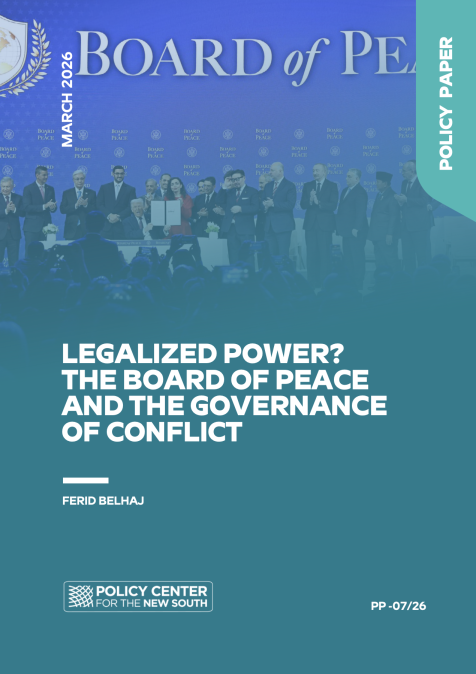
Legalized Power? The Board of Peace and the Governance of Conflict
Authors
March 30, 2026

This essay examines the establishment of the Board of Peace as a test case in contemporary peace governance and hegemonic experimentation. While the Board, politically activated in early 2026 and formally anchored in a resolution of the United Nations Security Council, benefits from derivative legality under the UN Charter, its legal foundation remains constitutionally fragile, its mandate ambiguously constrained, and its accountability architecture underdeveloped, notwithstanding explicit Security Council authorization.

Moving beyond a binary assessment of legality versus illegality, the essay situates the Board of Peace within a broader historical pattern of incremental institutional creation in international relations. Drawing on comparative examples such as the G7/G8, the Shanghai Cooperation Organization, and ASEAN’s late-stage legal codification, the analysis shows that many influential international arrangements emerged through crisis-driven political practice before hardening into legally constituted organizations, or, in some cases, evolving into parallel governance centers that diluted the authority of their parent institutions.

From a realist perspective—augmented by insights from critical legal realism—the Board of Peace is best understood as a legalized instrument of power management operating through international law while simultaneously testing its limits. Under President Donald Trump’s second administration, the Board reflects a broader hegemonic impulse: not an outright rejection of legality per se, but a strategic preference for flexible, sponsor-driven governance mechanisms that can bypass procedural constraints, re-center the agenda-setting power of the United States, and externalize political risk. It is an example of selective implementation of the so called ‘rules-based international order’. In this sense, the Board carries an inherent tension: while formally authorized by the Security Council, it has the potential to compete with it, gradually displacing deliberative multilateralism and potentially replacing it with executive-style peace and security management.

Yet the Israeli–Palestinian context, which is the departure point and original rationale of the Board of Peace, imposes non-derogable constraints. Occupation, self-determination, and the two-state framework cannot be neutralized by managerial governance without legal and political consequences. The sustainability of the Board will therefore depend less on its founding moment (adoption of UN Security Council resolution 2803) and more on its capacity to evolve from hegemonic expediency into rule-constrained institutional practice oriented toward ending occupation rather than stabilizing it. Absent such evolution, the Board risks entrenching questionable governance without sovereignty, hollowing out Security Council authority, and accelerating the drift toward fragmented, plurilateral peace and security management under hegemonic sponsorship.

Finally, it is important to clarify that this essay is not a polemical critique of the Board of Peace as a political stunt, nor a personalized indictment of the ad-hoc and visibly fragile governance mechanics surrounding a sui generis leader-centric governance experiment. While the legal and institutional shortcomings of the Board are acknowledged, the purpose of this analysis is neither to dismiss the initiative outright nor to adjudicate its immediate political legitimacy. Rather, the Board of Peace is treated as an analytical entry point: a contemporary case through which to examine the varied pathways by which international groupings and organizations come into being, evolve, and acquire authority. The essay’s central concern is structural and comparative: how crisis-driven arrangements, informal clubs, hegemon-sponsored mechanisms, and restraint-based regional orders differ in their relationships to legality, power, and endurance, and what these differences reveal about the changing architecture of international governance in an era of fragmentation.
RELATED CONTENT

  • February 20, 2020
    Le lancement et la conduite de toute négociation ne dépendent pas seulement des positions des parties, de leur volonté de faire des concessions et, éventuellement, du talent du médiateur. De la même manière qu’ils ne dépendent pas, uniquement, du règlement des questions de procédure et de l’adoption d’arrangements techniques destinés à contourner les objections préalables des parties, à ménager leurs sensibilités et à leur faire accepter un code de conduite adapté à chaque phase des ...
  • February 20, 2020
    The initiation and conduct of any negotiation are not solely dependent on the positions of parties, their willingness to make concessions and, possibly, the mediator's talent. Similarly, they do not merely hinge on the settlement of procedural issues and the adoption of technical arrangements designed to circumvent the parties' prior objections, to accommodate their sensitivities and to secure their acceptance of a code of conduct suited to each phase of the negotiations. Such techn ...
  • Authors
    January 20, 2020
    Le 3 octobre 2016, la Turquie a déposé une plainte contre le Maroc devant l’Organisation Mondiale du Commerce (OMC) au sujet des mesures antidumping appliquées par le Maroc contre les exportations turques en Acier laminé à chaud.1 Suite à l’échec des consultations entre les deux pays, la Turquie a demandé, le 12 janvier 2017, l’établissement d’un groupe spécial pour examiner la conformité des mesures prises par le Maroc avec le droit de l’OMC. Demande qui marque le passage du litige ...
  • September 13, 2019
    Au moment où le multilatéralisme se trouve mis à mal dans sa triple dimension de maintien de la paix et de la sécurité internationales, du développement du commerce international et de la lutte contre le changement climatique, de plus en plus de voix s’élèvent appelant à une réforme en profondeur des instances chargées de promouvoir ces objectifs fondamentaux de l’agenda international. Ce vent de réformes ne semble épargner ni l’Organisation mondiale du Commerce (OMC), ni la Banque ...
  • Authors
    July 1, 2019
    Few weeks ago, I gained the chance of reading the UN Security Council resolution 2468 of 30 April on MINURSO , and was surprised by the frequently repeated expression of “Morocco, the Frente Polisario, Algeria, and Mauritania”, instead of the previous “all parties and neighbours”. Besides, it was reported that the US representative twice referred to “Morocco, the Frente Polisario, Algeria, and Mauritania” in his short remark in the Security Council meeting1. Shortly after that, I co ...
  • Authors
    Matthieu Tardis
    February 8, 2019
    Le « Pacte mondial pour des migrations sûres, ordonnées et régulières » a été adopté à Marrakech les 10 et 11 décembre 2018, à l’issue de 18 mois de consultations et de négociations. Il est présenté comme le premier accord des Nations unies sur une approche globale des migrations internationales dans toutes ses dimensions. S’il vise à devenir la pierre angulaire d’une gouvernance mondiale des migrations, souhaitée par la communauté internationale, il se heurte pourtant à des priorit ...
  • Authors
    November 5, 2018
    The situation in Mali continues to evolve and is making MINUSMA’s task further challenging. Civilians in northern and central Mali continue to suffer from protection issues. In fact, since June 2018, at least 287 civilians have been killed by extremist groups or have been victims of acts of atrocities from rival communities, the highest number recorded since the deployment of MINUSMA.1 MINUSMA earned its name of being the most dangerous UN mission in the world due to lack of suffici ...
  • Authors
    Anabel Gonzalez
    August 30, 2018
    The agreement establishing the African Continental Free Trade Area (AfCFTA) is a framework to create a free trade area across the region, bringing together the 55 members of the African Union into a continental market with a cumulative Gross Domestic Product (GDP) exceeding US$2.2 trillion and a total population of over one billion people. When concluded and successfully implemented, it will become the largest free trade area in the world in terms of membership, opening up significa ...
  • Authors
    Malik Abaddi
    August 8, 2018
    The African Union goes to Mauritania Under the theme “Winning the Fight Against Corruption”, the 31st Summit of the African Union was held in early July in the desert capital Nouakchott. In a bitter prelude in late June, the AU’s commitment to this central theme was dealt a blow with the sudden – and public – resignation of Ghana’s Daniel Batidam from the AU Advisory Board on Corruption. Off to a rocky start, the summit had an even rougher road ahead of it.  A month ...
  • Authors
    March 15, 2018
    « Revise, Reboot, Rebuild : Strategies for a time of Distrust »: that was this year’s theme for the Brussels Forum, a yearly high-level conference held from March 8th to 10th by the US think tank German Marshall Fund (GMF), partner of the OCP Policy Center who attended the event through its delegation. This meeting of some 400 policymakers, academics and private sector operators is reviewing the relationship between Europe and the United States. Brexit, the Trump administration ...