Publications /
Policy Paper
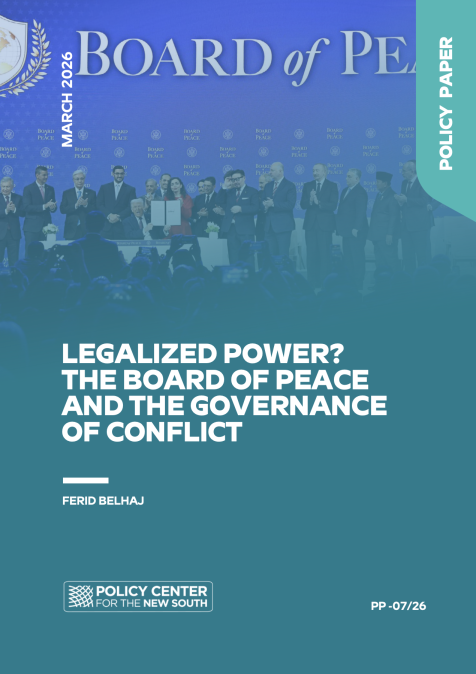
This essay examines the establishment of the Board of Peace as a test case in contemporary peace governance and hegemonic experimentation. While the Board, politically activated in early 2026 and formally anchored in a resolution of the United Nations Security Council, benefits from derivative legality under the UN Charter, its legal foundation remains constitutionally fragile, its mandate ambiguously constrained, and its accountability architecture underdeveloped, notwithstanding explicit Security Council authorization.
Moving beyond a binary assessment of legality versus illegality, the essay situates the Board of Peace within a broader historical pattern of incremental institutional creation in international relations. Drawing on comparative examples such as the G7/G8, the Shanghai Cooperation Organization, and ASEAN’s late-stage legal codification, the analysis shows that many influential international arrangements emerged through crisis-driven political practice before hardening into legally constituted organizations, or, in some cases, evolving into parallel governance centers that diluted the authority of their parent institutions.
From a realist perspective—augmented by insights from critical legal realism—the Board of Peace is best understood as a legalized instrument of power management operating through international law while simultaneously testing its limits. Under President Donald Trump’s second administration, the Board reflects a broader hegemonic impulse: not an outright rejection of legality per se, but a strategic preference for flexible, sponsor-driven governance mechanisms that can bypass procedural constraints, re-center the agenda-setting power of the United States, and externalize political risk. It is an example of selective implementation of the so called ‘rules-based international order’. In this sense, the Board carries an inherent tension: while formally authorized by the Security Council, it has the potential to compete with it, gradually displacing deliberative multilateralism and potentially replacing it with executive-style peace and security management.
Yet the Israeli–Palestinian context, which is the departure point and original rationale of the Board of Peace, imposes non-derogable constraints. Occupation, self-determination, and the two-state framework cannot be neutralized by managerial governance without legal and political consequences. The sustainability of the Board will therefore depend less on its founding moment (adoption of UN Security Council resolution 2803) and more on its capacity to evolve from hegemonic expediency into rule-constrained institutional practice oriented toward ending occupation rather than stabilizing it. Absent such evolution, the Board risks entrenching questionable governance without sovereignty, hollowing out Security Council authority, and accelerating the drift toward fragmented, plurilateral peace and security management under hegemonic sponsorship.
Finally, it is important to clarify that this essay is not a polemical critique of the Board of Peace as a political stunt, nor a personalized indictment of the ad-hoc and visibly fragile governance mechanics surrounding a sui generis leader-centric governance experiment. While the legal and institutional shortcomings of the Board are acknowledged, the purpose of this analysis is neither to dismiss the initiative outright nor to adjudicate its immediate political legitimacy. Rather, the Board of Peace is treated as an analytical entry point: a contemporary case through which to examine the varied pathways by which international groupings and organizations come into being, evolve, and acquire authority. The essay’s central concern is structural and comparative: how crisis-driven arrangements, informal clubs, hegemon-sponsored mechanisms, and restraint-based regional orders differ in their relationships to legality, power, and endurance, and what these differences reveal about the changing architecture of international governance in an era of fragmentation.