Publications /
Policy Brief

Back
Decoupling economic growth from CO2 emissions in the world
Authors
July 24, 2017

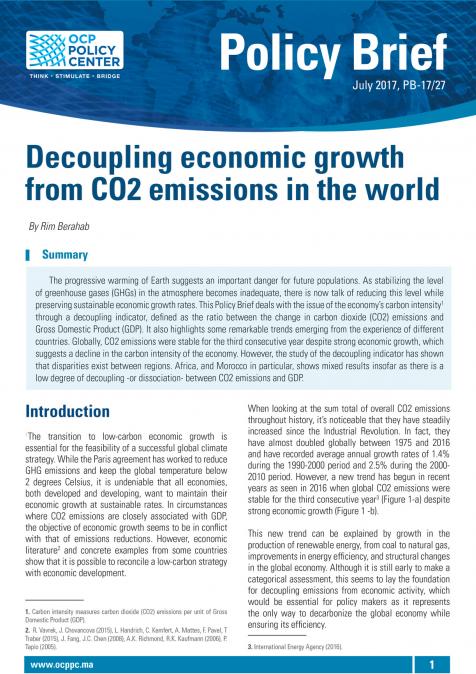
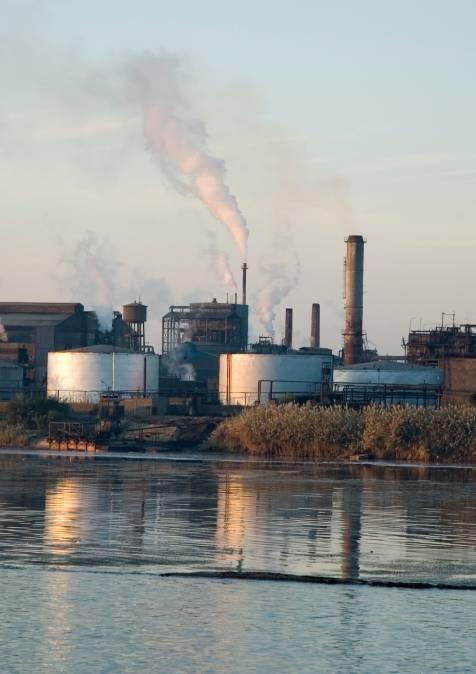
The progressive warming of Earth suggests an important danger for future populations. As stabilizing the level of greenhouse gases (GHGs) in the atmosphere becomes inadequate, there is now talk of reducing this level while preserving sustainable economic growth rates. This Policy Brief deals with the issue of the economy’s carbon intensity1 through a decoupling indicator, defined as the ratio between the change in carbon dioxide (CO2) emissions and Gross Domestic Product (GDP). It also highlights some remarkable trends emerging from the experience of different countries. Globally, CO2 emissions were stable for the third consecutive year despite strong economic growth, which suggests a decline in the carbon intensity of the economy. However, the study of the decoupling indicator has shown that disparities exist between regions. Africa, and Morocco in particular, shows mixed results insofar as there is a low degree of decoupling -or dissociation- between CO2 emissions and GDP.

RELATED CONTENT

  • Authors
    June 30, 2026
    The inventory is worrisomely low The US military has fired off more than 1000 Tomahawk cruise missiles, roughly ten times the number it currently buys each year. The Pentagon used more than 1200 Patriot interceptor missiles, "more than three million dollars a pop", and more than 1000 precision strike, ground based missiles, "leaving the inventories worrisomely low." US commanders were forced to ration interceptors by letting unguided or less destructive missiles hit empty or no ...
  • June 30, 2026
    This episode explores Morocco’s green transition, examining the country’s progress in renewable energy alongside the challenges of reducing dependence on fossil fuels. It discusses the economic and social impacts of climate change, particularly on water, agriculture, and health, while h...
  • Authors
    June 19, 2026
    The early March 2026 Pentagon briefings were tuned towards triumph and surrender - unconditional. The white flag of defeat was visible on the Iran horizon, and America's commander in chief needed only a few more weeks to declare "their military is gone. Wiped out". His secretary of war, Pete Hegseth, added to Trump's assessment his own, the Iranian navy was "decimated, destroyed and defeated", the naval fleet of the enemy rested on the bottom of the Persian Gulf. Iran's defense indu ...
  • Authors
    Mehran Haghirian
    June 15, 2026
    This article draws in part on perspectives shared by members of the Rihla Initiative for Green Economic Growth, whose regional insights helped inform the sections on how the costs of the war are being felt across the Global South. The war on Iran and in the Gulf has made it impossible to treat the Strait of Hormuz as a regional issue. The disruption around the Strait has moved through the world economy in concrete ways, from higher fuel bills and pressure on food and fertilizer ...
  • June 11, 2026
    The global energy system has entered a period of acute structural stress following the strikes by the United States and Israel on Iran in late February 2026, and the subsequent disruption of flows through the Strait of Hormuz. According to the International Energy Agency, the resulting shock marks the most severe disruption to global energy markets since the 1970s oil crises, with systemic characteristics comparable to the combined effects of those crises and the 2022 Russia-Ukraine ...
  • Authors
    June 8, 2026
    The energy shock caused by the war between the United States and Israel and Iran has highlighted the need for Africa to refine more of its own crude oil. Africa is a net hydrocarbon exporter, but remains stuck in the old colonial economic model: it mostly exports raw materials and imports refined products. Africa exports about 2.6 billion barrels of crude oil every year, and imports about 1.4 billion barrels of refined products. This is a problem for two reasons. First, Africa ...
  • June 5, 2026
    Driven by its mission to reflect on and analyze the major geopolitical, economic, and societal transformations shaping the contemporary world, and with a view to contributing to knowledge-sharing and disseminating the main outcomes of its research program, the Policy Center for the New South regularly publishes collective volumes addressing issues of particular importance to Morocco, Africa, and the broader Global/New South. In this spirit, the Center has recently released two volum ...
  • April 9, 2026
    Cet entretien explore le Nexus Eau-Énergie-Alimentation comme un défi systémique majeur pour le Maroc, dans un contexte de rareté croissante des ressources et de pressions sur la souveraineté. Il met en lumière les interdépendances critiques entre ces trois secteurs et les limites d’app...