Publications /
Policy Brief

Back
Decoupling economic growth from CO2 emissions in the world
Authors
July 24, 2017

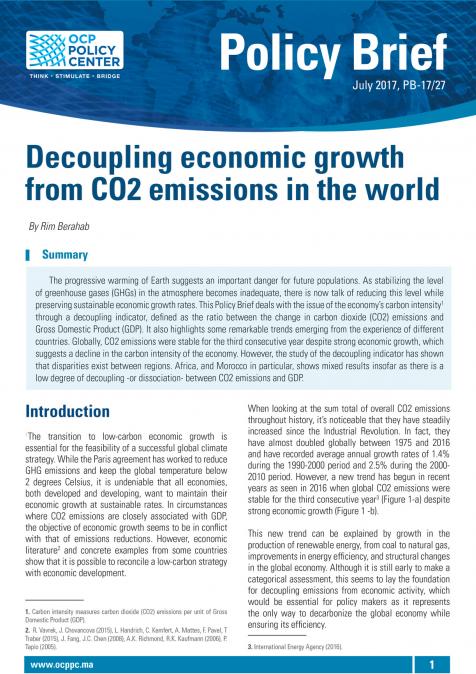
The progressive warming of Earth suggests an important danger for future populations. As stabilizing the level of greenhouse gases (GHGs) in the atmosphere becomes inadequate, there is now talk of reducing this level while preserving sustainable economic growth rates. This Policy Brief deals with the issue of the economy’s carbon intensity1 through a decoupling indicator, defined as the ratio between the change in carbon dioxide (CO2) emissions and Gross Domestic Product (GDP). It also highlights some remarkable trends emerging from the experience of different countries. Globally, CO2 emissions were stable for the third consecutive year despite strong economic growth, which suggests a decline in the carbon intensity of the economy. However, the study of the decoupling indicator has shown that disparities exist between regions. Africa, and Morocco in particular, shows mixed results insofar as there is a low degree of decoupling -or dissociation- between CO2 emissions and GDP.
RELATED CONTENT

  • Authors
    January 20, 2026
    This policy brief examines what the 2025–2026 period reveals about the future of global energy risk and the energy transition. After the shocks of 2021–2023, 2025 brought broad price easing: oil and coal prices declined as supply growth outpaced demand, and the World Bank projects further declines in the global energy price index in 2026, offering short-term relief for energy-importing economies. The brief argues, however, that the macroeconomic relevance of energy entering 202 ...
  • Authors
    January 13, 2026
    This policy brief was originally published on : euromesco.net This paper examines the nexus between governance structures, digital transformation, sustainability, and port service efficiency through an international comparative lens, with a specific focus on the Tanger Med–Algeciras corridor in the strait of Gibraltar. Using global best practices—from Singapore to Busan and Kaohsiung—it explores how public-private coordination, digital innovation, and green transition policies ...
  • November 25, 2025
    تستعرض هذه الحلقة جهود المغرب في تطوير قطاع الهيدروجين الأخضر، الذي يعد من القطاعات الواعدة لتحقيق التنمية المستدامة والطاقة النظيفة تتطرق الحلقة إلى الاستثمارات، المشاريع الاستراتيجية، السياسات الحكومية، والشراكات الدولية التي تدعم هذه المبادرة، إضافة إلى التحديات والفرص المتاحة أمام ا...
  • November 10, 2025
    This Opinion was originaly published on kalam.chathamhouse.org Morocco’s environmental governance rests on a comprehensive constitutional and legal architecture that establishes the right to a healthy environment as a fundamental right. The 2011 Constitution obliges the state to ensure equal access to water, a healthy environment, and sustainable development while also requiring the protection of natural resources and future generations, and guaranteeing equal environmental rig ...
  • October 03, 2025
    Rachid Yazami, Président & Directeur technique de KVI Battery et inventeur de l'anode-graphite pour les batteries lithium-ion, revient sur le rôle de l’intelligence artificielle dans ...
  • Authors
    October 3, 2025
    Artificial intelligence (AI) is rapidly emerging as both an energy optimizer and a structural source of energy demand. While AI promises efficiency gains in forecasting, grid management, and emissions reduction, its expansion is already reshaping electricity systems: data center consumption could more than double by 2030. Beyond this techno-economic duality lies a deeper challenge: the sovereignty of digital and energy systems. AI rests on highly concentrated supply chains of chips, ...
  • September 30, 2025
    This episode explores Morocco’s green hydrogen offer, focusing on governance frameworks, ecosystem development, and flagship projects. It highlights strategic national initiatives and partnerships with industry stakeholders, while addressing technological advances, regulatory hurdles, a...