
John Sawers, former Chief of the Secret Intelligence Service (MI6), shares his insights on how security threats have evolved with the rise of digital technologies and social media. In this interview, he offers a compelling exploration of the shift from traditional methods to contemporary security challenges. Sawers examines how intelligence approaches have adapted to address new threats, including the influence of social media on democratic processes and the evolving global geopolitical landscape. The discussion provides An insightful analysis of the current dynamics in intelligence work and highlights the critical issues facing intelligence services in an increasingly interconnected and digital world.
RELATED CONTENT
-
 May 29, 2026Ce podcast analyse les vulnérabilités logistiques des pays de l’Alliance des États du Sahel (AES), fortement dépendants de quelques corridors d’accès aux ports atlantiques. À travers l’ex ...
 -
 May 26, 2026The Africa Center and the Policy Center for the New South host a discussion on the challenges facing the Sahel and to explore credible pathways towards a return to peace. ...
 -
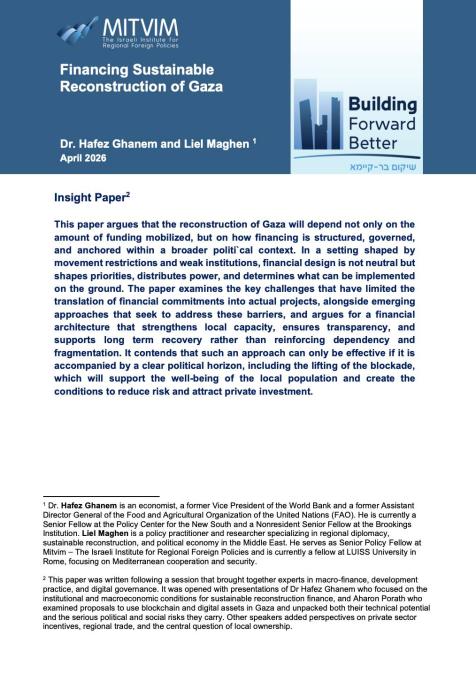 May 11, 2026This Paper was originally published on mitvim.org.il This paper argues that the reconstruction of Gaza will depend not only on the amount of funding mobilized, but on how financing is structured, governed, and anchored within a broader politi`cal context. In a setting shaped by movement restrictions and weak institutions, financial design is not neutral but shapes priorities, distributes power, and determines what can be implemented on the ground. The paper examines the key cha ...
 -
 May 6, 2026Cette publication est le résultat de la 19° édition des Dialogues Stratégiques, organisée le 24 octobre 2025, où ont été présentés et débattus 15 chapitres autour de deux thématiques majeures: « Recompositions et dynamiques croisées en Asie du Sud-Ouest : Focus sur PIran, l'Afghanistan, le Pakistan et l'Inde » et « Nouvelles perceptions de l'Afrique dans les stratégies internationales».Au croisement de ces discussions, émerge une interrogation centrale: comment les États et les régi ...
 -
 May 6, 2026Trump’s Strategy of Overriding Constitutional SafeguardsPerhaps bearing in mind that only a minority of voters in the United States support U.S. military action against Iran, President Donald Trump has called the war a “short term excursion” and a “little journey” that may be over “pretty quickly”. The war is thus not a war, although Trump has said the U.S. will take Iran “back to the stone ages, where they belong”, and the U.S. military has admitted to attacks on 14,000 Irania ...
 -
 De l'engagement à l'impact : le Plan d'Action National 1325 du Maroc à l'épreuve de la mise en œuvreApril 9, 2026Trois ans après l'adoption du premier Plan d'Action National (PAN) sur l'Agenda Femmes, Paix et Sécurité (FPS), le Maroc affiche des avancées institutionnelles réelles mais une mise en œuvre encore insuffisante. L'extension du PAN ouvre une fenêtre d'opportunité pour préparer un second cycle plus ambitieux et opérationnel.Ce Policy Brief identifie quatre obstacles persistants : un taux d'activité féminine de 19,1% en quasi-stagnation, une représentation des femmes inférieure à 3% da ...
 -
April 03, 2026Ce podcast met en lumière la montée en puissance progressive mais structurée de l’influence chinoise en Afrique depuis les années 2000, initialement ancrée dans les échanges universitaire ...
-
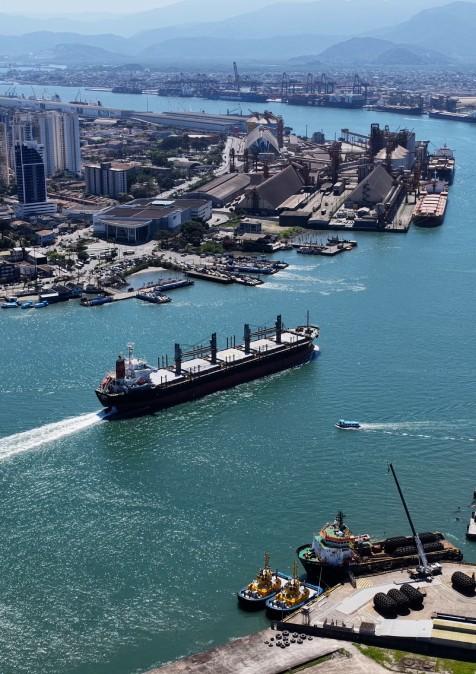 April 1, 2026We are now in the fifth week since the U.S. airstrike that killed top leaders of the Iranian regime, initiating a war involving the United States and Israel against the country. More than a month of mutual bombardments between Iran and Israel has ensued, extending to other Persian Gulf nations, U.S. military installations—and even Cyprus. From a global perspective, the impact has stemmed primarily from disruptions to regional production of goods and the blockade of the Strait of Hor ...
 -
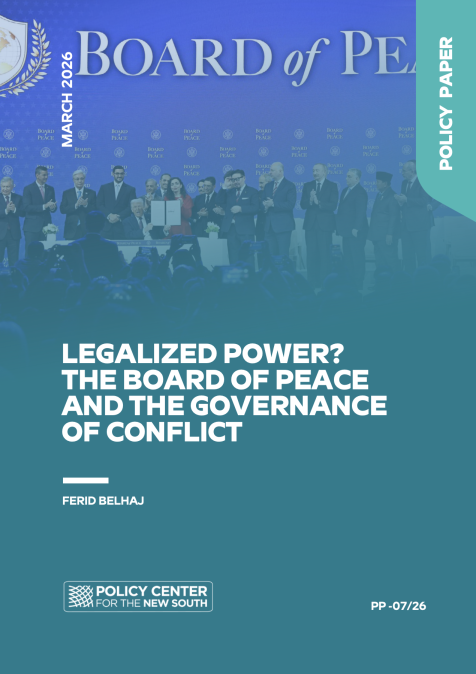 March 30, 2026This essay examines the establishment of the Board of Peace as a test case in contemporary peace governance and hegemonic experimentation. While the Board, politically activated in early 2026 and formally anchored in a resolution of the United Nations Security Council, benefits from derivative legality under the UN Charter, its legal foundation remains constitutionally fragile, its mandate ambiguously constrained, and its accountability architecture underdeveloped, notwithstand ...
 -
March 27, 2026This interview analyzes how tariff wars are transforming global power dynamics, disrupting trade systems, and redefining trade policy as a geopolitical tool, while examining the risks and opportunities for emerging economies and the Global South, the repositioning of regions like Latin ...

