
John Sawers, former Chief of the Secret Intelligence Service (MI6), shares his insights on how security threats have evolved with the rise of digital technologies and social media. In this interview, he offers a compelling exploration of the shift from traditional methods to contemporary security challenges. Sawers examines how intelligence approaches have adapted to address new threats, including the influence of social media on democratic processes and the evolving global geopolitical landscape. The discussion provides An insightful analysis of the current dynamics in intelligence work and highlights the critical issues facing intelligence services in an increasingly interconnected and digital world.
RELATED CONTENT
-
 October 23, 2026In this episode, Mehran Haghirian explores the global economic consequences of disruptions in the Strait of Hormuz, beyond oil and gas. He examines their impact on trade, fertilizer suppl ...
 -
 October 22, 2026Strategic hedging is rational when it preserves a worthwhile choice at a tolerable cost while respecting existing commitments. Drawing on the literature on hedging and Latin American autonomy, this Policy Brief examines contrasting illustrations of that proposition. It distinguishes ambiguity about future alignment from uncertainty about existing obligations and explains how clearly bounded commitments can reconcile autonomy with credibility. The cases reveal different vulnerabiliti ...
 -
 October 13, 2026“Every gun that is made, every warship launched, every rocket fired signifies in the final sense, a theft from those who hunger and are not fed, those who are cold and are not clothed.”President Dwight Eisenhower, April 16, 1953 This paper examines the economic and human impacts of the first six months of the Iran war—from February to the end of August 2026—on Iran’s Arab neighbors and compares these impacts with those on the three countries directly involved—Iran, Israel and t ...
 -
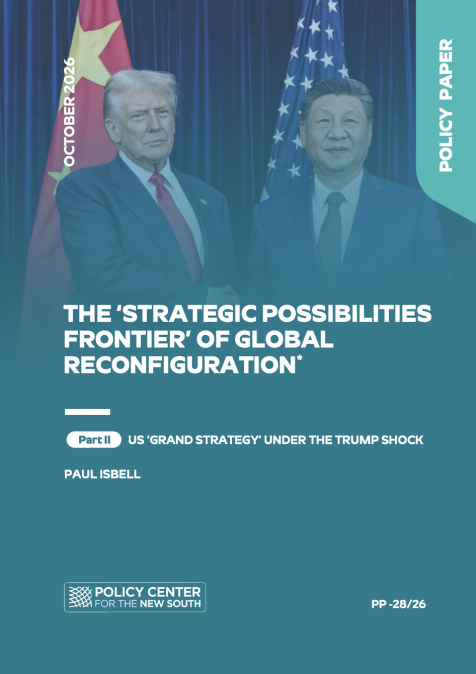 October 9, 2026In the first seven Policy Briefs of this ongoing series of analysis on Pan-Atlanticism: The Atlantic Basin in a Multipolar-Transnational World, we developed the argument that the strategic significance of the Atlantic Basin is on the rise for a range of international actors (states, regions and non-state agents) and from distinct political or ideological perspectives. In addition, in the most recently published Policy Brief -- “The U.S. and the Current International Reconfiguration: ...
 -
 October 8, 2026In the two years since the fall of Bashar al-Assad in Syria, Russia has restructured its Mediterranean presence. Although Russia’s limited and increasingly conditional access to the Khmeimim and Tartus facilities in Syria has been preserved, its presence in the country has morphed from Assad’s ‘patron-client’ configuration to a more negotiated engagement. Simultaneously, Russia has upgraded its force-projection and logistical infrastructure in eastern Libya, giving it an access path ...
 -
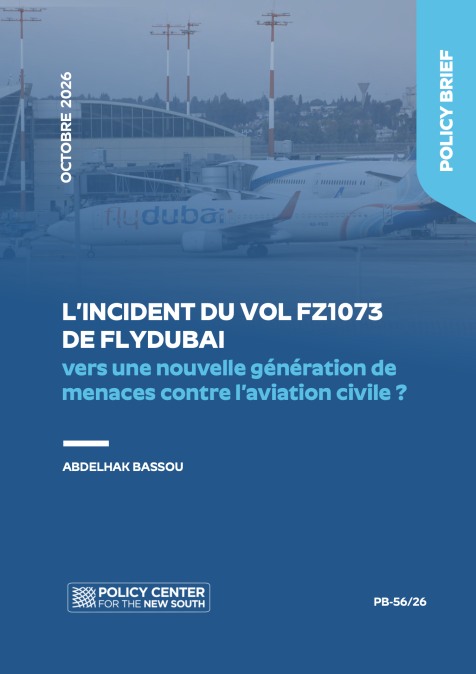 October 2, 2026L’incident du vol FZ1073 entre Dubaï et Tel-Aviv ne permet encore aucune attribution définitive. Il constitue en revanche un révélateur utile : à mesure que la sûreté aérienne ferme les voies classiques d’intrusion, la menace cherche à emprunter des voies alternatives en exploitant les personnes, les prestataires et les systèmes auxquels l’écosystème aéronautique doit nécessairement accorder sa confiance. ...
 -
October 02, 2026Building on his Policy Brief "Latin America, World Politics and the Great Powers", Nizar Messari examines how recent developments are reshaping U.S. influence in the region and affecting ...
-
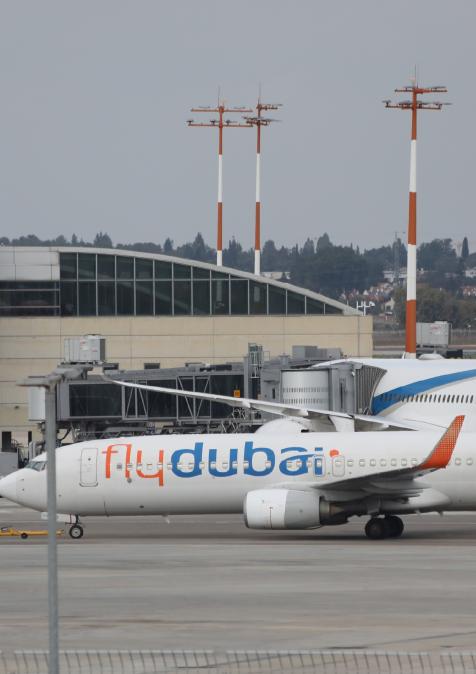 October 2, 2026The incident involving Flydubai Flight FZ1073 between Dubai and Tel Aviv does not yet support any definitive attribution. It does, however, provide a useful warning sign: as aviation security closes off traditional avenues of intrusion, threats may shift towards alternative pathways by exploiting the people, service providers, and systems that the aviation ecosystem must necessarily trust. ...
 -
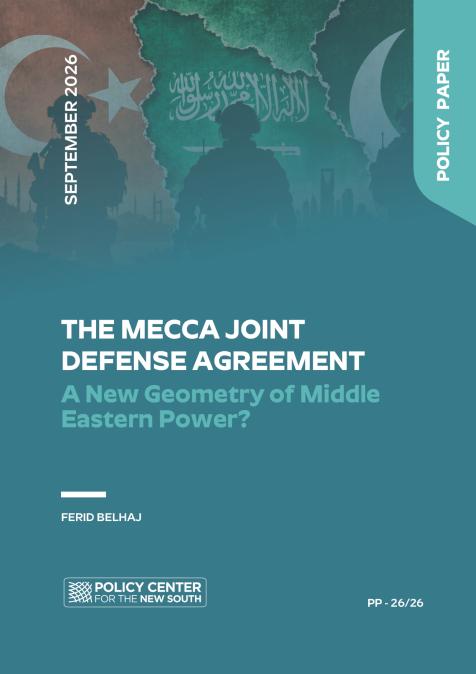 September 30, 2026On August 7, 2026, Saudi Arabia, Turkey, and Pakistan signed the Mecca Joint Défense Agreement, a collective-defense pact widely compared to NATO’s Article 5. This essay argues that the comparison is misleading. Mecca borrows NATO’s language of solidarity without yet possessing NATO’s institutional machinery, and the Houthi offensive against Saudi Arabia in September 2026 provided an early and revealing test of what the agreement actually means in practice. Neither Pakistan nor Turk ...
 -
 September 25, 2026Dans cet épisode d’Africafé, Amadou Diop analyse les défis de sécurité maritime auxquels font face les pays de l’Afrique atlantique, de la piraterie aux trafics transfrontaliers. Il souligne la nécessité de mutualiser les moyens et de partager l’information entre États. L’échange aborde...

