APSACO 2021 - WORKSHOP : Report Presentation: ISIS Files

June 23, 2021

The events in Iraq and Syria over the last seven years constitute one of the darkest pages in recent history. The so-called Islamic State (IS) managed to control an area the size of Britain and dominated its residents with an iron fist. It subjugated, terrorized and confiscated property of religious minorities. It mercilessly killed its opponents. It created a pervasive system of enforcement of strict moral codes, meting out corporal punishment to those who did not abide by them. It used its territory to plan and incite terrorist attacks worldwide. And it even officially introduced slavery, sanctioning it with religious edicts and imposing it on thousands of women from the Yazidi minority. In order to do all this the Islamic State created an extremely sophisticated bureaucracy. Seeing itself as a state, it created ministries, administrations, a complex tax collection system, even a consumer protection agency. And this bureaucracy, like any other, left behind a huge paper trail, a myriad of documents that reveal the inner workings of one of history’s deadliest and best organized terrorist organizations. Starting in 2015, as the Iraqi government and the international community had begun to take the battle to IS, New York Times reporter Rukmini Callimachi spent several months embedded with the Iraqi military as it liberated areas of Iraq from IS. While reporting on the military efforts, Callimachi also obtained permission from the Iraqi army officials she was embedded with to retrieve some of the documents IS had left behind. She ended up collecting some 15,000 pages of documents which came to be known as “The ISIS Files”. Callimachi and The New York Times understood the importance of making this collection, which documents a dark page of recent history that has hardly been completely turned, available to the public. In 2018, The New York Times and the George Washington University announced an exclusive partnership to digitize, translate, analyze, and publish roughly 15,000 pages of internal ISIS Files. Extensive work has been done by GW to preserve and present the information contained in The ISIS Files in an accurate, accessible, secure, and impartial manner. The ISIS Files project is ongoing with documents in additional themes being made available as they are completed. ------ Moderator: Mehdi Benomar, Head of Department of Research in International Relations, Policy Center for the New South Speakers: Devorah Margolin, Adjunct Professor, George Washington University Discussants: - Dina Hussein, Counterterrorism Policy Lead for EMEA, Facebook - El Mostafa Rezrazi, Senior Fellow, Policy Center for the New South

Speakers
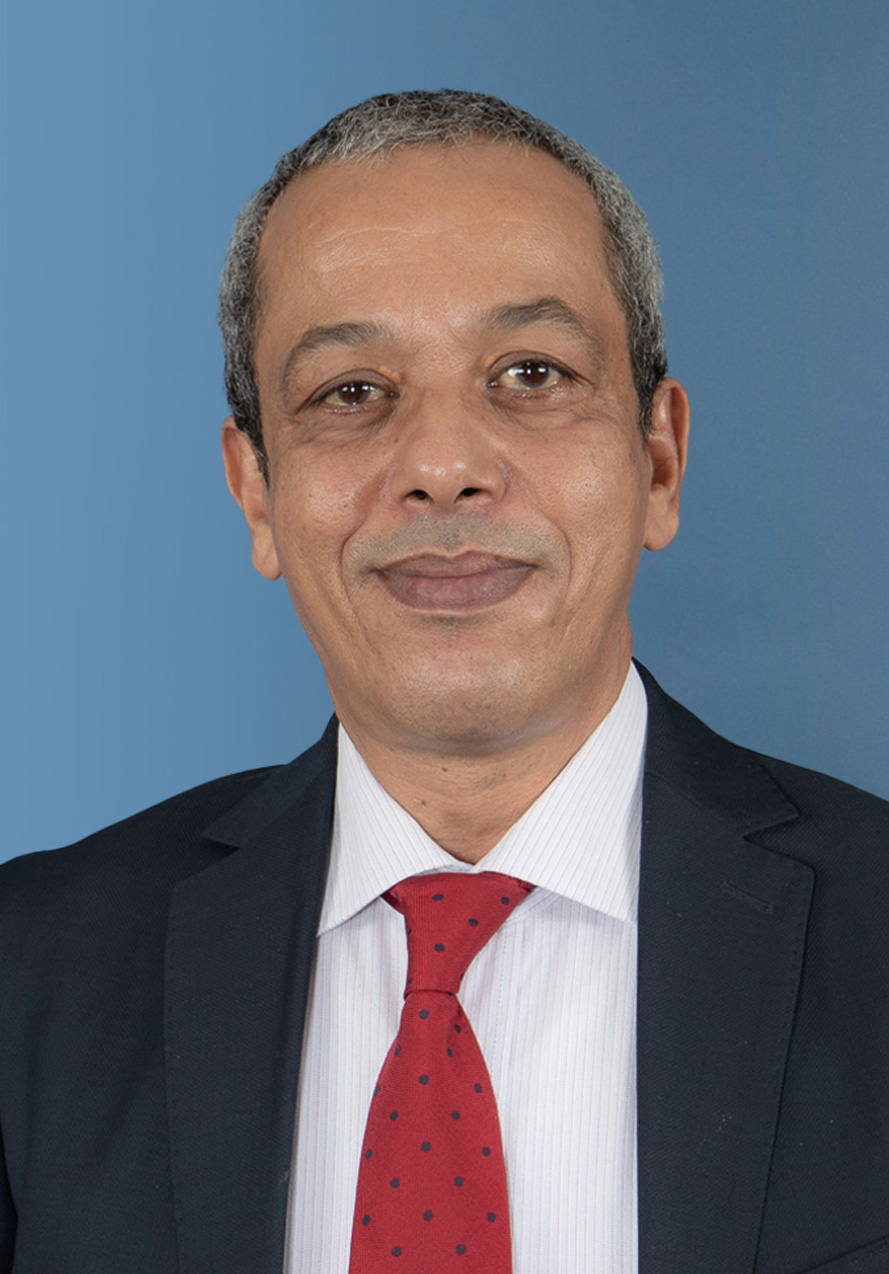
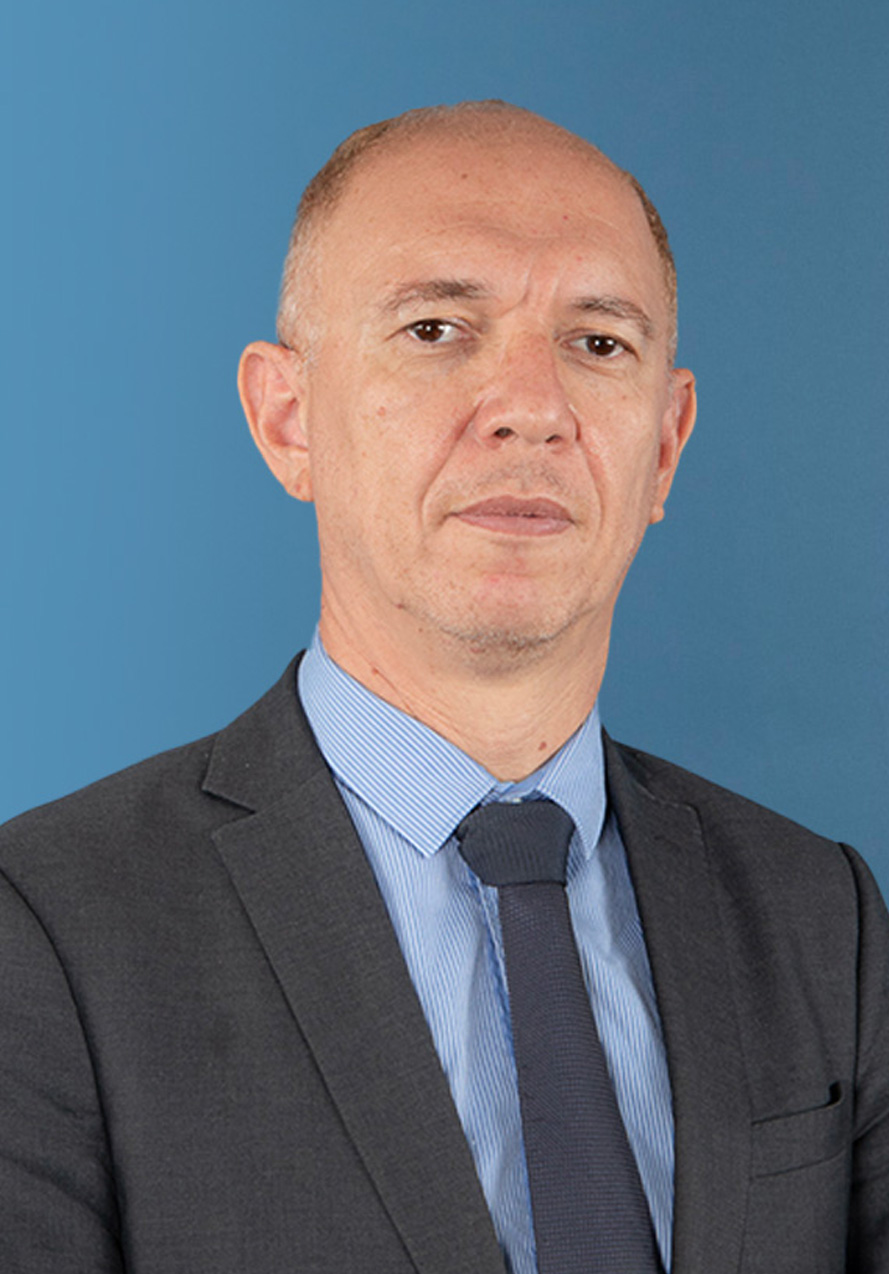
Mehdi Benomar
Head – Research in International Relations
Mehdi Benomar has cumulated 18 years of experience as analyst and occupied several positions in public organizations: in National Defense as head of division (2000-2008), in the cabinet of the ministry of Mines and Energy (2010-12) and in OCP Group (2012-2017). He also served as senior consultant in private firm Global Intelligence Partners (G.I.P.) (2008-2010) in Rabat. He specialized in strategic monitoring issues and contributed on different topics related to proliferation, energy and development in sub-Saharan Africa. Nuclear Engineer, he graduated from the Commissariat à l'énergie atomique et aux énergies alternatives and has a master in sciences. ...
El Mostafa Rezrazi
Senior Fellow
Dr El Mostafa Rezrazi is a professor of Crisis Management, and Security Studies and a Senior Fellow at the Policy Center for the New South who focuses on Terrorism, Security and East Asia studies. His area of Expertise covers Afro-Asian Affairs, Strategic & Security Studies, Terrorism, Extremism and Deradicalization, mainly from the view of Criminal; Legal and Forensic Psychology.  He got his Ph.D. in Regional & International Affairs from the University of Tokyo in 1998, and later a Doctorate from the University of Mohammed V on the Psychological dynamisms of Suicide Bombers (2014). He is the executive director of the Moroccan Observatory on Extremism and Violence, Director of the African Center for Asian Studies, Rabat. Currently, he is Visiting Professor a ...
RELATED CONTENT

  • Authors
    June 13, 2016
    La constitution en 1980 du contingent des Moudjahidin en Afghanistan, pour lutter contre l'occupation soviétique, avait ouvert la porte devant l'internationalisation du Djihadisme, qui jusqu'à cette date était confiné dans des dimensions locales et nationales. Cette internationalisation avait donné naissance à la première internationale terroriste qu'est Al Qaeda. Le terrorisme international avait pris, avec l'invasion des Etats-Unis en Irak, une autre dimension qui a abouti en 2014 ...
  • Authors
    June 13, 2016
    In 1980, the establishment of the Mujahideen contingent in Afghanistan to fight against the Soviet occupation opened the door to the globalization of jihadism, which until then had been confined to local and national dimensions. This globalization gave rise to the first international terrorist group, Al Qaeda. With the United States’ invasion of Iraq, international terrorism took another dimension that culminated in 2014 with the birth of the "Islamic State", also known as Daech. Ch ...
  • Authors
    April 26, 2016
    Après l’intervention russe en Syrie, l’intensification des frappes aériennes de la coalition arabo- occidentale sur les positions de Daech et la libération d’une partie des provinces occupées par l’organisation en Irak, les voix commencent à s’élever dans plusieurs cercles officiels pour annoncer la fin prochaine de « l’organisation Etat islamique ». Daech a subi sur le terrain de sérieux revers. De Ramadi à Palmyre en passant par Kobané et Tikrit, Russes, américains, armée ir ...
  • March 31, 2016
    In the context of the strategic partnership between OCP Policy Center and the German Marshall Fund of the United States, the Policy Center is a key partner for the Brussels Forum organized by GMF. - The Hon. Youssef Amrani, Head of Mission, Royal Cabinet, Kingdom of Morocco - General ...
  • Authors
    March 16, 2016
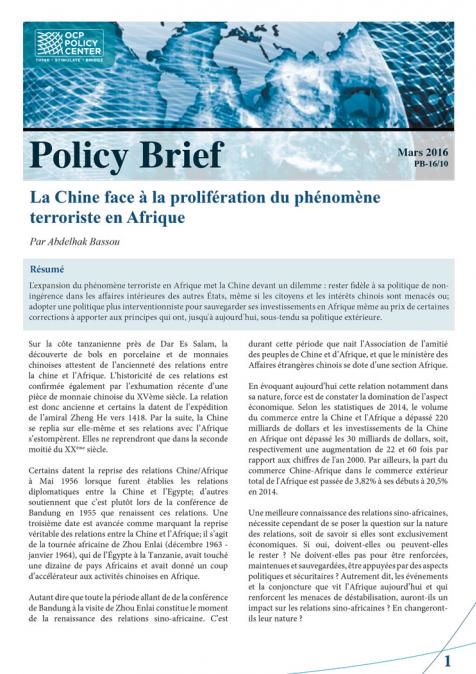
    L'expansion du phénomène terroriste en Afrique met la Chine devant un dilemme : rester fidèle à sa politique de noningérence dans les affaires intérieures des autres États, même si les citoyens et les intérêts chinois sont menacés ou; adopter une politique plus interventionniste pour sauvegarder ses investissements en Afrique même au prix de certaines corrections à apporter aux principes qui ont, jusqu'à aujourd'hui, sous-tendu sa politique extérieure. ...
  • Authors
    March 16, 2016
    The expansion of the terrorist phenomenon in Africa puts China in a dilemma: to remain true to its non-interference policy in the internal affairs of other States, even if Chinese citizens and interests are threatened or; adopt a more interventionist policy to protect its investments in Africa even at the cost of making certain corrections to the principles that have, until now, underpinned its foreign policy. ...
  • Authors
    February 23, 2016
    Deux des plus grands producteurs d'hydrocarbures en Afrique, le Nigeria sur l'Atlantique et la Libye sur la Méditerranée font face aux deux groupes terroristes les plus violents sur le continent. Daech version libyenne et Boko Haram semblent avancer pour se rejoindre dans un espace constitué par trois Etats qui présentent des vulnérabilités favorables à l'extension du terrorisme. Au Cameroun, le chao est à craindre dans l'après Biya. La battle fatigue peut atteindre l'Etat tchadien ...
  • Authors
    February 23, 2016
    Two of the largest oil producers in Africa, Nigeria on the Atlantic and Libya on the Mediterranean are facing the two most violent terrorist groups on the continent. The Libyan version of Daesh and Boko Haram seem to be gaining ground to join in an area formed by three states that are vulnerable to the spread of terrorism. In Cameroon, the chaos is a concern post-Biya. Battle fatigue may reach the Chadian state that has been involved in an all-out battle. Niger, which is limited by ...
  • Authors
    December 7, 2015
    The Euro-Mediterranean Partnership was initiated with the aim to build a space of shared prosperity and security among all the countries in the region. The achievement of this objective, however, continues to be challenged by several geopolitical, economic and social factors. In such a context, there is now a greater urgency to adapt the approach and the instruments, thus allowing Euro-Mediterranean partners to seize opportunities towards an effective area of shared stability and pr ...