APSACO 2021 - WORKSHOP : Report Presentation: ISIS Files

June 23, 2021

The events in Iraq and Syria over the last seven years constitute one of the darkest pages in recent history. The so-called Islamic State (IS) managed to control an area the size of Britain and dominated its residents with an iron fist. It subjugated, terrorized and confiscated property of religious minorities. It mercilessly killed its opponents. It created a pervasive system of enforcement of strict moral codes, meting out corporal punishment to those who did not abide by them. It used its territory to plan and incite terrorist attacks worldwide. And it even officially introduced slavery, sanctioning it with religious edicts and imposing it on thousands of women from the Yazidi minority. In order to do all this the Islamic State created an extremely sophisticated bureaucracy. Seeing itself as a state, it created ministries, administrations, a complex tax collection system, even a consumer protection agency. And this bureaucracy, like any other, left behind a huge paper trail, a myriad of documents that reveal the inner workings of one of history’s deadliest and best organized terrorist organizations. Starting in 2015, as the Iraqi government and the international community had begun to take the battle to IS, New York Times reporter Rukmini Callimachi spent several months embedded with the Iraqi military as it liberated areas of Iraq from IS. While reporting on the military efforts, Callimachi also obtained permission from the Iraqi army officials she was embedded with to retrieve some of the documents IS had left behind. She ended up collecting some 15,000 pages of documents which came to be known as “The ISIS Files”. Callimachi and The New York Times understood the importance of making this collection, which documents a dark page of recent history that has hardly been completely turned, available to the public. In 2018, The New York Times and the George Washington University announced an exclusive partnership to digitize, translate, analyze, and publish roughly 15,000 pages of internal ISIS Files. Extensive work has been done by GW to preserve and present the information contained in The ISIS Files in an accurate, accessible, secure, and impartial manner. The ISIS Files project is ongoing with documents in additional themes being made available as they are completed. ------ Moderator: Mehdi Benomar, Head of Department of Research in International Relations, Policy Center for the New South Speakers: Devorah Margolin, Adjunct Professor, George Washington University Discussants: - Dina Hussein, Counterterrorism Policy Lead for EMEA, Facebook - El Mostafa Rezrazi, Senior Fellow, Policy Center for the New South

Speakers
Mehdi Benomar
Head – Research in International Relations
Mehdi Benomar has cumulated 18 years of experience as analyst and occupied several positions in public organizations: in National Defense as head of division (2000-2008), in the cabinet of the ministry of Mines and Energy (2010-12) and in OCP Group (2012-2017). He also served as senior consultant in private firm Global Intelligence Partners (G.I.P.) (2008-2010) in Rabat. He specialized in strategic monitoring issues and contributed on different topics related to proliferation, energy and development in sub-Saharan Africa. Nuclear Engineer, he graduated from the Commissariat à l'énergie atomique et aux énergies alternatives and has a master in sciences. ...
El Mostafa Rezrazi
Senior Fellow
Dr El Mostafa Rezrazi is a professor of Crisis Management, and Security Studies and a Senior Fellow at the Policy Center for the New South who focuses on Terrorism, Security and East Asia studies. His area of Expertise covers Afro-Asian Affairs, Strategic & Security Studies, Terrorism, Extremism and Deradicalization, mainly from the view of Criminal; Legal and Forensic Psychology.  He got his Ph.D. in Regional & International Affairs from the University of Tokyo in 1998, and later a Doctorate from the University of Mohammed V on the Psychological dynamisms of Suicide Bombers (2014). He is the executive director of the Moroccan Observatory on Extremism and Violence, Director of the African Center for Asian Studies, Rabat. Currently, he is Visiting Professor a ...

RELATED CONTENT

  • Authors
    Lemine Ould M. Salem
    June 6, 2018
    Les quatre acteurs majeurs de la crise libyenne ont approuvé, le 29 mai 2018, lors du Sommet organisé par le Président français Emmanuel Macron au Palais de l’Elysée à Paris, une “Déclaration politique sur la Libye” qui prévoit l’organisation le 10 décembre prochain d’un double scrutin, législatif et présidentiel. Ce texte “historique”, selon le Chef de l’Etat français, reste cependant menacé par la complexité de la réalité sur le terrain libyen. On ne compte plus les initiatives v ...
  • Authors
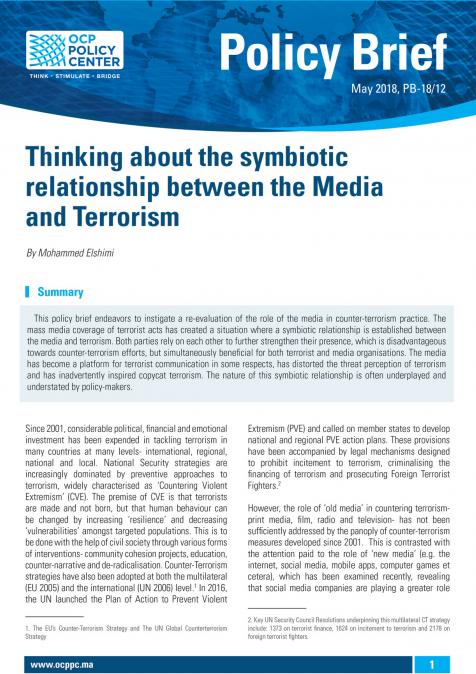
    Mohammed Elshimi
    May 3, 2018
    This policy brief endeavors to instigate a re-evaluation of the role of the media in counter-terrorism practice. The mass media coverage of terrorist acts has created a situation where a symbiotic relationship is established between the media and terrorism. Both parties rely on each other to further strengthen their presence, which is disadvantageous towards counter-terrorism efforts, but simultaneously beneficial for both terrorist and media organisations. The media has become a pl ...
  • Authors
    Mokhtar Ghailani
    April 9, 2018
    Fidèle à sa tradition de diffuser la connaissance et de promouvoir le débat d’idées, l’OCP Policy Center a reçu, le 5 avril 2018, le journaliste mauritanien Lemine Ould Salem, pour la présentation de son tout dernier livre intitulé « L’histoire secrète du Djihad. D’al-Qaïda à l’Etat islamique», paru en janvier dernier aux éditions Flammarion. Dans cet ouvrage, l’auteur rapporte ses entrevues avec l’une des principales figures d’Al-Qaïda, Abou Hafs en l’occurrence, « conseiller spiri ...
  • Authors
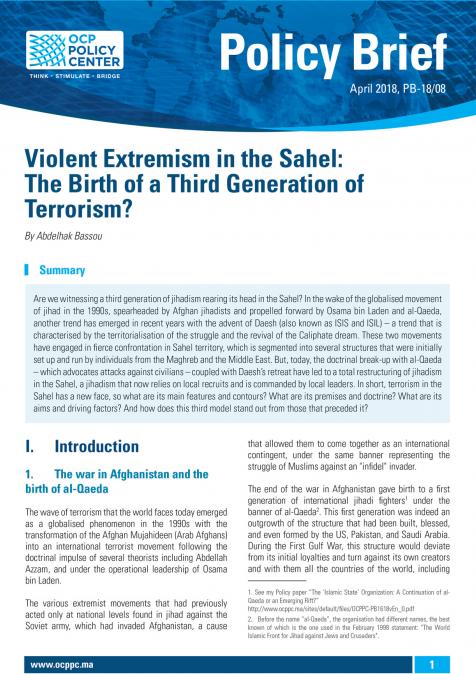
    April 5, 2018
    Are we witnessing a third generation of jihadism rearing its head in the Sahel? In the wake of the globalised movement of jihad in the 1990s, spearheaded by Afghan jihadists and propelled forward by Osama bin Laden and al-Qaeda, another trend has emerged in recent years with the advent of Daesh (also known as ISIS and ISIL) – a trend that is characterised by the territorialisation of the struggle and the revival of the Caliphate dream. These two movements have engaged in fierce conf ...
  • Authors
    April 5, 2018
    هل نشهد اليوم نشأة جيل ثالث من العنف في الساحل؟ بعد الظاهرة العالمية لتسعينيات القرن الماضي التي نشأت بدافع من المجاهدين الأفغان وقادها أسامة بن لادن وتنظيم القاعدة، برز مع ظهور تنظيم داعش خلال السنوات الأخيرة تيار جديد يتسم بأقلمة النضال وحُلم الخلافة. وخاضت هاتان الحركتان معركة صعبة على أرض الساحل المجزأة إلى العديد من الهياكل المؤلفة في البداية من قيادات تنحدر من المغرب العربي والشرق الأوسط. لكن، القطيعة المذهبية مع تنظيم القاعدة – الذي يدعو إلى مهاجمة الساكنة المدنية – وتراج ...
  • Authors
    April 5, 2018
    Sommes-nous en train d’assister à l’émergence d’une troisième génération de jihadisme au Sahel ? Après le phénomène mondialisé des années 90 né sous l’impulsion des jihadistes afghans et porté par Oussama Ben Laden et Al Qaeda, un autre courant a vu le jour ces dernières années avec l’arrivée de Daech, caractérisé par une territorialisation de la lutte et le rêve d’un califat. Ces deux mouvements se sont livrés une rude bataille en terrain sahélien, fragmenté en plusieurs structures ...
  • Authors
    Mokhtar Ghailani
    March 30, 2018
    L’OCP Policy Center a eu la primeur de la présentation, par l’historien Jean Pierre Filiu, de son dernier livre « Généraux, gangsters et jihadistes. Histoire de la contre-révolution arabe », la toute première hors de son pays, la France. Une première dont il se réjouira au début du débat-échange autour de son ouvrage, tenue le 28 mars 2018, en partenariat avec l’Institut Français du Maroc. Habitué à faire appel à plusieurs disciplines scientifiques à la fois, telles que l ...
  • Authors
    December 20, 2017
    La troisième et dernière journée de la conférence de haut niveau Atlantique Dialogues, organisée du 13 au 15 décembre à Marrakech par l’OCP Policy Center, a porté pour l’essentiel sur des questions de géopolitique africaine, ainsi que sur la “croissance sans emploi”, “les partenariats Sud-Sud” et les témoignages apportés par trois anciens présidents d’Argentine et du Costa-Rica sur les trajectoires de développement latino-américaines. “Sécurité dans le Sahel et implications transat ...