Publications /
Policy Paper

Back
The Secretary-General of Everything and the United Nations of Nothing: How Mission Inflation Has Weakened the UN and Why the Next Secretary-General Must Put Peace First
Authors
August 25, 2026

The next Secretary-General should begin with an act of institutional rebellion: refuse to become the Secretary-General ofeverything. Over three decades the office's political and administrative reach has spread across sustainable development, climate, health, migration, digital governance, financing, gender, food systems, and a still-growing list of global priorities. These issues are not unimportant; the trouble is that institutional ambition has simply outrun institutional capability. Call it mission inflation: more agendas, more coordination mechanisms, more summits and declarations, and a correspondingly diffuse sense ofwho is actually responsible for what.

This essay draws on the post-1945 architecture of the United Nations, the Bretton Woods institutions, and the specialized agencies to argue for a return to functional specialization and institutional subsidiarity. The Secretariat should gradually withdraw from fields where other institutions already hold stronger financing instruments, technical depth, or operational authority, while the Secretary-General preserves political capital for the tasks that have no substitute: preventive diplomacy, mediation, collective security, and the preservation of international peace. At a moment of renewed great-power rivalry and multiplying wars, a stronger United Nations may need a more disciplined Secretariat — one prepared to do less, in order to become indispensable again in theone area the Charter actually gave it.
RELATED CONTENT

  • Authors
    Carlos Antonio Carrasco
    Pascal Chaigneau
    Nicolas Desgrais
    Thierry Garcin
    Firmin Edouard Matoko
    Bouchra Rahmouni
    Michel Raimbaud
    Olivier Tramond
    April 10, 2019
    À travers cette publication conjointe, le Centre HEC de Géopolitique et le Policy Center for the New South ont souhaité présenter seize papiers discutés et enrichis au cours de la sixième édition des Dialogues Stratégiques qui s’est tenue le 3 octobre 2018. Cette rencontre avait choisi d’analyser l’espace politique et les enjeux géostratégiques de notre monde contemporain en se focalisant sur deux sujets d’actualité internationale : les crises et sorties de crises en Amérique l ...
  • Authors
    Matthieu Tardis
    February 8, 2019
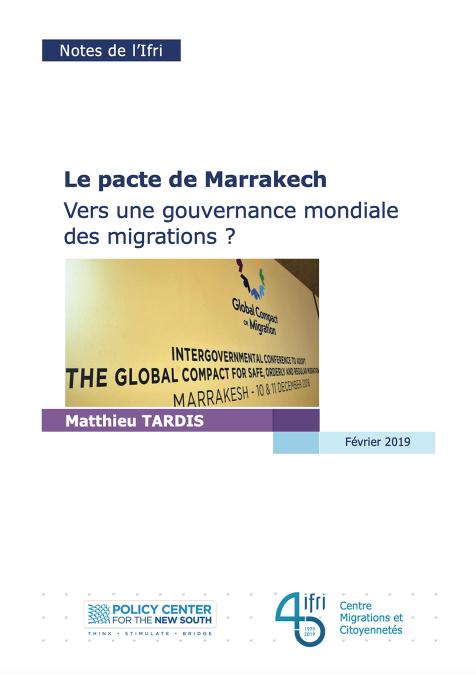
    Le « Pacte mondial pour des migrations sûres, ordonnées et régulières » a été adopté à Marrakech les 10 et 11 décembre 2018, à l’issue de 18 mois de consultations et de négociations. Il est présenté comme le premier accord des Nations unies sur une approche globale des migrations internationales dans toutes ses dimensions. S’il vise à devenir la pierre angulaire d’une gouvernance mondiale des migrations, souhaitée par la communauté internationale, il se heurte pourtant à des priorit ...
  • Authors
    Pierre-Richard Agénor
    November 30, 2018
    L'importance de la stabilité macroéconomique et financière pour l'amélioration à long terme des niveaux de vie a conduit à un profond renouvellement de l'analyse macroéconomique dans les pays en développement, tant sur le plan analytique qu'empirique. Pour la première fois, le présent ouvrage fournit au public francophone un traitement approfondi et rigoureux des questions actuelles liées à l'analyse et à la gestion macroéconomique dans ces pays. Cette macroéconomie du développemen ...
  • Authors
    November 15, 2018
    The workshop “Coping with Climate Change” gathered experts, policy-makers and researchers to discuss recent econometric work on decoupling greenhouse gas emissions and economic growth. It explored different policies and instruments that countries and financial institutions are adopting to cope with the effects of climate change (adaptation) and to contribute to the global effort to combat climate change (mitigation).    Session 1: Decoupling of Emissions and Economic Acti ...
  • Authors
    Anabel Gonzalez
    August 30, 2018
    The agreement establishing the African Continental Free Trade Area (AfCFTA) is a framework to create a free trade area across the region, bringing together the 55 members of the African Union into a continental market with a cumulative Gross Domestic Product (GDP) exceeding US$2.2 trillion and a total population of over one billion people. When concluded and successfully implemented, it will become the largest free trade area in the world in terms of membership, opening up significa ...
  • Authors
    Malik Abaddi
    August 8, 2018
    The African Union goes to Mauritania Under the theme “Winning the Fight Against Corruption”, the 31st Summit of the African Union was held in early July in the desert capital Nouakchott. In a bitter prelude in late June, the AU’s commitment to this central theme was dealt a blow with the sudden – and public – resignation of Ghana’s Daniel Batidam from the AU Advisory Board on Corruption. Off to a rocky start, the summit had an even rougher road ahead of it.  A month ...