Publications /
Policy Paper

Back
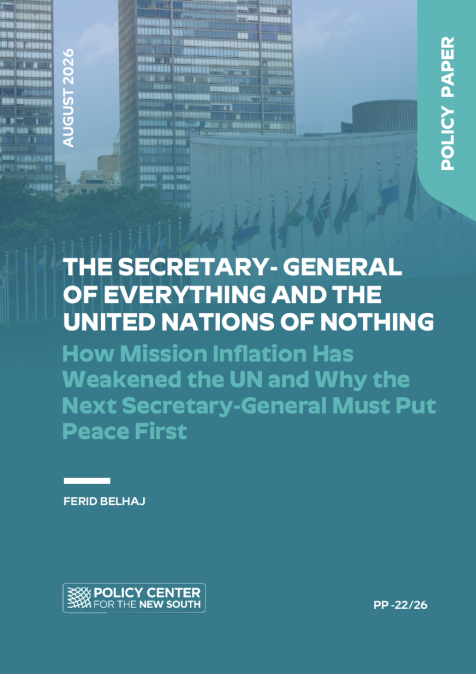
The Secretary-General of Everything and the United Nations of Nothing: How Mission Inflation Has Weakened the UN and Why the Next Secretary-General Must Put Peace First
Authors
August 25, 2026

The next Secretary-General should begin with an act of institutional rebellion: refuse to become the Secretary-General ofeverything. Over three decades the office's political and administrative reach has spread across sustainable development, climate, health, migration, digital governance, financing, gender, food systems, and a still-growing list of global priorities. These issues are not unimportant; the trouble is that institutional ambition has simply outrun institutional capability. Call it mission inflation: more agendas, more coordination mechanisms, more summits and declarations, and a correspondingly diffuse sense ofwho is actually responsible for what.

This essay draws on the post-1945 architecture of the United Nations, the Bretton Woods institutions, and the specialized agencies to argue for a return to functional specialization and institutional subsidiarity. The Secretariat should gradually withdraw from fields where other institutions already hold stronger financing instruments, technical depth, or operational authority, while the Secretary-General preserves political capital for the tasks that have no substitute: preventive diplomacy, mediation, collective security, and the preservation of international peace. At a moment of renewed great-power rivalry and multiplying wars, a stronger United Nations may need a more disciplined Secretariat — one prepared to do less, in order to become indispensable again in theone area the Charter actually gave it.

RELATED CONTENT

  • December 16, 2022
    In this video recorded during the Atlantic Dialogues, our Columnist Mr. Helmut Sorge interviews Ms. Ana Palacio, Spain's Former Minister of Foreign Affairs on the position of Spain and Europe towards the War in Ukraine, the interview also tackles different questions regarding Energy, se...
  • December 16, 2022
    In this video recorded during the Atlantic Dialogues, our Columnist Mr. Helmut Sorge interviews Mr. Alessandro Minuto-Rizzo, President of the NATO Defense College Foundation in Rome on the NATO’s reactions amidst the War in Ukraine, Mr Minuto answers questions on how countries of the Na...
  • September 20, 2022
      أصدر مركز السياسات من أجل الجنوب الجديد النسخة الخامسة للتقرير السنوي للجيوسياسة الإفريقية بنقاط قوتها ومعيقاتها، بمميزاتها وعيوبها، ما يجب تصحيحه وإعادة تنظيمه، وما يجب صيانته وتقويته وتوطيده. تدور الأسئلة التي تم تناولها من خلال التقرير حول جهات القارة الافريقية بين الأمن و ال...
  • Authors
    August 11, 2022
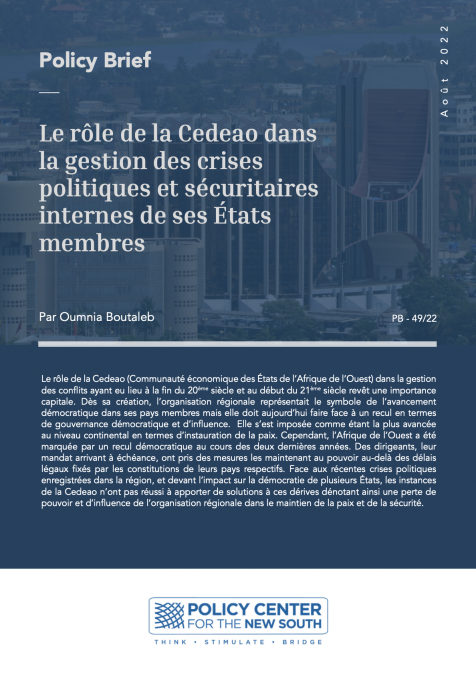
    Le rôle de la Cedeao (Communauté économique des États de l’Afrique de l’Ouest) dans la gestion des conflits ayant eu lieu à la fin du 20ème siècle et au début du 21ème siècle revêt une importance capitale. Dès sa création, l’organisation régionale représentait le symbole de l’avancement démocratique dans ses pays membres mais elle doit aujourd’hui faire face à un recul en termes de gouvernance démocratique et d’influence. Elle s’est imposée comme étant la plus av ...
  • August 9, 2022
    يخصص مركز السياسات من أجل الجنوب الجديد حلقة برنامجه الأسبوعي "حديث الثلاثاء" لمناقشة العلاقات الافريقية اليابانية في ضوء القمة الثامنة "تيكاد 2022" التي ستنعقد في تونس نهاية هذا الشهر مع عبد الله ساعف، باحث بارز بمركز السياسات من أجل الجنوب الجديد. جاء اهتمام اليابان بأفريقيا في ...
  • Authors
    Said El Hachimi
    July 27, 2022
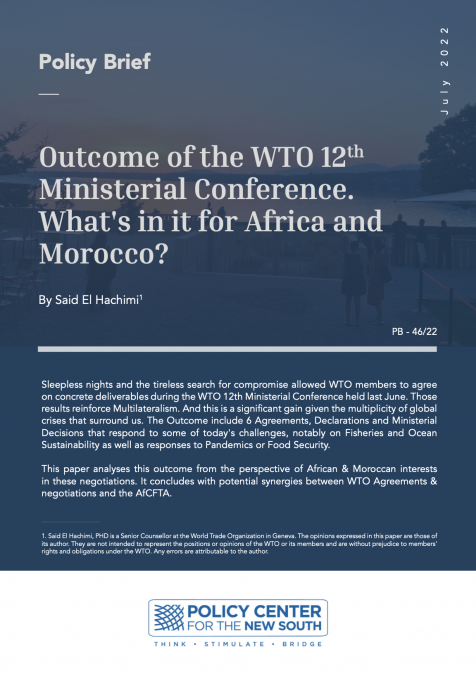
    Sleepless nights and the tireless search for compromise allowed WTO members to agree on concrete deliverables during the WTO 12th Ministerial Conference held last June. Those results reinforce Multilateralism. And this is a significant gain given the multiplicity of global crises that surround us. The Outcome include 6 Agreements, Declarations and Ministerial Decisions that respond to some of today's challenges, notably on Fisheries and Ocean Sustainability as well as responses to P ...
  • Authors
    July 25, 2022
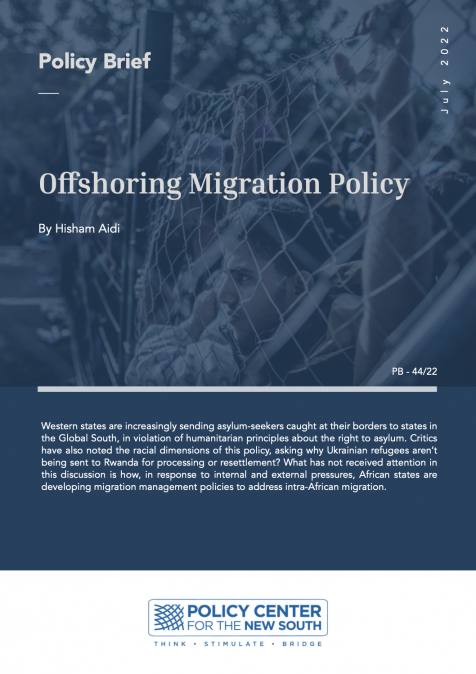
    Western states are increasingly sending asylum-seekers caught at their borders to states in the Global South, in violation of humanitarian principles about the right to asylum. Critics have also noted the racial dimensions of this policy, asking why Ukrainian refugees aren’t being sent to Rwanda for processing or resettlement? What has not received attention in this discussion is how, in response to internal and external pressures, African states are developing migration management ...