Publications /
Policy Paper

Back
The United States' economic strategy and presence in the Maghreb
Authors
Kassim Bouhou
September 17, 2010

Before the 9/11 events, US-Maghreb relations were growing stronger, especially after the United States had long left the floor to the Maghreb’s “natural” European partner. Therefore the American action in this region was in line with a mechanism previously set off by Clinton Administration member, Stuart Eizenstat, which aimed at reducing intra regional obstacles and stimulating American investments towards an area where Americans were little-represented. Hence Washington seemed more involved in promoting the emergence of a strong, world-economy-integrated Maghrebi market.
RELATED CONTENT

  • Authors
    January 15, 2020
    “The Nightmare we feared has arrived” Death was late because the departure time of the plane was delayed. But death arrived- six minutes after takeoff from Tehran’s “Imam Khomeini International Airport. It was still dark, 6.12 hours’ local time, when flight 752 of “Ukraine International Airlines” took course toward Kyiv, the Ukraine capital three hours and fourty two minutes away. The Boeing 737 800 NG had reached 2400 meters, when the American military’s “Space Based Infrared ...
  • Authors
    Simone Tagliapieta
    Marion Jansen
    Yassine Msadfa
    Mario Filadoro
    August 28, 2017
    Endowed with half of the world’s known oil and gas reserves, the Middle East and North Africa (MENA) region became – particularly during the second half of the twentieth century – a cornerstone of the global energy architecture (Yergin, 1991, 2011; Maugeri, 2006). This architecture is currently undergoing a structural transformation, prompted by two different forces: decarbonisation policies and technological developments. The adoption and quick entry into force of the Paris Agreem ...
  • Authors
    Russel Dinh
    January 27, 2016
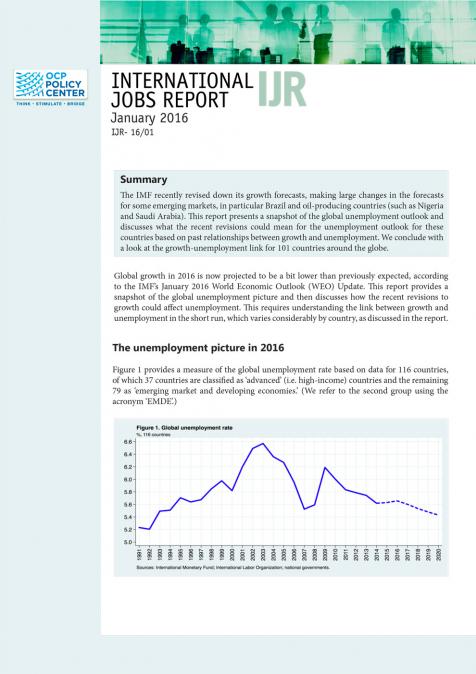
    The IMF recently revised down its growth forecasts, making large changes in the forecasts for some emerging markets, in particular Brazil and oil-producing countries (such as Nigeria and Saudi Arabia). This report presents a snapshot of the global unemployment outlook and discusses what the recent revisions could mean for the unemployment outlook for these countries based on past relationships between growth and unemployment. We conclude with a look at the growth-unemployment link f ...
  • Authors
    December 7, 2015
    The Euro-Mediterranean Partnership was initiated with the aim to build a space of shared prosperity and security among all the countries in the region. The achievement of this objective, however, continues to be challenged by several geopolitical, economic and social factors. In such a context, there is now a greater urgency to adapt the approach and the instruments, thus allowing Euro-Mediterranean partners to seize opportunities towards an effective area of shared stability and pr ...
  • Authors
    Kassim Bouhou
    September 17, 2010
    Before the 9/11 events, US-Maghreb relations were growing stronger, especially after the United States had long left the floor to the Maghreb’s “natural” European partner. Therefore the American action in this region was in line with a mechanism previously set off by Clinton Administration member, Stuart Eizenstat, which aimed at reducing intra regional obstacles and stimulating American investments towards an area where Americans were little-represented. Hence Washington seemed mor ...