Publications /
Policy Paper

Back
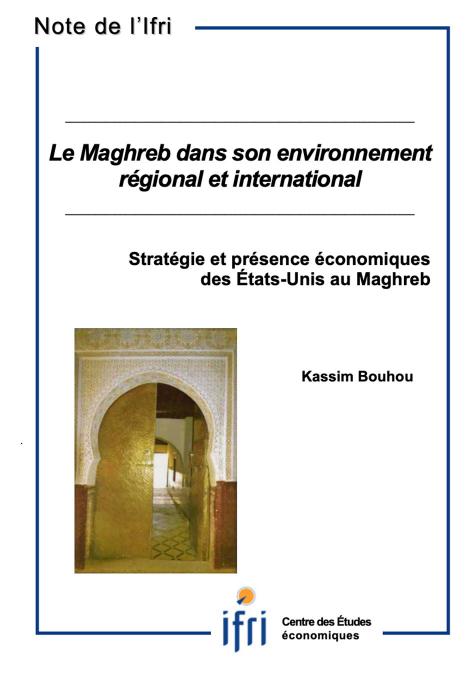
The United States' economic strategy and presence in the Maghreb
Authors
Kassim Bouhou
September 17, 2010

Before the 9/11 events, US-Maghreb relations were growing stronger, especially after the United States had long left the floor to the Maghreb’s “natural” European partner. Therefore the American action in this region was in line with a mechanism previously set off by Clinton Administration member, Stuart Eizenstat, which aimed at reducing intra regional obstacles and stimulating American investments towards an area where Americans were little-represented. Hence Washington seemed more involved in promoting the emergence of a strong, world-economy-integrated Maghrebi market.
RELATED CONTENT

  • Authors
    Simone Tagliapieta
    Marion Jansen
    Yassine Msadfa
    Mario Filadoro
    August 28, 2017
    Endowed with half of the world’s known oil and gas reserves, the Middle East and North Africa (MENA) region became – particularly during the second half of the twentieth century – a cornerstone of the global energy architecture (Yergin, 1991, 2011; Maugeri, 2006). This architecture is currently undergoing a structural transformation, prompted by two different forces: decarbonisation policies and technological developments. The adoption and quick entry into force of the Paris Agreem ...
  • Authors
    December 7, 2015
    The Euro-Mediterranean Partnership was initiated with the aim to build a space of shared prosperity and security among all the countries in the region. The achievement of this objective, however, continues to be challenged by several geopolitical, economic and social factors. In such a context, there is now a greater urgency to adapt the approach and the instruments, thus allowing Euro-Mediterranean partners to seize opportunities towards an effective area of shared stability and pr ...
  • Authors
    Kassim Bouhou
    September 17, 2010
    Before the 9/11 events, US-Maghreb relations were growing stronger, especially after the United States had long left the floor to the Maghreb’s “natural” European partner. Therefore the American action in this region was in line with a mechanism previously set off by Clinton Administration member, Stuart Eizenstat, which aimed at reducing intra regional obstacles and stimulating American investments towards an area where Americans were little-represented. Hence Washington seemed mor ...