Publications /
Book / Report

Back
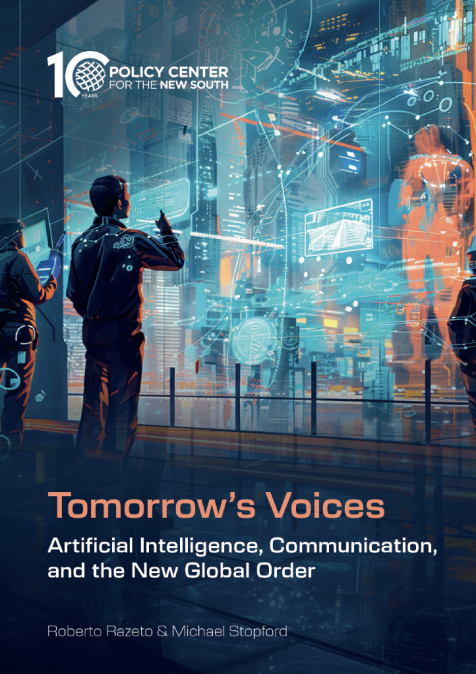
Tomorrow’s Voices: Artificial Intelligence, Communication, and the New Global Order
Authors
Roberto Razeto
Michael Stopford
February 10, 2025

Tomorrow’s Voices: Artificial Intelligence, Communication, and the New Global Order" by Roberto Razeto and Michael Stopford is an eye-opening exploration of how communication—and the rise of artificial intelligence—are reshaping the world. In an era defined by climate crises, pandemics, and spiralling geopolitical tensions, the book reveals how language, diplomacy, and AI-driven technology can bridge divides and drive global solutions. In fact today’s daunting global challenges can only be met through an effective use of communications.

From the power of storytelling to the ethical challenges of AI, Razeto and Stopford present real-world examples of communication's transformative impact. They show how AI, when used responsibly, can amplify voices, foster transparency, and combat misinformation. Yet, they also warn of the dangers: how unchecked technology might mislead, manipulate, or deepen divides.

Through vivid case studies, the authors illustrate the role of communication in fostering a more resilient, interconnected world. "Tomorrow’s Voices" invites readers to imagine a future where communication not only informs but inspires collective action, guided by ethics and innovation. This is more than a treatise—it’s a call to shape the digital age with clarity, empathy, and purpose.

  • September 24, 2025
    Il y a presque deux ans, le Burkina Faso, le Mali et le Niger ont quitté la CEDEAO (Communauté économique des États de l’Afrique de l’Ouest) - Organisation régionale regroupant quinze pays- pour créer un nouveau groupement d’intégration: l’Alliance des États du Sahel (AES).  Les motivations des trois pays ne sont pas conjoncturelles. Elles reflètent les difficultés de l’Organisation régionale à accompagner les pays en question dans leur quête de sécurité et de développemen ...
  • Authors
    September 22, 2025
    Le Processus des États de l’Afrique atlantique (PEAA), lancé par Sa Majesté le Roi Mohammed VI en novembre 2023, ambitionne de transformer la façade atlantique africaine — jusqu’ici morcelée et vulnérable — en un espace géopolitique cohérent, intégré et prospère. L’Initiative s’appuie sur les provinces du Sud marocain comme pont stratégique vers les vingt- trois pays riverains de l’Atlantique, et sur une vision d’ouverture Sud-Sud et euro-africaine.Malgré des disparité ...
  • September 19, 2025
    Few symbols capture the post-war international order as vividly as the United Nations headquarters in New York. Officially opened in 1952, the building was conceived as both the stage of global governance and the emblem of Allied victory. Yet, nearly eight decades later, it is worth asking whether its location still reflects the true centre of gravity of world affairs. As the 80th Ordinary Session of the United Nations General Assembly approaches, economic transformation, geopolitic ...
  • Authors
    Patricia Ahanda
    September 18, 2025
    L’autrice de cette opinion, Patricia Ahanda, est une alumna du programme Atlantic Dialogues Emerging Leaders 2018. Cette opinion a été publiée initialement sur patriciaahanda.paris Dans un monde marqué par l’émergence d’une instabilité géopolitique globale, par la non-linéarité et l’imprévisibilité croissante des rapports de force, le Maroc s’impose comme un leader pivot du Sud global. Un acteur incontournable capable de relier continents, blocs et cultures dans un mo ...
  • Authors
    September 17, 2025
    Le développement de l’Afrique repose sur la mobilisation de leviers catalyseurs capables d’accélérer la dynamique de croissance avec des retombées élargies au bénéfice des populations africaines. Les transitions numérique, énergétique et démographique constituent autant de défis majeurs, mais elles présentent parallèlement de nouvelles opportunités de transformation pour le continent. Dans ce contexte, l’Afrique atlantique apparaît comme un espace stratégique et prometteur, grâce à ...
  • September 17, 2025
    Cet épisode s’interroge sur l’avenir des blocs régionaux africains, pris entre l’idéal d’intégration et une réalité marquée par la fragmentation. De la fragilisation de la CEDEAO à l’émergence de l’Alliance des États du Sahel, en passant par l’influence croissante d’acteurs extérieurs, ...
  • Authors
    September 15, 2025
    The October 2025 general elections in Tanzania unfold within a political culture grounded in consensus and institutional continuity. President Samia Suluhu Hassan’s leadership has reopened political space by restoring elite dialogue, easing restrictions on rallies, and facilitating the return of exiled figures. Yet the exclusion of CHADEMA—the principal opposition party—highlights the enduring limits of pluralism. This paper analyzes the Tanzanian electoral process less as a convent ...
  • Authors
    Fadoua Ammari
    September 12, 2025
    The Atlantic Initiative, announced by King Mohammed VI in November 2023 to provide landlocked Sahelian countries with access to the Atlantic Ocean via Moroccan territory, promises to profoundly reshape the bilateral relationship between Rabat and Nouakchott. This research paper examines how this unprecedented project creates new strategic opportunities while raising shared challenges for Morocco and Mauritania. Diplomatically, the rapprochement around the Atlantic Initiative unfolds ...
  • September 10, 2025
    This Policy Paper analyzes Jacob Zuma’s July 2025 visit to Morocco as a revealing episode in the reconfiguration of South African foreign policy. Far from being mere protocol issue, the event activated multiple registers of mobilization—anti-apartheid legacy, territorial integrity, and diplomatic coherence—while shifting a dossier long confined to elites into the public sphere. Drawing on a corpus of 2,200 posts on X, and 20 South African press articles, the study shows that the con ...