Publications /
Book / Report

Back
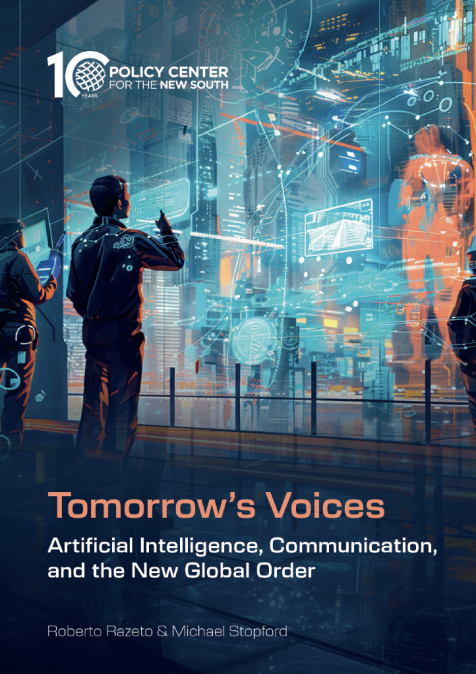
Tomorrow’s Voices: Artificial Intelligence, Communication, and the New Global Order
Authors
Roberto Razeto
Michael Stopford
February 10, 2025

Tomorrow’s Voices: Artificial Intelligence, Communication, and the New Global Order" by Roberto Razeto and Michael Stopford is an eye-opening exploration of how communication—and the rise of artificial intelligence—are reshaping the world. In an era defined by climate crises, pandemics, and spiralling geopolitical tensions, the book reveals how language, diplomacy, and AI-driven technology can bridge divides and drive global solutions. In fact today’s daunting global challenges can only be met through an effective use of communications.

From the power of storytelling to the ethical challenges of AI, Razeto and Stopford present real-world examples of communication's transformative impact. They show how AI, when used responsibly, can amplify voices, foster transparency, and combat misinformation. Yet, they also warn of the dangers: how unchecked technology might mislead, manipulate, or deepen divides.

Through vivid case studies, the authors illustrate the role of communication in fostering a more resilient, interconnected world. "Tomorrow’s Voices" invites readers to imagine a future where communication not only informs but inspires collective action, guided by ethics and innovation. This is more than a treatise—it’s a call to shape the digital age with clarity, empathy, and purpose.
  • February 20, 2026
    تناول هذا البودكاست، المنظم على هامش الدورة الرابعة عشرة من منتدى الحوارات الأطلسية، الدور الاستراتيجي للممرات البحرية باعتبارها رافعة للتنمية ومحركاً لإدماج اقتصادات الجنوب في التجارة ال ...
  • February 19, 2026
    This Africafe's episode examines Brazil-Africa relations: historical ties shaped by the slave trade and diaspora, Lula’s trade expansion, and competition with China/EU. It explores South-South diplomacy’s potential to reshape global institutions, the role of “South Atlanticism,” and fut...
  • February 18, 2026
    Following Donald Trump’s statements asserting that the United States should acquire Greenland, fundamental questions about sovereignty, alliances, and the authority of international law have resurfaced. The Greenland case reveals the tensions between security imperatives, alliance cohes...
  • Authors
    February 17, 2026
    La Marche Verte fait partie de ces moments féconds qui n’ont pas cessé d’influer sur le cours des événements politiques du Maroc, par la place qu’elle a prise, dès le départ, dans la longue durée, le contexte dans lequel elle s’est déployée, la logique des interactions dans laquelle elle s’est inscrite par ses causes et ses effets, et comme une des figures éclatantes du récit national. ...
  • February 13, 2026
    Le général Olivier Tramond analyse la réduction de la présence militaire française en Afrique comme un changement stratégique profond plutôt qu’un renoncement. Au-delà des coups d’État et ...
  • Authors
    Sofia Formigli
    February 13, 2026
    There is a story told by Václav Havel, the Czech dissident writer who later became president after the fall of communism. In his essay The Power of the Powerless, Havel describes a shopkeeper who, every morning, places a sign in his window reading: “Workers of the world, unite!” He does not believe in it. Nor do the people around him. Yet the sign remains. ...
  • Authors
    February 13, 2026
    Le 27 janvier 2026, le gouvernement espagnol a adopté par décret royal une mesure de régularisation extraordinaire visant les personnes en situation administrative irrégulière ou engagées dans une procédure de protection internationale. Le choix du décret royal permet une mise en œuvre rapide de la mesure, sans passage par un débat parlementaire, dans un contexte politique fortement polarisé sur les questions migratoires.La régularisation concerne les personnes pouvant justifier d’u ...
  • Authors
    February 12, 2026
    Divergent regulatory regimes for data, driven by different motivations, ranging from privacy protection in the European Union to information control in China, could eventually produce distinctively different, and possibly contradictory, bodies of data. Artificial-intelligence models trained on those datasets could produce differing and possibly even conflicting outputs. To the extent that AI outputs start to shape human perception and to influence decisions, in governments and ...