Publications /
Policy Paper

Back
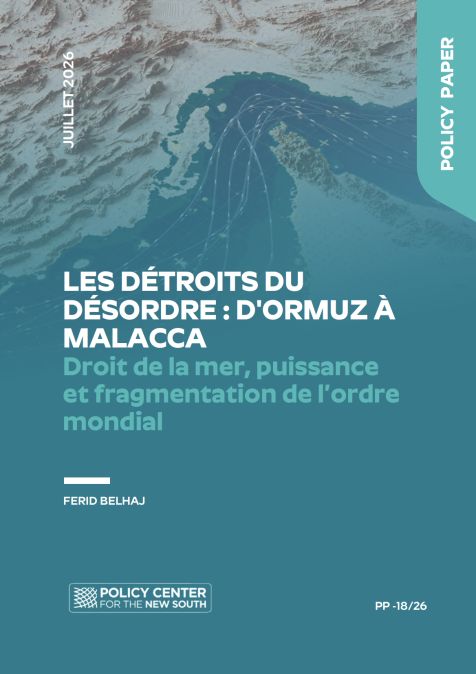
LES DÉTROITS DU DÉSORDRE : D'ORMUZ À MALACCA - Droit de la mer, puissance et fragmentation de l’ordre mondial
Authors
July 9, 2026

Cet essai analyse la guerre Iran–États-Unis–Israël de 2026 comme un révélateur de la transformation profonde de l’ordre international. À travers le prisme du droit de la mer, du détroit d’Ormuz, des alliances fragmentées, des câbles sous-marins et des flux énergétiques, il montre que le pouvoir mondial se déplace progressivement du contrôle des territoires vers la maîtrise des infrastructures de circulation. Loin de disparaître, la mondialisation entre dans une phase de connectivité sous tension, où les interdépendances deviennent des vulnérabilités stratégiques. Le droit international demeure central, mais il est de plus en plus interprété et, d’une manière plus affirmée, comme un instrument de puissance. L’essai soutient ainsi que le XXIe siècle marque l’émergence d’une géopolitique des flux, dans laquelle détroits, ports, corridors énergétiques, réseaux financiers et infrastructures numériques deviennent les nouveaux centres de gravité de la puissance mondiale.
RELATED CONTENT

  • Authors
    July 9, 2026
    Cet essai analyse la guerre Iran–États-Unis–Israël de 2026 comme un révélateur de la transformation profonde de l’ordre international. À travers le prisme du droit de la mer, du détroit d’Ormuz, des alliances fragmentées, des câbles sous-marins et des flux énergétiques, il montre que le pouvoir mondial se déplace progressivement du contrôle des territoires vers la maîtrise des infrastructures de circulation. Loin de disparaître, la mondialisation entre dans une phase de connectivité ...
  • Authors
    June 19, 2026
    Fin mai 2026, des frappes israéliennes ont visé les abords du château de Beaufort (Qalaat al-Chaqif), près de Nabatiyeh, avant que l'armée israélienne n'en annonce la prise. Ce fait soulève une question centrale : pourquoi une hauteur fortifiée au Moyen Âge conserve-t-elle une valeur militaire à l'ère des satellites, des drones et des missiles de croisière ?Le présent Policy Brief tente de démontrer que la valeur de Beaufort est géographique avant d'être idéologique ou technologique ...
  • Authors
    June 19, 2026
    At the end of May 2026, Israeli airstrikes targeted the surroundings of Beaufort Castle (Qalaat al-Chaqif), near Nabatiyeh, before the Israeli army announced that it had captured the site. This development raises a fundamental question: why does a medieval fortified hilltop retain military value in the age of satellites, drones, and cruise missiles?This Policy Brief argues that Beaufort's significance is geographical before it is ideological or technological. Overlooking the Litani ...
  • Authors
    June 12, 2026
    This essay argues that the current debate about the future of the international monetary system is not really about Gulf currencies, oil pricing, or de-dollarization in the narrow technical sense. It is about something deeper and more important: whether institutional trust can survive when geopolitical certainty is eroding.The Gulf monarchies—Saudi Arabia, the United Arab Emirates, Qatar, Kuwait, Bahrain, and Oman—increasingly exist in a world where the United States no longer looks ...
  • June 5, 2026
    Driven by its mission to reflect on and analyze the major geopolitical, economic, and societal transformations shaping the contemporary world, and with a view to contributing to knowledge-sharing and disseminating the main outcomes of its research program, the Policy Center for the New South regularly publishes collective volumes addressing issues of particular importance to Morocco, Africa, and the broader Global/New South. In this spirit, the Center has recently released two volum ...
  • Authors
    Liel Maghen
    May 11, 2026
    This Paper was originally published on mitvim.org.il This paper argues that the reconstruction of Gaza will depend not only on the amount of funding mobilized, but on how financing is structured, governed, and anchored within a broader politi`cal context. In a setting shaped by movement restrictions and weak institutions, financial design is not neutral but shapes priorities, distributes power, and determines what can be implemented on the ground. The paper examines the key cha ...
  • Authors
    April 1, 2026
    We are now in the fifth week since the U.S. airstrike that killed top leaders of the Iranian regime, initiating a war involving the United States and Israel against the country. More than a month of mutual bombardments between Iran and Israel has ensued, extending to other Persian Gulf nations, U.S. military installations—and even Cyprus. From a global perspective, the impact has stemmed primarily from disruptions to regional production of goods and the blockade of the Strait of Hor ...
  • Authors
    December 18, 2025
    The return of President Donald Trump to the White House at the start of 2025 was expected to signal an American retreat from international engagement, especially in regions of traditional security interest, such as southern Europe, North Africa, and the Middle East. To the surprise of many observers around the Mediterranean, and perhaps to the dismay of some in the Trump administration’s ideological orbit, this has not happened. If anything, the second half of 2025 has seen a high d ...
  • Authors
    December 17, 2025
    I recently participated in a discussion between Israelis and Arabs, some living in the Middle East, some living abroad[1]. The discussion topic was ‘The Two State Solution’. This article presents my personal takeaways from the discussion. It does not try to describe the details, and other participants may have different takeaways.I joined the discussion thinking that the two-state solution was dead. Most of the other participants felt the same way—all very pessimistic. But I left fe ...