Publications /
Policy Paper

Back
The New Flexi-Lateralism: International Cooperation in an Era of Raw Power Politics
Authors
Stephan Klingebiel
Andy Sumner
September 4, 2026

This Paper was originally published on cgdev.org.


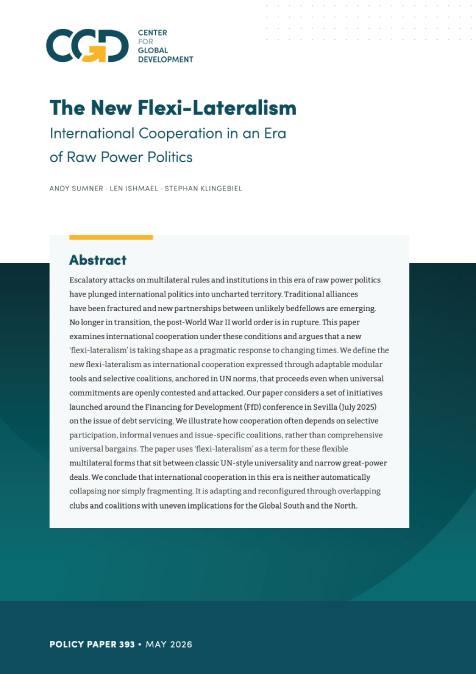
Escalatory attacks on multilateral rules and institutions in this era of raw power politics have plunged international politics into uncharted territory. Traditional alliances have been fractured and new partnerships between unlikely bedfellows are emerging. No longer in transition, the post-World War II world order is in rupture. This paper examines international cooperation under these conditions and argues that a new "flexi-lateralism" is taking shape as a pragmatic response to changing times. We define the new flexi-lateralism as international cooperation expressed through adaptable modular tools and selective coalitions, anchored in UN norms, that proceeds even when universal commitments are openly contested and attacked. Our paper considers a set of initiatives launched around the Financing for Development (FfD) conference in Sevilla (July 2025) on the issue of debt servicing. We illustrate how cooperation often depends on selective participation, informal venues, and issue-specific coalitions, rather than comprehensive universal bargains. The paper uses "flexi-lateralism" as a term for these flexible multilateral forms that sit between classic UN-style universality and narrow great-power deals. We conclude that international cooperation in this era is neither automatically collapsing nor simply fragmenting. It is adapting and reconfigured through overlapping clubs and coalitions with uneven implications for the Global South and the North.
RELATED CONTENT

  • Authors
    Marianna Albuquerque
    September 23, 2026
    The author of this opinion, Marianna Albuquerque, is a 2022 alumna of the Atlantic Dialogues Emerging Leaders Program.As world leaders gather in New York for the 81st United Nations General Assembly, climate change returns to the center of multilateral diplomacy under markedly different circumstances. The debate is no longer confined to whether the world must decarbonize, but increasingly centers on how the transition will happen, who will bear its costs, who will capture ...
  • Authors
    Joana Ama Osei-Tutu
    September 12, 2026
    The author of this opinion, Joana Ama Osei-Tutu, is a 2017 alumna of the Atlantic Dialogues Emerging Leaders Program.South-South cooperation (SSC) is often presented as an alternative to the hierarchical relationships that have historically characterized international development. In principle, SSC means Global South countries learn from one another, share expertise and resources, and develop solutions grounded in their own experiences, rather than importing models designe ...
  • Authors
    Stephan Klingebiel
    Andy Sumner
    September 4, 2026
    This Paper was originally published on cgdev.org. Escalatory attacks on multilateral rules and institutions in this era of raw power politics have plunged international politics into uncharted territory. Traditional alliances have been fractured and new partnerships between unlikely bedfellows are emerging. No longer in transition, the post-World War II world order is in rupture. This paper examines international cooperation under these conditions and argues that a new "flexi-l ...
  • Authors
    August 25, 2026
    The next Secretary-General should begin with an act of institutional rebellion: refuse to become the Secretary-General ofeverything. Over three decades the office's political and administrative reach has spread across sustainable development, climate, health, migration, digital governance, financing, gender, food systems, and a still-growing list of global priorities. These issues are not unimportant; the trouble is that institutional ambition has simply outrun institutional capabil ...
  • August 25, 2026
    Predictions of American decline have become increasingly prevalent. The United States has run persistent trade deficits for decades, but its public debt now exceeds its annual economic output. Meanwhile, and new centers of industrial and technological power continue to emerge across Asia. Yet despite these developments, no country has so far replaced the United States as the main organizing power of the international economy. Conventional explanations explain this in terms of U.S. m ...
  • August 14, 2026
    In this Episode, Arup Banerji discusses why local expertise—not just international advice—should be intentionally embedded in African development policy. He cites cash transfer programs a ...
  • Authors
    August 13, 2026
    The Resolution adopted by an overwhelming majority of elected European officials in Strasbourg on June 10, 2021, on "the violation of the UN Convention on the Rights of the Child and the exploitation of minors by the authorities in the migration crisis in Ceuta" (2021/2747/RSP), could not fail to leave its mark.Decoding the ResolutionThe Resolution shocked Moroccans to such an extent that it was quickly set aside at the time, as if there were a wish to forget it as fast as possible. ...
  • Authors
    August 11, 2026
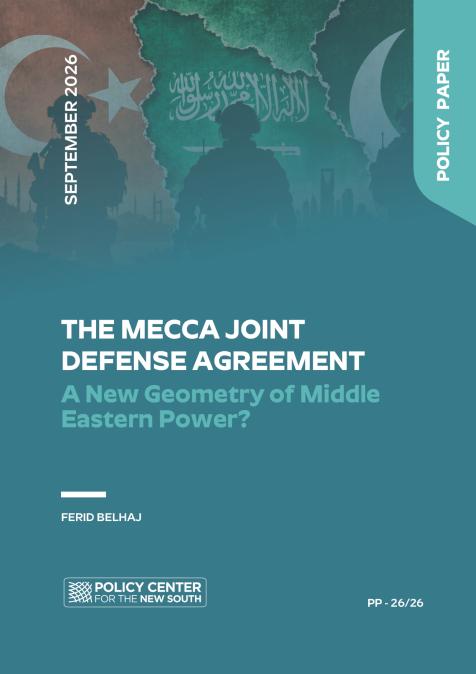
    The Mecca Agreement: A First Step Towards a New Regional Security Architecture? On 7 August, Saudi Arabia, Türkiye and Pakistan signed the Mecca Agreement, a trilateral defense pact aimed at strengthening collective security and defense cooperation between the three countries. At its core lies a collective defense commitment under which an attack on one member is considered an attack on all three. While many details concerning its practical implementation remain unclear, the agreeme ...