Publications /
Policy Paper

Back
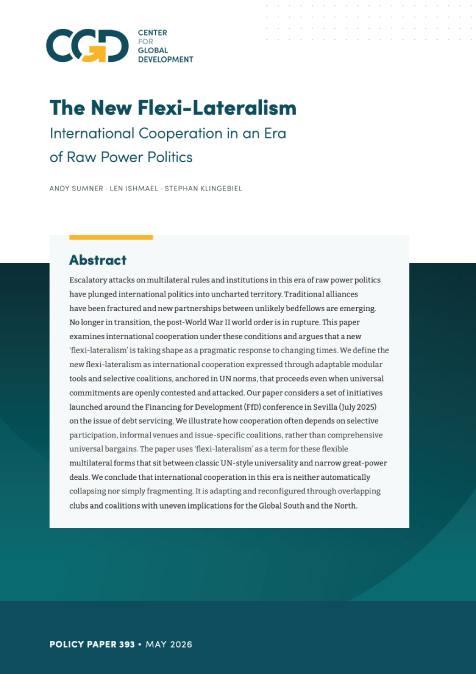
The New Flexi-Lateralism: International Cooperation in an Era of Raw Power Politics
Authors
Stephan Klingebiel
Andy Sumner
September 4, 2026

This Paper was originally published on cgdev.org.


Escalatory attacks on multilateral rules and institutions in this era of raw power politics have plunged international politics into uncharted territory. Traditional alliances have been fractured and new partnerships between unlikely bedfellows are emerging. No longer in transition, the post-World War II world order is in rupture. This paper examines international cooperation under these conditions and argues that a new "flexi-lateralism" is taking shape as a pragmatic response to changing times. We define the new flexi-lateralism as international cooperation expressed through adaptable modular tools and selective coalitions, anchored in UN norms, that proceeds even when universal commitments are openly contested and attacked. Our paper considers a set of initiatives launched around the Financing for Development (FfD) conference in Sevilla (July 2025) on the issue of debt servicing. We illustrate how cooperation often depends on selective participation, informal venues, and issue-specific coalitions, rather than comprehensive universal bargains. The paper uses "flexi-lateralism" as a term for these flexible multilateral forms that sit between classic UN-style universality and narrow great-power deals. We conclude that international cooperation in this era is neither automatically collapsing nor simply fragmenting. It is adapting and reconfigured through overlapping clubs and coalitions with uneven implications for the Global South and the North.
RELATED CONTENT

  • September 17, 2025
    Cet épisode s’interroge sur l’avenir des blocs régionaux africains, pris entre l’idéal d’intégration et une réalité marquée par la fragmentation. De la fragilisation de la CEDEAO à l’émergence de l’Alliance des États du Sahel, en passant par l’influence croissante d’acteurs extérieurs, ...
  • August 28, 2025
    Alors que l’ordre mondial bascule vers un système multipolaire, l’Afrique se trouve face à un tournant décisif. Comment éviter la marginalisation et tirer parti de ses atouts stratégiques ? Entre partenariats concurrentiels des grandes puissances, montée du Sud global et élargissement d...
  • Authors
    Bruno Saraiva
    July 21, 2025
    This article assesses the economic performance of the original BRICS economies, relative to the growth and currency appreciation projections presented in the papers that introduced the acronym, prior to the grouping becoming a diplomatic, political, and economic reality. It also discusses the BRICS agenda in the current challenging geopolitical context, in which economic fragmentation tends to raise costs for the global economy and presents considerable obstacles for emerging and de ...
  • July 18, 2025
    Vingt ans après sa création, le Parlement panafricain demeure un organe institutionnel marginalisé au sein de l’Union africaine. Pensé comme instrument de représentation des peuples africains, il n’a jamais acquis les prérogatives ni les relais lui permettant de jouer un rôle politique important. Ce Policy Paper analyse les raisons de cette impasse à partir de trois angles : la faiblesse institutionnelle et le déficit de légitimité du PAP ; le blocage du Protocole de Malabo, révélat ...
  • July 11, 2025
    In this episode, we discuss whether Africa’s sub-regions foster unity or deepen divides, examine how they handle political crises, and consider the impact of global powers on regional dynamics. We explore what’s needed for stronger cooperation and how Africa can preserve its diversity w...
  • Authors
    Pepe Zhang
    Fernando Straface
    June 13, 2025
    This Paper was originally published on cebri.org Within an ever-evolving system of multilateral development banks (MDB) currently reshaped by four structural geo-economic trends, the emergence of new MDBs like the Asian Infrastructure Investment Bank (AIIB) and the New Development Bank (NDB) carries great geopolitical significance. Yet the new MDBs, attuned to institutional and operational realities, have not upended the MDB system. Their relationship with long-e ...
  • Authors
    February 12, 2025
    يستكشف هذا العرض الحاجة الملحة إلى إحداث تحول في النموذج المعتمد حاليّا في عملية تقديم المساعدات الإنسانية، في سياق حالات النزاع وما بعد النزاع، في منطقة الشرق الأوسط وشمال إفريقيا. ويدعو هذا العرض إلى تبني مقاربة ذات "بعد تنموي للمساعدات الإنسانية"، تجمع بين الإغاثة الفورية والأهداف التنموية على المدى الطويل. كما يدعو هذا المقال، من خلال تركيزه على محدودية المساعدات الإنسانية التقليدية، لا سيما في سياق الأزمات الطويلة، مثل: العراق، اليمن، لبنان وغزة، لضرورة تبني آليات تمو ...
  • Authors
    October 22, 2024
    This paper explores the urgent need for a paradigm shift in humanitarian aid within conflict and post-conflict settings in the MENA region, advocating for a ‘developmental humanitarianism’ approach that integrates immediate relief with long-term development goals. Focusing on the limitations of traditional aid, particularly in protracted crises such as in Iraq, Yemen, Lebanon, and Gaza, the paper argues for innovative financing mechanisms and a realist perspective that aligns humani ...
  • Authors
    August 16, 2024
    The UN-led Summit for the Future represents both a significant opportunity and a formidable challenge for global development. While its ambitious agenda has the potential to drive meaningful progress, it also faces substantial obstacles that could impede its success. By learning from past experiences, fostering genuine multilateral cooperation, and ensuring clear and accountable commitments, the Summit can enhance the prospects for development. Ultimately, the Summit’s success will ...