Publications /
Policy Paper

Back
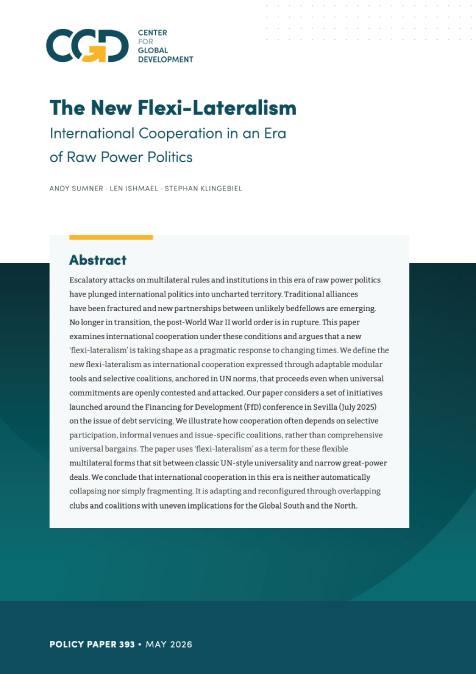
The New Flexi-Lateralism: International Cooperation in an Era of Raw Power Politics
Authors
Stephan Klingebiel
Andy Sumner
September 4, 2026

This Paper was originally published on cgdev.org.


Escalatory attacks on multilateral rules and institutions in this era of raw power politics have plunged international politics into uncharted territory. Traditional alliances have been fractured and new partnerships between unlikely bedfellows are emerging. No longer in transition, the post-World War II world order is in rupture. This paper examines international cooperation under these conditions and argues that a new "flexi-lateralism" is taking shape as a pragmatic response to changing times. We define the new flexi-lateralism as international cooperation expressed through adaptable modular tools and selective coalitions, anchored in UN norms, that proceeds even when universal commitments are openly contested and attacked. Our paper considers a set of initiatives launched around the Financing for Development (FfD) conference in Sevilla (July 2025) on the issue of debt servicing. We illustrate how cooperation often depends on selective participation, informal venues, and issue-specific coalitions, rather than comprehensive universal bargains. The paper uses "flexi-lateralism" as a term for these flexible multilateral forms that sit between classic UN-style universality and narrow great-power deals. We conclude that international cooperation in this era is neither automatically collapsing nor simply fragmenting. It is adapting and reconfigured through overlapping clubs and coalitions with uneven implications for the Global South and the North.

RELATED CONTENT

  • March 10, 2022
    Africafé est une émission du Policy Center for the New South qui décrypte l’actualité des organisations africaines et de l’Afrique. A travers de courtes interviews, l’émission tente de proposer d’aborder de manière pédagogique les enjeux des organisations africaines et l’actualité du co...
  • Authors
    March 8, 2022
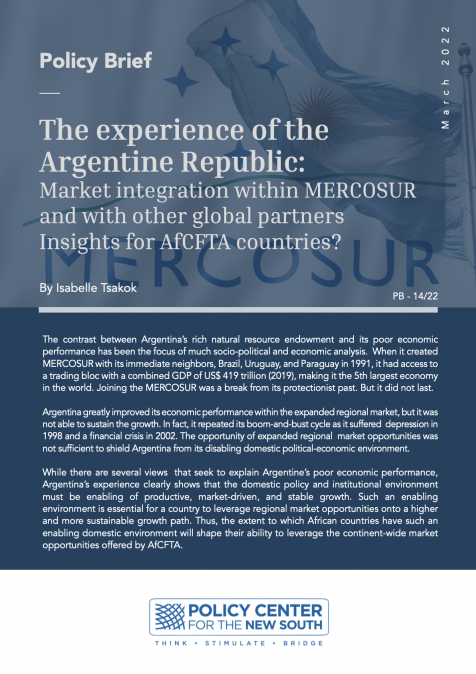
    The contrast between Argentina’s rich natural resource endowment and its poor economic performance has been the focus of much socio-political and economic analysis. When it created MERCOSUR with its immediate neighbors, Brazil, Uruguay, and Paraguay in 1991, it had access to a trading bloc with a combined GDP of US$ 419 trillion (2019), making it the 5th largest economy in the world. Joining the MERCOSUR was a break from its protectionist past. But it did not last. Argentina greatl ...
  • March 1, 2022
    يخصص مركز السياسات من أجل الجنوب الجديد حلقة برنامجه الأسبوعي "حديث الثلاثاء" لتقييم مخرجات القمة الاوروبية الافريقية ونموذج الشراكة الجديدة بين الطرفين، مع محمد لوليشكي، باحث بارز لدى مركز السياسات من أجل الجنوب الجديد. خلال القمة السادسة التي جمعت الاتحاديين في بروكسل ...
  • Authors
    Patricia Ahanda
    February 23, 2022
    Le Sommet Union européenne (UE) - Union africaine (UA), qui s’est tenu à Bruxelles les 17 et 18 février 2022, entend marquer un tournant dans les relations entre les deux continents. L’agenda européen pour l’année 2022 met au centre de ses priorités les relations Europe - Afrique. Celles-ci sont aussi l'un des principaux axes défendus par la Présidence française du Conseil de l’Union européenne (PFUE) et le Président français Emmanuel Macron dans de son discours inaugur ...
  • February 18, 2022
    Presiding over the Council of the European Union, France has big ambitions but enormous challenges ahead. Migration remains a deeply divisive topic, and European sovereignty in the techno ...
  • Authors
    Policy Center
    ACET
    ECDPM
    February 15, 2022
    The African Union (AU) and the European Union (EU) have never struggled to list common areas of interest or set up thematic partnerships and joint initiatives. The persistent challenge however is translating these partnerships into impact for both blocs of nations, particularly where interests diverge, such as those related to migration and green transition. Fifteen years since the critical Lisbon summit and the Joint Africa-EU Strategy, the time to move is now. To make the partne ...
  • Authors
    January 6, 2022
    Le président français Emmanuel Macron a de grandes ambitions pour l'Union européenne. Sa doctrine est d'approfondir l'intégration politique de l'Union. Donner à l'Europe l'esprit et les moyens pour faire face aux bouleversements écologiques, sécuritaires, énergétiques et technologiques qui menacent la place de l'Union dans un monde en profondes ruptures. La présidence française du Conseil de l'Union européenne pour le premier semestre 2022 est pleine de défis, mais c'est l'occasion ...
  • Authors
    December 6, 2021
    Between January 2020 and June 2021, the world spent about US $16.5 trillion (18% of world GDP) to fight COVID-19, and this amount does not even include the most important losses such as deaths, mental health effects, restrictions on human freedom, and other nonmonetary suffering. Nearly 90% of this amount was spent by developed economies; the rest by emerging market and developing economies. Low-income countries spent just US $12.5 billion, or less than 0.0001% of the total. Moreove ...