Publications /
Policy Paper

Back
The New Flexi-Lateralism: International Cooperation in an Era of Raw Power Politics
Authors
Stephan Klingebiel
Andy Sumner
September 4, 2026

This Paper was originally published on cgdev.org.


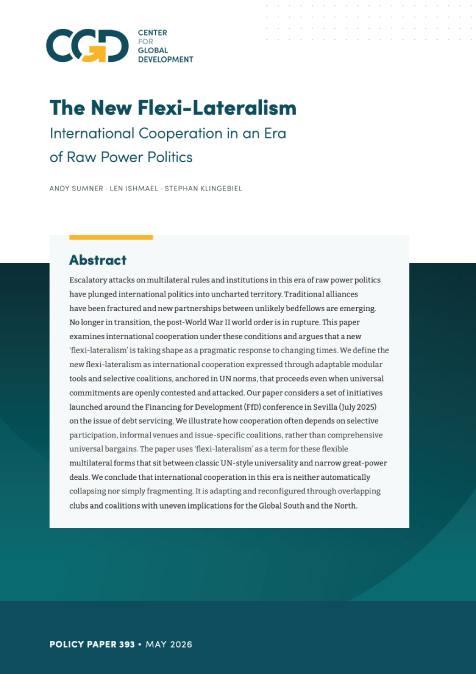
Escalatory attacks on multilateral rules and institutions in this era of raw power politics have plunged international politics into uncharted territory. Traditional alliances have been fractured and new partnerships between unlikely bedfellows are emerging. No longer in transition, the post-World War II world order is in rupture. This paper examines international cooperation under these conditions and argues that a new "flexi-lateralism" is taking shape as a pragmatic response to changing times. We define the new flexi-lateralism as international cooperation expressed through adaptable modular tools and selective coalitions, anchored in UN norms, that proceeds even when universal commitments are openly contested and attacked. Our paper considers a set of initiatives launched around the Financing for Development (FfD) conference in Sevilla (July 2025) on the issue of debt servicing. We illustrate how cooperation often depends on selective participation, informal venues, and issue-specific coalitions, rather than comprehensive universal bargains. The paper uses "flexi-lateralism" as a term for these flexible multilateral forms that sit between classic UN-style universality and narrow great-power deals. We conclude that international cooperation in this era is neither automatically collapsing nor simply fragmenting. It is adapting and reconfigured through overlapping clubs and coalitions with uneven implications for the Global South and the North.


RELATED CONTENT

  • Authors
    Gabriela Keseberg Dávalos
    January 26, 2026
    This Opinion was originally published by the Hanns Seidel Stiftung on January 19th, 2026. The author of this opinion, Gabriela Keseberg Dávalos, is a 2013 alumna of the Atlantic Dialogues Emerging Leaders Program. The signing of the EU–Mercosur agreement is a small geopolitical miracle. Signed on 17 January 2026 in Paraguay, it arrives at a moment when Europe is unmistakably being cast aside by the United States. Meanwhile Latin America, and with it, the Mer ...
  • January 23, 2026
    This episode of AfriCAFÉ examines how Africa’s development aid landscape is shifting amid major cuts by traditional donors and changing global priorities. Through a discussion with Stephen Klingebiel and Andrew Sumner, it questions whether aid has truly driven development or fostered de...
  • January 2, 2026
    Ce Policy Paper analyse les enjeux politiques, économiques et opérationnels du Fonds pour les pertes et dommages, créé pour répondre aux impacts climatiques irréversibles subis par les pays les plus vulnérables. Il clarifie d’abord la notion de pertes et dommages, qui mêle effets économiques et non économiques, et souligne les défis d’attribution liés à la superposition entre chocs climatiques et fragilités structurelles. L’analyse met ensuite en lumière les tensions d’économie poli ...
  • Authors
    December 18, 2025
    The return of President Donald Trump to the White House at the start of 2025 was expected to signal an American retreat from international engagement, especially in regions of traditional security interest, such as southern Europe, North Africa, and the Middle East. To the surprise of many observers around the Mediterranean, and perhaps to the dismay of some in the Trump administration’s ideological orbit, this has not happened. If anything, the second half of 2025 has seen a high d ...
  • Authors
    December 1, 2025
    This Paper was originally published on transatlantic.org The contemporary maritime domain is increasingly recognized as a geopolitical and economic space, but also as an environment intertwined with human, social, ecological, and governance systems ashore. The United Nations Institute for Disarmament Research (UNIDIR 2024) report argues that maritime security has evolved from a narrow naval and state-centered concern into a multidimensional issue embedded in global human s ...
  • November 25, 2025
    This Policy Paper analyses the Fourth Industrial Revolution (4IR) through the critical lens of technological colonialism. It argues that the fusion of physical, digital, and biological technologies is not merely a technical phenomenon but a civilizational shift reshaping the foundations of global power. The article traces a historical continuum from previous industrial revolutions, demonstrating how patterns of inequality and extraction persist, now transposed into the digital realm ...
  • November 4, 2025
    Cette tribune a été initialement publiée sur telos-eu.comSi un domaine est supposé devoir échapper à la « démocratie d’opinion », c’est bien la politique étrangère, surtout dans la France de la Ve République. Elle se doit d’être articulée autour d’intérêts à long terme et de calculs savants, sans reculer devant la raison d’Etat. L’opinion des Français à son propos est rarement scrutée.Elle se révèle plus construite qu’on ne croit. Telle est la leçon du sondage Toluna-Louis ...
  • October 24, 2025
    Georg Charpentier, Senior Advisor at CMI Martti Ahtisaari Centershares insights on the dynamics of United Nations peace operations and regional stability. He underscores the importance of ...
  • Authors
    Leonardo Párraga
    October 9, 2025
    The author of this opinion, Leonardo Párraga, is a 2016 alumnus of the Atlantic Dialogues Emerging Leaders Program. The next chapter of peacebuilding won’t be written only around the negotiating table or in United Nations chambers. Traditional peacebuilding processes have been characterized by exclusion of some of the key stakeholders that can make them more sustainable: women, young people, and local communities. This trend has been seen in recent peace agreements. For example ...
  • Authors
    October 1, 2025
    The era of relative stability grounded in post-Second World War idealism, and a global compact around the principle of supporting the most vulnerable, is coming to an abrupt close. In its place is hard-nosed realpolitik, raw power, and transactional politics. The current discordant, fractious epoch—despite the sense of foreboding and crises in some quarters—may yet create the space and conditions for much needed honest dialogue on the future of development cooperation. This dialogue ...