Publications /
Policy Paper

Back
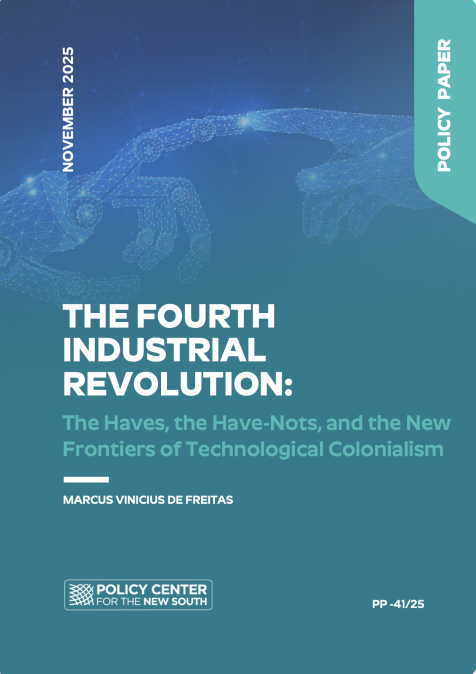
The Fourth Industrial Revolution: The Haves, the Have-Nots, and the New Frontiers of Technological Colonialism
November 25, 2025

This Policy Paper analyses the Fourth Industrial Revolution (4IR) through the critical lens of technological colonialism. It argues that the fusion of physical, digital, and biological technologies is not merely a technical phenomenon but a civilizational shift reshaping the foundations of global power. The article traces a historical continuum from previous industrial revolutions, demonstrating how patterns of inequality and extraction persist, now transposed into the digital realm. In this new paradigm, the “haves” of capital, data, and algorithms consolidate an invisible dominion, whilst the “have-nots”—particularly in the Global South—are relegated to the role of data producers, subjected to an algorithmic dependence that threatens their sovereignty.

The Paper proposes an architecture for a new digital social contract grounded in equity, ethics, and empowerment. Urging immediate action, it advocates a “Digital Bretton Woods”—a new multilateral pact to govern data and artificial intelligence (AI) as global public goods, drawing inspiration from the Chinese model of technological sovereignty while critiquing outdated global governance structures. 

The conclusion underscores that the ultimate challenge of the 4IR is not technological but philosophical: to redefine progress in terms of human dignity and to reassert humanity's moral authority over its own creations. The true landmark of this revolution will not be the intelligence of machines, but the wisdom of society in guiding them. This redefinition is not merely a suggestion, but an ethical imperative in the face of the 4IR.

RELATED CONTENT

  • July 6, 2026
    Cette interview explore les grands enjeux de l’urbanisation au Maroc, en mettant l’accent sur les défis de gouvernance, de planification et de politiques publiques. Elle revient sur l’évolution des modèles de développement urbain, les effets du changement climatique sur les villes, ains...
  • July 3, 2026
    This Policy Paper has also been published in French and Spanish by Le Grand Continent Morocco offers a compelling example of how a middle-income economy can navigate a more fragmented global environment, characterized by weak growth and slower convergence. Since 2022, economic activity has remained relatively strong, with growth exceeding that of many comparable economies. Non-agricultural growth has averaged 4.4% since 2022, around 1.3 percentage points above its historical av ...
  • June 24, 2026
    Africa, Latin America, and the Caribbean have both the potential and the desire to transform their people's lives through Green Industrial Policy. Yet they have long been constrained by structural obstacles embedded in the international system. The current rupture in that system, which ...
  • Authors
    February 11, 2026
    The U.S.–China technological rivalry has become a central axis of global economic and geopolitical competition. While the United States continues to lead in frontier innovation—most notably in advanced semiconductors and artificial intelligence (AI)—China has consolidated strengths in large-scale implementation, manufacturing capacity, and control over critical segments of global supply chains. These advantages are especially visible in clean energy technologies and in the processin ...
  • November 25, 2025
    This Policy Paper analyses the Fourth Industrial Revolution (4IR) through the critical lens of technological colonialism. It argues that the fusion of physical, digital, and biological technologies is not merely a technical phenomenon but a civilizational shift reshaping the foundations of global power. The article traces a historical continuum from previous industrial revolutions, demonstrating how patterns of inequality and extraction persist, now transposed into the digital realm ...
  • Authors
    June 18, 2025
    In 2000, The Economist dismissed Africa as the “Hopeless Continent”—a label reflecting a broader system of marginalization rooted in colonial legacy and post-Cold War neglect. This essay offers a realist reappraisal, arguing that Africa’s growing strategic relevance is not the result of benevolence, but of structural necessity.Amid a fracturing global order and the rise of transactional geopolitics under Trump 2.0’s Bessent Doctrine, Africa has become indispensable: rich in critical ...
  • Authors
    September 24, 2024
      This paper was originally published on t20brasil.org The resurgence of Neo protectionism as a reality is creating a pressing need to establish New Industrial Policies (NIPs) capable of striking a balance between Global Value Chains (GVC) managers' quest for efficiency and policy makers' need for more increasing resilience or national security in a turmoiled geopolitical landscape. Furthermore, although NIPs might pursue legitimate non-economic objectives, they are often cap ...
  • November 24, 2022
    This chapter was originally published in the book "Africa–Europe Cooperation and Digital Transformation", co-edited by Chux Daniels, Benedikt Erfoth, and Chloe Teevan Since the mid-2010s, North African countries have been pursuing what some observers have called a “return to Africa” (Dworkin, 2020). Egypt, Morocco, and Tunisia have attempted to position themselves as major components of Europe- Mediterranean-Africa infrastructure and supply chains corridors (Tanchum, 2020). The thr ...