Publications /
Research Paper

Back
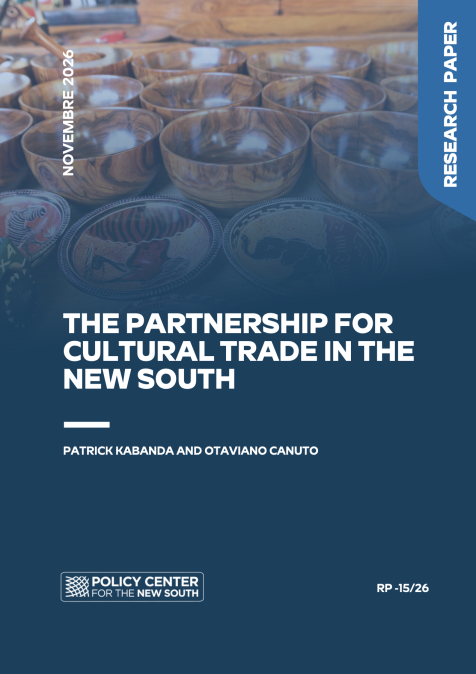
The Partnership for Cultural Trade in the New South
Authors
Patrick Kabanda
November 10, 2026

Cultural trade is a dynamic engine for economic diversification in the New South. Despite decades of diversification rhetoric, however, this sector remains underrealized. Thus, many countries across Africa, Latin America and the Caribbean, Asia, and the Middle East are still commodity-dependent, even though the global creative economy has grown roughly eightfold since 2002, to surpass $2 trillion—that figure, moreover, does not even account for the nonmonetary benefits that merit consideration in equal measure. In any case, given that conventional trade statistics understate the creative sector’s potential, such approaches as trade in value added (TiVA) may prove essential: they could better capture the creative and cultural inputs embedded in global value chains, including products that are increasingly driven by artificial intelligence.

This paper examines the state of cultural and creative trade across the tourism, arts, and education sectors, as well as cultural diplomacy, with particular attention paid to South-South cooperation, digital technologies, infrastructure and intellectual-property gaps, and barriers to the movement of artists (visas). It also raises cross-cutting policy issues: professionalism and follow-through in creative production, fair attribution and value capture for New South creators, the non-monetary social and diplomatic benefits of cultural exchange, and the risks of over-tourism and reputational ‘value-subtraction.’ 

Building on this diagnosis, the study proposes institutional mechanisms for a ‘Partnership for Cultural Trade in the New South.’ These include a dedicated Cultural Fund, inter-South cultural exchange and library programs, visa facilitation for artists, and stronger interministerial and regional coordination. Cultural trade can advance economic diversification, while also fostering shared prosperity and peace among New South nations. But policymakers need to move beyond treating cultural diversification as rhetoric, and translate it into coordinated action.

RELATED CONTENT

  • Authors
    Patrick Kabanda
    November 10, 2026
    Cultural trade is a dynamic engine for economic diversification in the New South. Despite decades of diversification rhetoric, however, this sector remains underrealized. Thus, many countries across Africa, Latin America and the Caribbean, Asia, and the Middle East are still commodity-dependent, even though the global creative economy has grown roughly eightfold since 2002, to surpass $2 trillion—that figure, moreover, does not even account for the nonmonetary benefits that merit co ...
  • October 8, 2026
    This paper was originaly published on Higher Education Policy Journal This article critically assesses the alignment between Morocco’s public guidance schemes for international students and its national development goals. Specifically, it investigates the capacity of these mechanisms to transform student mobility from a potential ‘brain drain’ into a tangible ‘brain gain’. Employing a qualitative case study approach, we conducted a systematic content analysis of 204 mobili ...
  • September 8, 2026
    La conférence de lancement du projet POMIRE Sud-Sud, tenue au Policy Center for the New South à Rabat les 11 et 12 février 2026, a constitué un moment fondateur. Pour la première fois, l'ensemble des acteurs institutionnels de cinq des six pays partenaires du projet — Côte d'Ivoire, Guinée, Mali, Maroc et Sénégal — se sont réunis pour poser les piliers d’une vision commune et identifier les priorités qui guideront les phases opérationnelles du projet. Quatre focus groupes thématique ...
  • Authors
    Hicham Kasraoui
    September 2, 2026
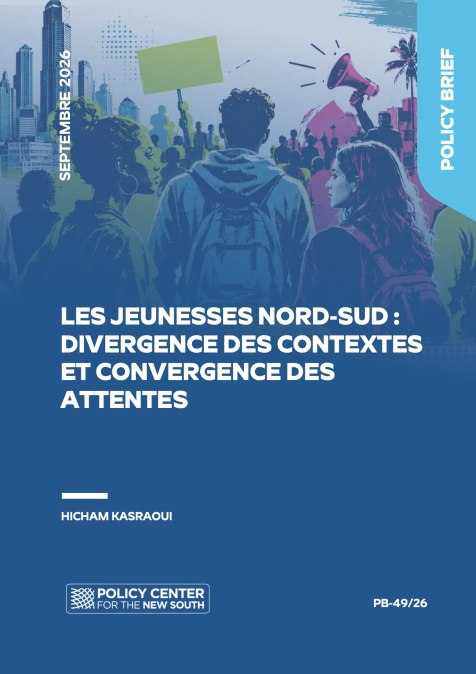
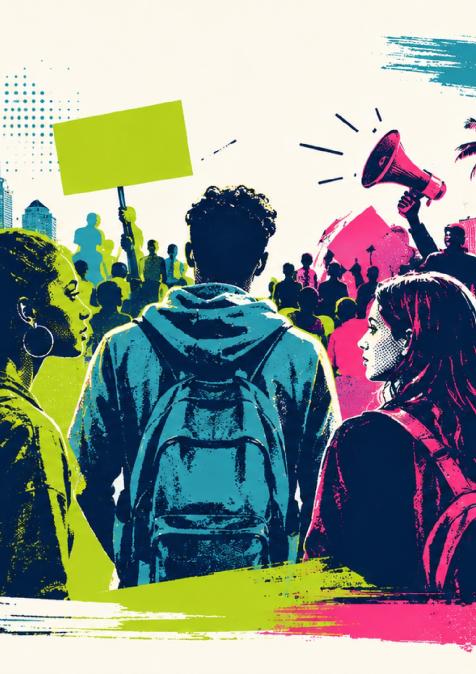
    Dans un contexte marqué par la superposition des crises sanitaires, géopolitiques, économiques, technologiques et climatiques, les jeunesses du Nord et du Sud évoluent dans des environnements distincts mais convergent progressivement vers un ensemble commun de préoccupations. Malgré des niveaux de développement et des trajectoires historiques différents, elles font face à des défis similaires : incertitudes croissantes sur l’avenir, difficultés d’insertion professionnelle, accès com ...
  • Authors
    Hicham Kasraoui
    September 2, 2026
    Amid overlapping health, geopolitical, economic, technological and climate crises, young people in the North and South are evolving in distinct environments that are progressively converging toward a shared set of concerns. Despite differing levels of development and historical trajectories, they face similar challenges: growing uncertainty about the future, difficulties entering the labor market, complex access to housing, fragile mental health, territorial inequalities and ecologi ...
  • August 26, 2026
    The Africa Center, in partnership with the Policy Center for the New South, hosts a discussion on how air transport in Africa could be a powerful catalyst of economic growth, underpin regional trade, and fuel skilled job creation. ...
  • Authors
    July 28, 2026
    The term “K-shaped recovery” was introduced to describe the economic recovery from the recession triggered by the Covid-19 pandemic. It refers to the uneven and divergent growth pattern between leading industries or sectors (the upper arm of the letter K—mainly the high-technology sector) and laggards, or the rest of the economy (the lower arm—the traditional industries). Since then the term has become popular in portraying divergent growth patterns within and between countries, esp ...