Publications /
Policy Paper

Back
Beyond Aid - A Wake-Up Call for Development Cooperation Tough but Timely
Authors
October 1, 2025

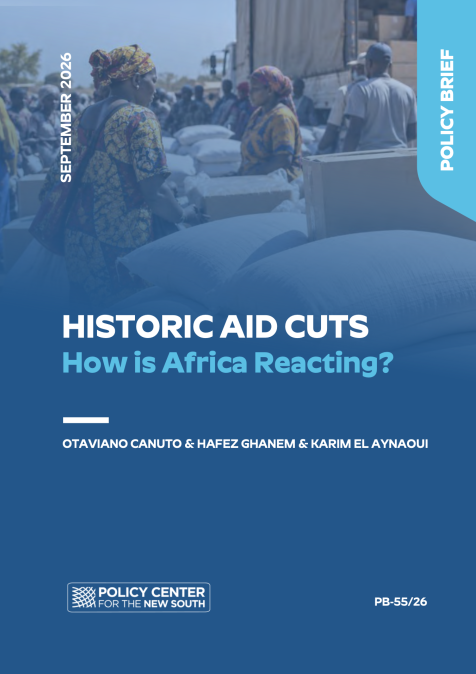
The era of relative stability grounded in post-Second World War idealism, and a global compact around the principle of supporting the most vulnerable, is coming to an abrupt close. In its place is hard-nosed realpolitik, raw power, and transactional politics. The current discordant, fractious epoch—despite the sense of foreboding and crises in some quarters—may yet create the space and conditions for much needed honest dialogue on the future of development cooperation. This dialogue should be based on principles of sovereignty, empowerment, equity, and inclusion. But this requires a political path forward and transformative leadership.

The retreat of the United States from various multilateral forums, has been mostly consistent with the Trump administration’s first term in 2017. The abrupt dismantling of the United States Agency for International Development (USAID) operations worldwide, however, has sent shock waves throughout the development community. By linking the delivery of American aid and cooperation more generally with how its interests are served, the U.S., in the clearest way possible, has exposed an inconvenient truth about one of the underlying —if unspoken—goals of aid: that of garnering geopolitical advantage and influence in advancing the interests of a specific country or community. Upending of the norms around development cooperation and ODA by the U.S., —the country that led the design of the liberal rules-based world order—raises questions not only about the rules and their endurability, but also points to a larger concern: if the entire global architecture for development cooperation can be derailed by a single country, how sustainable is the system? This is why this conversation may be inconvenient, but also timely.

The wider reality however, is that the global landscape of development cooperation has been changing for the last twenty years or more. Persistent questions and misgivings have been raised about several issues, including the dependencies created by aid, power asymmetries entrenched in the Western-led post-war development cooperation model, the undeclared interests of donor communities, and the role of international NGOs. There is however a sense – especially in the West - that the entire system is being tipped into crisis. This need not be the case. For all actors, it may prove to be an opportune time to review the many facets of development cooperation, with a view to elaborating a framework for the future. This should reflect changes in the landscape within which cooperation around development takes place, both in the context of evolving needs and the emergence of new actors.

As the mix of actors’ changes, so does the power dynamics. Economic power is shifting from west to east, and impatience with the status quo has resulted in the development of non-Western institutions and mechanisms providing alternatives to Western instruments. Cooperation, rather than competition around development is a key requirement of a new model. Perhaps it is time to agree that striving toward one universally accepted model of multilateralism is faulty, and multilateralism can take many forms. In any event, new models of development co-operation are required that respond to the need for mutual respect, dignity, and mutual wins with leadership reflective of the world today. The time has come for uncomfortable conversations around inconvenient truths.
RELATED CONTENT

  • July 10, 2026
    For much of the post-war period, the Global South was framed as an object of history, defined by dependency, constrained by structural asymmetries, and confined to the margins of global decision-making. That narrative, once empirically grounded, is now no longer adequate. A profound yet uneven transformation is underway. The Global South is no longer only reacting; it is increasingly shaping rules, institutions, and narratives.This Policy Brief argues that the Global South is thus t ...
  • July 7, 2026
    For a long time, security in the Sahel relied on Western military deployments, which failed to curb the jihadist threat, thereby demonstrating the limitations of a cooperation model based on logistical and doctrinal dependence on foreign partners. The three Sahelian states have decided to break away from this system and build“integrated security sovereignty.” This approach has taken hold against a backdrop of openness to new partners. Russia has thus established itself as the main m ...
  • Authors
    July 6, 2026
    We take the 2026 G7 Summit in Évian-les-Bains as a case study for understanding how a leading existing multilateral organisation adapts to a more fragmented, technologically inflected, and multipolar world. We argue that the significance of Évian lies less in the summit agreements themselves than in what the summit reveals: a qualitative shift in governance away from exclusive summit diplomacy and towards more selective coalition-building, broader engagement with non-state actors, a ...
  • June 22, 2026
    What does it take for think tanks to stay trusted, relevant, and heard in a world that's increasingly sceptical of institutions? At the Policy Center for the New South we put that question to keynote speakers Erica Schoder and Héctor Cárdenas on the sidelines of the OTT Conference 2026 ...
  • June 15, 2026
    As part of the OECD Multilateral Development Finance Week 2026 (MDF Week), the Policy Center for the New South (PCNS) is organizing a webinar entitled “Rethinking Development Finance: African Agency and the Future of Multilateral Development Co-operation after ODA Retrenchment.” The dis...
  • April 24, 2026
    Pendant longtemps, la sécurité du Sahel reposait sur les dispositifs militaires occidentaux qui ne sont pas parvenus à juguler la menace jihadiste, démontrant ainsi les limites d’un modèle de coopération fondé sur la dépendance logistique et doctrinale envers les partenaires étrangers. Les trois États sahéliens ont décidé de rompre avec ce système et de construire « une souveraineté sécuritaire intégrée » Cette orientation s’est affirmée dans un contexte d’ouverture à de nouvea ...
  • March 18, 2026
    Le premier sommet des BRICS, tenu à l’initiative de la Russie en 2009, sera suivi de 16 autres, le dernier étant celui de Rio dont les travaux se sont déroulés les 6 et 7 juillet 2025. Jusqu’en 2022, un seul élargissement est intervenu, celui accueillant l’Afrique du Sud, transformant les BRIC en BRICS. À partir de 2023, en revanche, trois sommets, ceux de 2023, 2024 et 2025, vont se solder par la transformation des BRICS en BRICS+5, accueillant 5 nouveaux pays membres, en ...
  • Authors
    Gabriela Keseberg Dávalos
    January 26, 2026
    This Opinion was originally published by the Hanns Seidel Stiftung on January 19th, 2026. The author of this opinion, Gabriela Keseberg Dávalos, is a 2013 alumna of the Atlantic Dialogues Emerging Leaders Program. The signing of the EU–Mercosur agreement is a small geopolitical miracle. Signed on 17 January 2026 in Paraguay, it arrives at a moment when Europe is unmistakably being cast aside by the United States. Meanwhile Latin America, and with it, the Mer ...